
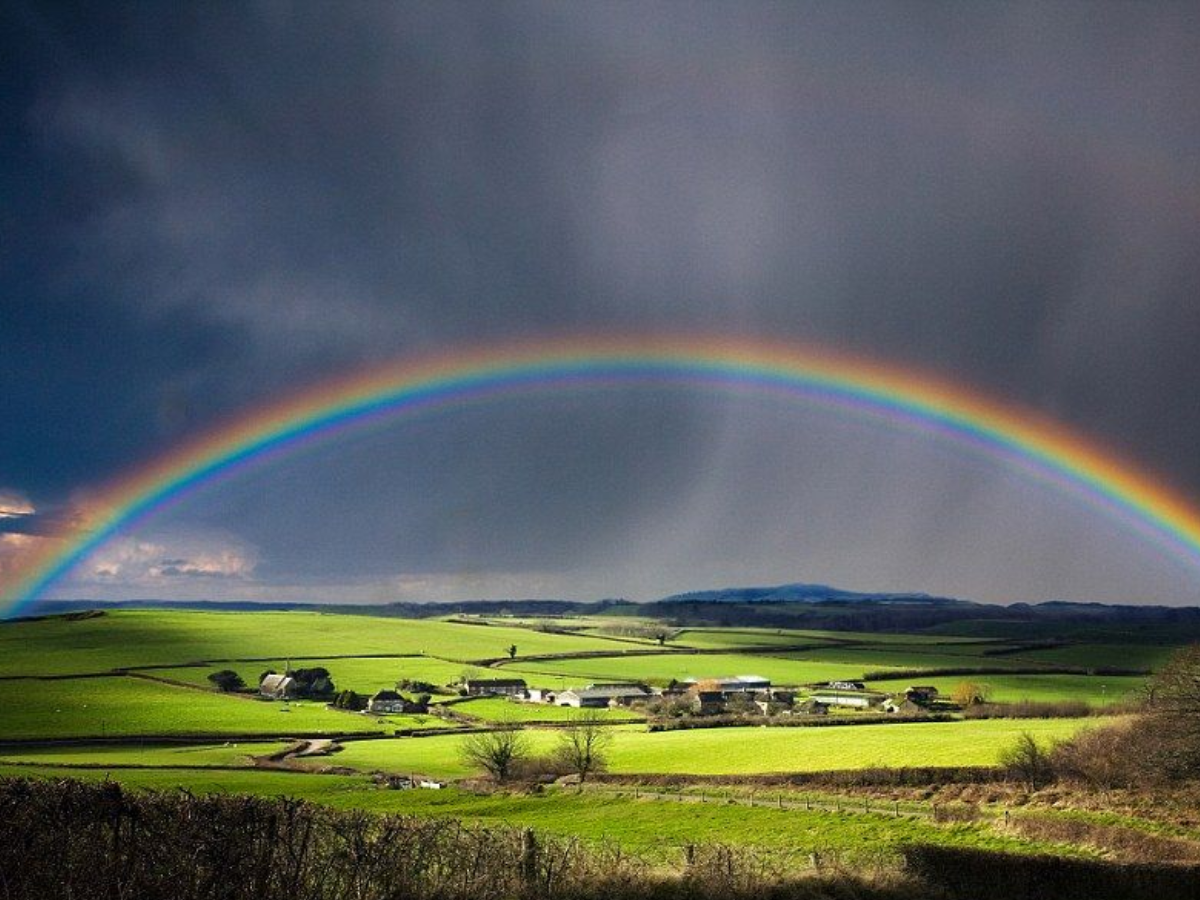
A rainbow is formed when sunlight interacts with water droplets most commonly raindrops but also mist or spray. As light passes through the droplet it refracts and reflects from the back inner surface and refracts once more on its exit.
It is this double bending, internal reflection and again bending by refraction which splits the beam into separate colors. Each one is bending the light to make a circle, but we only see the upper half from ground level.
What is the rainbow and Optical Illusions?
We only see the rainbow because it is directly shining into our eyes, and no two people will see exactly the same bow. That is why one can never find its end and why physical pursuit must always fail rainbows are a wholly personal optical phenomena and not a physical thing.
It will also appear by night, and equally rare phenomenon called moonbow. This happened as moonlight was refracted. Red rainbows will form, this time because the sun is very low and its light has to pass through a much thicker surface atmospheric layer.
ALSO READ: The Fiery “Door to Hell”: Turkmenistan’s Burning Crater Still Alive After 50 Years
What Are the Seven Colors in the Rainbow?
The hues in a natural rainbow spectrum are red, orange, yellow, green, blue, indigo and violet mnemonically remembered as ROY G BIV. This sequence which Sir Isaac Newton defined upon passing white light through a prism and thus revealing the colors of the composite effect was actually selected by him as seven in allegorical harmony with the musical scale.
Who discovered the Rainbow?
Newton indeed gets credit for explaining what a rainbow really is and using a prism in the seventeenth century, he obtained sunlight and split it into colors creating a garland of colors and disproved the centuries old theory that any prism made colors visible. By adding another prism, he also famously combined that spectrum into white light and proving through the prism that white light in itself is nothing but a mixture of all visible colors.
Before Newton, the only mathematician mentioned for having described the rainbow was Rene Descartes. He mathematically accounted for the geometry of the rainbow in particular and it has a radius of 42° and the role of internal reflection that occurs inside the droplets.
ALSO READ: Life of a Comet: What Makes Comets Light Up Our Night Skies From the Kuiper Belt to Earth’s View
How Rainbows Form in Nature?
You do not need a glass prism to catch that rainbow sparkle nature’s droplets do the same thing. The further sunlight enters a droplet, bends, reflects internally and bends again at exit. It is a simple yet elegant tandem bending dispersing light way of painting the sky with bright arcs.
Everything falls just perfectly for a stunning double rainbow light gets reflected twice within the droplet before finally making its exit. The outermost bow is pale and reversed in color order and making it a stunning sight when everything sets perfectly with atmospheric optics.
Rainbow May Disappear from India Soon
Climate change has altered the weather, and the disappearance will even take away the joy of watching a rainbow. A recently concluded study predicts that around 2100 most areas in the world will gain extra rainbow looking days by about 4-5% more than that percentage figure. This percentage figure will vary some cold regions and high mountains like the Arctic might get more rainbow days and with a few populated and dry areas losing them.
Indians are likely to increase their rainbow days from which much of the study showed, as the changing of precipitation patterns and inhabitation intensified. Other areas bordering some parts might miss out on these increases because of the general increase.
Rainbows are not directly affecting ecosystems or economies, but their presence binds us emotionally to the loveliness of nature. If they lose in reality and not imagining them and many little moments of wonder would be dulled.
ALSO READ: Science of Color: How Light, Vision & Brain Create the World we See