
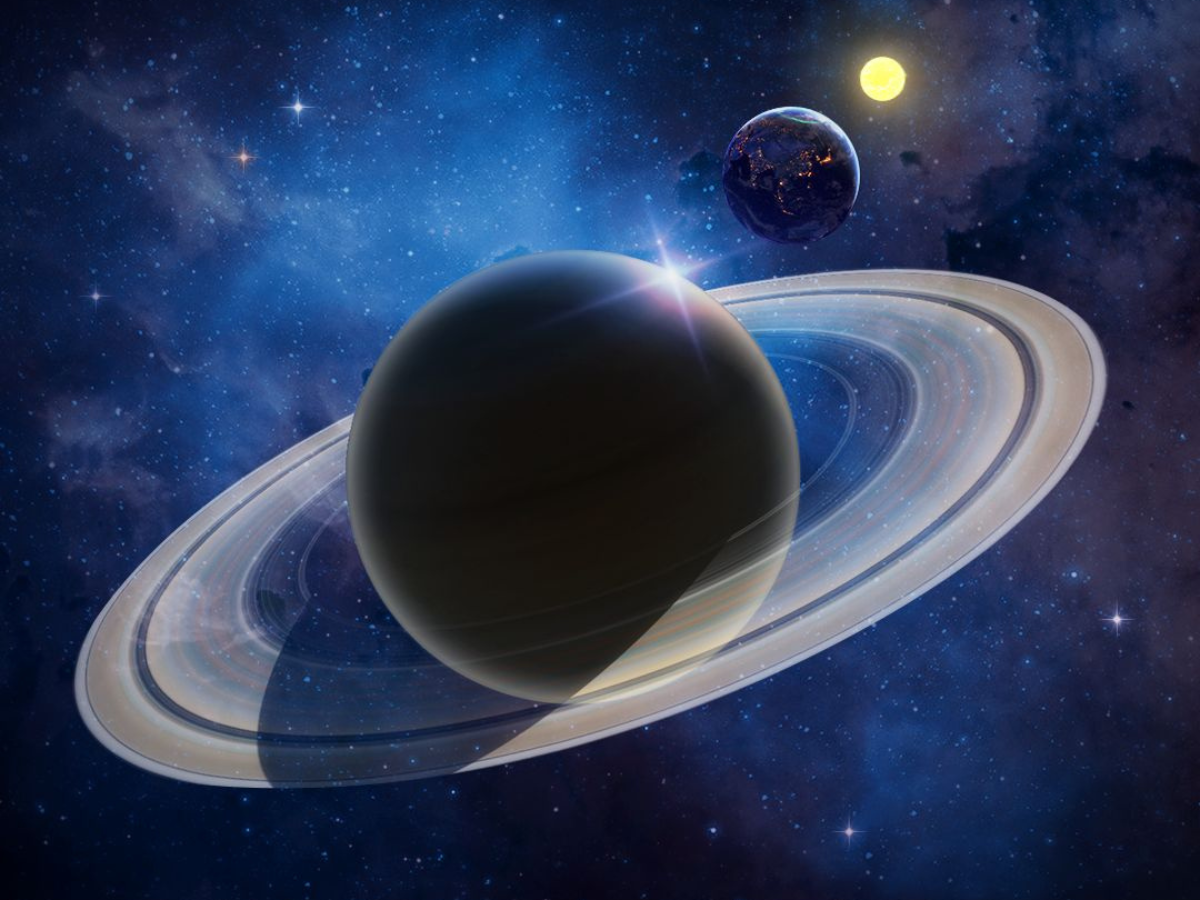
Saturn will reach opposition on September 21, 2025, a prominent event in Saturn’s orbit, where it is located directly opposite the Sun as observed from Earth. This signifies that Saturn will come closest to Earth an average distance of about 1.28 billion kilometers resulting in Saturn appearing larger, brighter, and blue-hued closer to midnight than ever before in the night sky.
At opposition, the planet will rise to the east as the Sun sets, reaching its highest point in the south at midnight through the night before setting in the west around sunrise. While in India, stargazers will miss out on much beauty by not seeing the golden-yellow planet shining light of a barely discernible orb in the constellation Pisces.
The Seeliger effect will enhance the brightness of Saturn’s rings by increasing the reflection of sunlight from the icy ring particles, in order to experience what will be the clearest ring-system display of the planet.
Neptune Opposition: Distant Blue Planet
Two days after Saturn’s opposition days will come Neptune’s, on September 23, 2025, at this year’s sunny encounter for Neptune and Earth, the ice giant will measure some 4.3 billion kilometers away. All the ice giants, it will give the appearance of a mere glowing blue speck that will be too faint for the naked eye and from places in India, Neptune’s ascension to the sky will be in the East and quite some time after sunset.
ALSO READ: Bay vs Ocean: Key Differences in Size, Depth & Why They Matter
That will be when all the stars would be almost straight in alignment in the way up apart from the early-risen Virgo, as the constellation begins to slightly step away from the Sun. The planet will culminate near an angle when placed exactly over the observer’s head at around midnight.
Sightseeing Tips for Stargazers
To obtain the best experience viewing Saturn and Neptune, follow the following:
- Location: Find an urban area that is dark enough to allow escape from the glaring city lights that often obscure faint celestial objects.
- Timing: The best time is after sunset and before the dawn twilight begins.
- Equipment: Saturn can easily be seen naked. However, binoculars and a little telescope could add light to the view of the rings. Neptune is strictly out of reach for the naked eye and demands a telescope.
- Weather: Clear skies are a must so that you should keep yourself updated with the local weather forecast for possible bad weather on the day you plan to view the constellations.
- Titan’s Shadow: Temporary Beauty Spot of Saturn
One more sequence of two events following each other that offers a glimpse of Saturn’s brilliant magnificence falls on September 20, 2025: the shadow of Titan, Saturn’s largest moon, will cross the face of the ring planet.” The event will occur between 5:09 AM and 7:34 AM UTC, and it will be the best sighting time in the American region.
The shadow of Titan will create a transient dark spot on Saturn’s blazing disk, giving a rare, composite kind of display of the interplay between planet and moon. This hands-down once-in-a-lifetime happening is sure to attract astronomers and others intrigued by nature.
ALSO READ: Mystery Solved: 43-Million-Year-Old Silverpit Crater Caused by Asteroid Impact
What are Tips for Spotting Saturn & Neptune in the Sky?
With some preparation, Saturn and Neptune are bit less hard to find. Saturn, being the brighter of the two, will manifest in the eastern sky shortly after sunset. It will shine steadily with minimal flickering typical of the stars on account of its considerable size and close distance.
Looking like a small shining yellow beacon, it should be easily distinguished from nearby twinkling stars. Neptune, however, will only be visible using a telescope and will look like a small, flickering blue disk. As they will be relatively closer in the sky, observing them both with naked eyes seems enticing yet challenging for our stargazing brethren.
An Uncommon Celestial Alignment
The near-simultaneous opposition of Saturn and Neptune offers that even rarer astronomical spectacle when both amateur and professional astronomers can have a unique opportunity to observe the two outer giants of our solar system during opposition glow and closest approach toward Earth for the year. This particular alignment contributes greatly to illuminating these distant worlds.
ALSO READ: Solar Eclipse 2009: Why It Was India’s Longest & Most Spectacular
Disclaimer: Observe all celestial events safely using proper equipment; viewing times vary by location. This article is for informational purposes only.