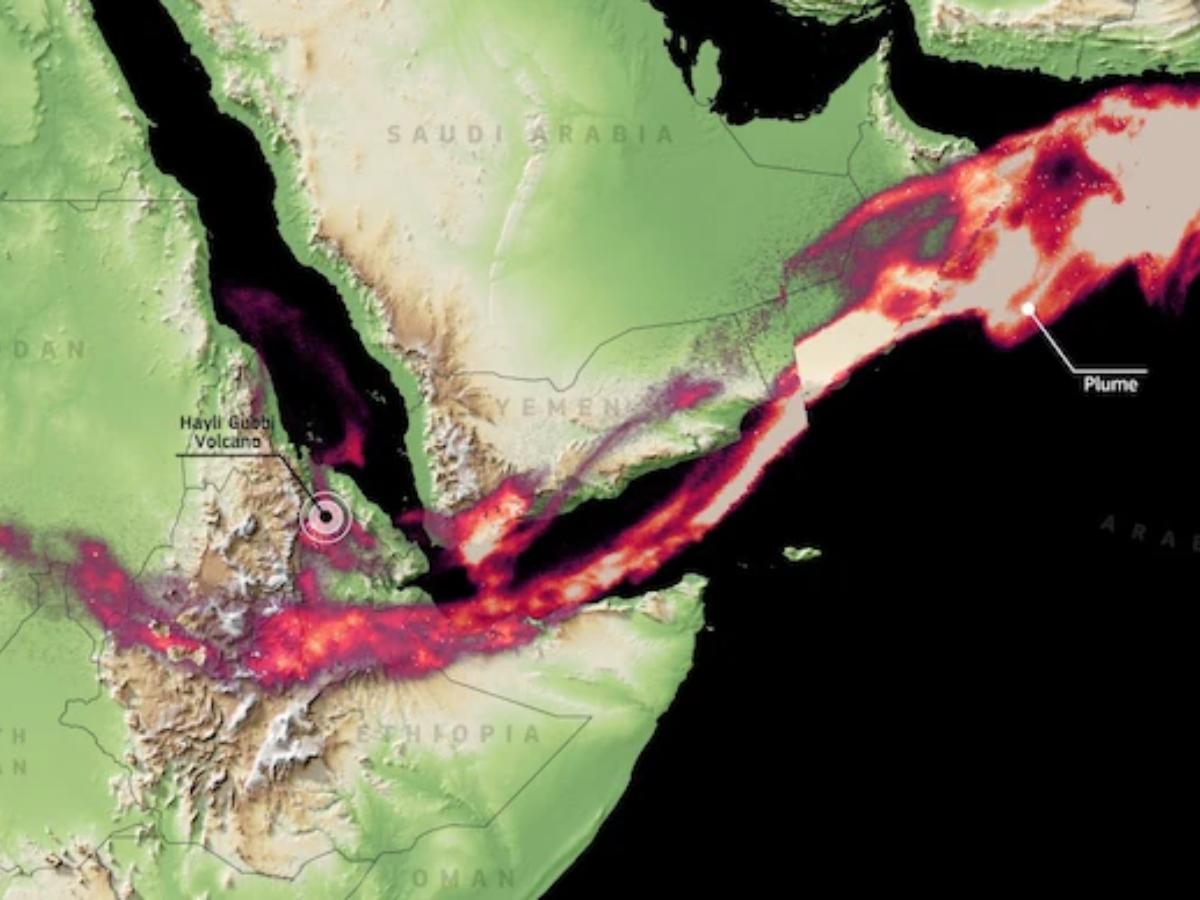
Hayli Gubbi Eruption: The sudden awakening of Ethiopia’s Hayli Gubbi volcano on November 23, 2025, surprised scientists and global aviation networks. This shield volcano had lain dormant for almost 12,000 years before its sudden eruption, spewing a towering plume of sulphur dioxide high into the atmosphere.
What started as a local geological phenomenon quickly escalated into a crosscontinental atmospheric disturbance, reminding the world just how interconnected our air really is.
Rare Eruption with Global Reach
Hayli Gubbi, situated about 800 kilometres northeast of Addis Ababa, emitted a sub-Plinian eruption that lofted ash and volcanic gases to as high as 45,000 feet, well into commercial flight lanes.
Satellites soon detected the plume fanning out more than 3,700 kilometers, drifting east over the Arabian Peninsula, sweeping across the Arabian Sea and eventually reaching western India. The Copernicus Sentinel-5P satellite was providing some of the most dramatic imagery, which unveiled the full extent of the sulphur-rich cloud.
How the Plume Spread Across Regions
Meteorologists identified two distinct ash paths have one plume which moved northeast, while another shifted northwest, enabling experts to trace its rapid migration across regions. Containing sulphur dioxide, volcanic ashes and microscopic glass particles, the cloud posed serious hazards to aircraft and the environment.
ALSO READ: SpaceX Pushes Starship’s Next Test Flight to 2026 After Booster Explosion
Airlines in India canceled or rerouted flights as the plume approached busy air corridors. The event has again pointed out how volcanic emissions released in East Africa can travel vast distances and influence air quality half a continent away.
Atmospheric & Climate Effects
Once in the atmosphere, sulphur dioxide reacts with sunlight and moisture to form sulfate aerosols. These tiny particles can have a temporary cooling effect on the atmosphere and decrease visibility besides irritating the respiratory system.
Of particular concern was the short-term spikes in SO2 air pollution in regions along the path of the plume, given the high volume emitted by Hayli Gubbi. While temporary, such events illustrate the broader climatic and environmental consequence of a single eruption.
ALSO READ: India Issues NOTAM Over Bay of Bengal, Likely Missile Test Between December 6–8
What is the Role of Space Based Monitoring
For instance, space agencies around the world rely on satellites like Sentinel-5P for tracking volcanic gases and delivering timely assessments for aviation authorities. Such tools offer near real-time updates of plume behavior. It has enabled quick responses from flight operators and environmental agencies.
The Hayli Gubbi eruption was a powerful example of why advanced monitoring systems are an investment worth making-particularly when natural events have the potential to affect the weather, travel and regional air quality well beyond their origin point.
ALSO READ: December 2025 Supermoon: When, Where & How to Watch | Last Big Moon of the Year
Disclaimer: This article provides general information based on available reports and scientific assessments. It should not substitute official advisories or expert guidance.