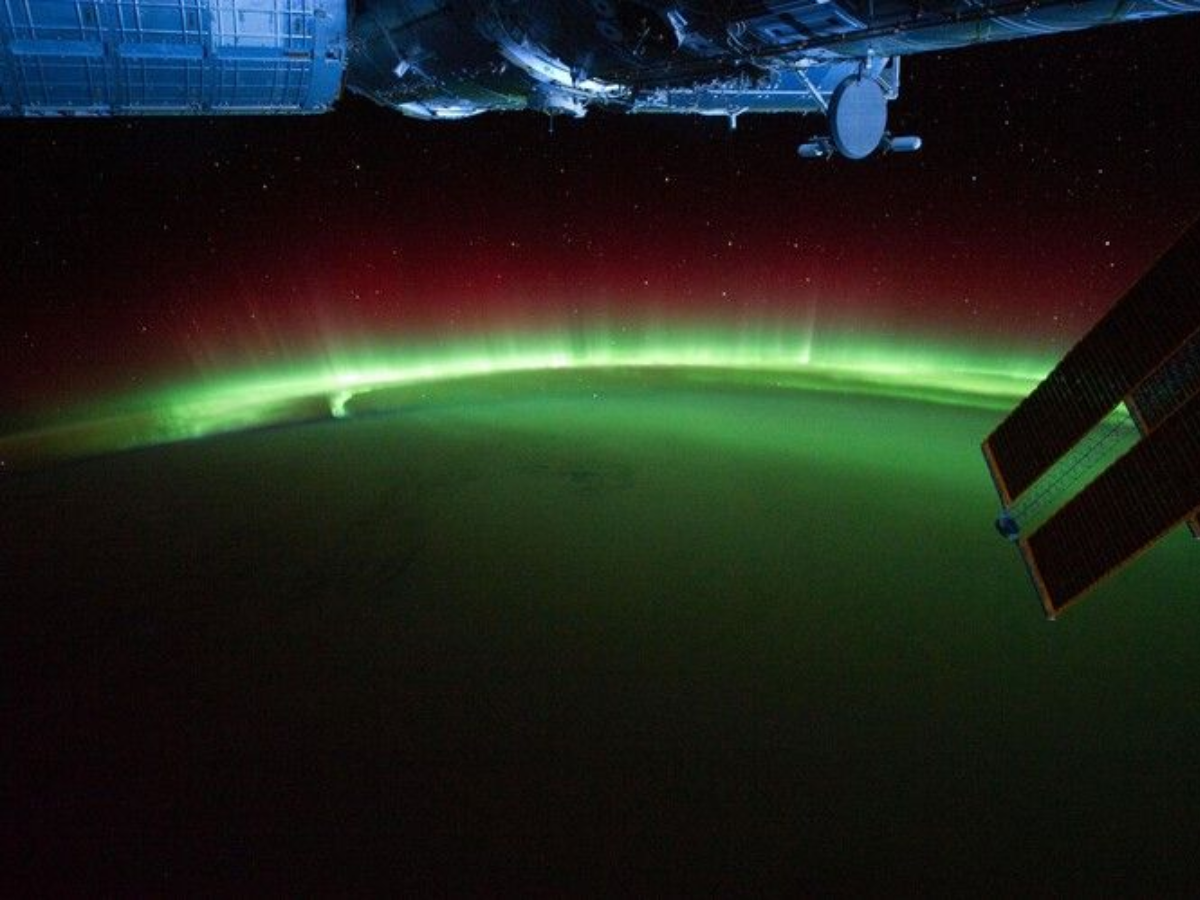
Red Aurora glowing above Earth, it is a brilliant and rare natural phenomenon that once again reminds people about the beauty and mystery of the planet’s skies. An excellent video demonstrating an unusually bright red aurora glowing above Earth was shared by NASA astronaut Don Pettit, the current occupant of the International Space Station (ISS) on Instagram. Such views are not just breathtaking but also scientifically exciting. These auroras happen a few times during an average six-month orbit. Pettit said that auroras this intense are rare events and that such video footage would be an exceptional treasure for those who are into space.
Red auroras of this size and vibrancy are rare, occurring 2-3 times during a six month mission to the International Space Station. pic.twitter.com/5zdXOk5gMs
— Don Pettit (@astro_Pettit) August 30, 2025
How Auroras Are Born
Auroras are the sight visible at the end of a cosmic dance between the Sun and Earth. When the Sun in a solar flare or coronal mass ejection and throws charged particles mostly electrons and protons into the solar system, those particles speed toward the Earth. They interact with the planet’s magnetic field, exciting it to tell the particles to go toward the polar regions and at that moment, those particles collide with atoms and molecules at upper altitudes and release energy as light.
ALSO READ: Alien Tech or Cosmic Rock? The Mystery of Manhattan Sized Object 3I/ATLAS
Colors depend on the altitude of the collisions and the atmospheric gases involved. Green, the most prevalent color, appears at lower altitudes reds, which are fairly rare and emerge at heights above about 200 kilometers (124 miles). The crimson glow is especially elusive and rarely seen in such splendor from the ground, making Pettit’s recording from 250 miles above Earth that much more remarkable.
A Celestial Canvas
NASA explains that the aurora can manifest in diverse forms-as diffuse glows, streaks, rays, or in shimmering curtains moving and pulsing unpredictably. Its colors range from greenish and reddish through to bluish and violet all depending on the energy of the particles and what atmospheric molecules they are enticing.
The red auroras which include Pettit’s capture are among the rarest of all. These are caused when the high-altitude oxygen atoms release photons when struck by charged particles. While the perfect conditions may allow a ground observer to see the faintest hint of red, a full seat of it goes to our astronauts above.
ALSO READ: Asteroid 2025 QY4 to Fly Past Earth: NASA Confirms Safe Passage at 2.81 Million Miles
Don Pettit Astronaut Legacy
Don Pettit is 70 years of age and is currently NASA’s oldest active astronaut. He has gone to space four times in the course of a very successful career. Besides contributing to space exploration, Pettit is known for his ability to capture the imagination of people about the Earth and the vastness of space from photos and videos he took.
He once humorously summed up the experience of watching a red aurora with “The sun goes burp and the atmosphere turns red. ” If his last recording adds yet another diamond to his much-admired jewelry of space imagery.
Why it Matters
Auroras, farther than just impressive natural spectacles, also indicate the state of solar activity and space weather. These could affect satellites and telecommunication systems and, in some cases, power grids on Earth.
Documenting and studying such rare events and therefore, not only brings, as it does for Pettit, pure pleasure but also teaches an ongoing understanding of the complex interactions between the Sun and our planet. Balancing aesthetic science makes every glance at an aurora both a beautiful moment and a nugget of research.
ALSO READ: Blood Moon on Sept 7: Lunar Eclipse Timings in the US and How to Watch Live