
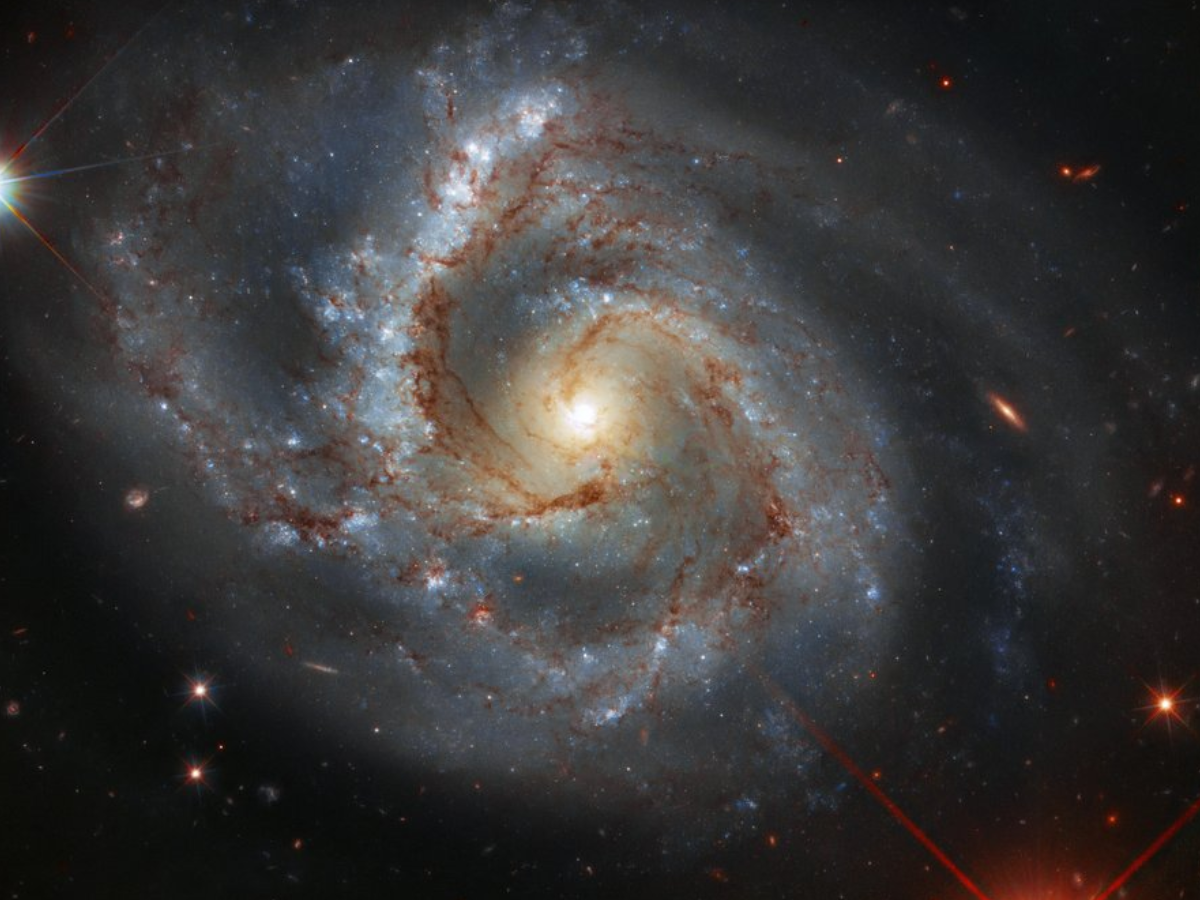
Pegasus a spectacular telescope view of the constellation and it offers an incredible aperture into the great beyond and it has the potential to deliver an even broader view than that of a full Moon at night. Brilliance increases in front of those dazzling stars of the Milky Way by the expressiveness of awesome cross shaped diffraction spikes or chest rated optical effect by design in telescope. Such luminous patterns emphasize the real drama behind the star field in a manner that can be made more coherent by the entire scene.
Exploring Pegasus: NGC 7497 Beyond a Veil of Dust Lies a Spiral Galaxy
Probably the most fascinating part within this image is none other than the spiral galaxy by the name of NGC 7497. Almost appearing to erupt from behind MBM 54, it is really at a much greater distance, roughly 60 million light years away.
ALSO READ: Last Solar Eclipse of 2025: Check Date, Time & Where It Will Be Visible
Seen almost edge on, NGC7497 has elegantly sinuous spiral arms adorned with dark dust lanes, thus resembling the Milky Way. There is, quite an illusion, an entanglement of this particular dim, remote distant galaxy and the cirrus dust up close and a cosmic layering of near and far.
Galactic Cirrus: Whispering Dust of Space
Above the stars, a diffuse veil like glow that is formed from interstellar dust clouds can be seen. Galaxies because they float through the galactic plane-pretty much like cosmic silk-scatter starlight into a fine and ghostly glow often termed as galactic cirrus or integrated flux nebulae.
If bright nebulae are associated with birthing new stars, galactic cirrus is subdued and elusive both appear faintly in deep images taken with telescopic lenses, though their scope of observation can be quite revealing. These gossamer threads, although quiet, are important the great raw material for stars of the future that will shape the cycles of galactic evolution.
ALSO READ: Blood Moon 2025: List of Cities in India to Witness the Rare September Eclipse
MBM 54: A Local Cloud Feeble Presence, Worldly Vastness
Centuries capturing the heavenly landscape are captured in MBM 54. It is a diffuse cloud of interstellar dust found close to Earth, and it is very near because it is less than a thousand light years away.
In fact, it is quite acceptable on most cosmic terms MBM 54 encompasses the entire image with its softly glowing tendrils. Its feeble yet enormous structures extend across the field, staining a canvas that shows even the quietest features of space have views across the universe.
A Cosmic Symphony
All comprising the stars, dust clouds and galaxies, form a stage where the local and the distant can unite in a single breathtaking frame. For Pegasus holds out to one the contemplation that the universe is not merely a collection of objects, but rather a grand symphony in itself.
Indicating in its layering of brilliance and shadow, this portrait shows the next intimacy between interstellar dust within reach and granite mountains beyond her horizon, bound forever in the timeless rhythm of the cosmos.
ALSO READ: Explosives, Cybercrime, Dark Web: The Alarming Secrets AI Chatbots Revealed In Safety Trials