
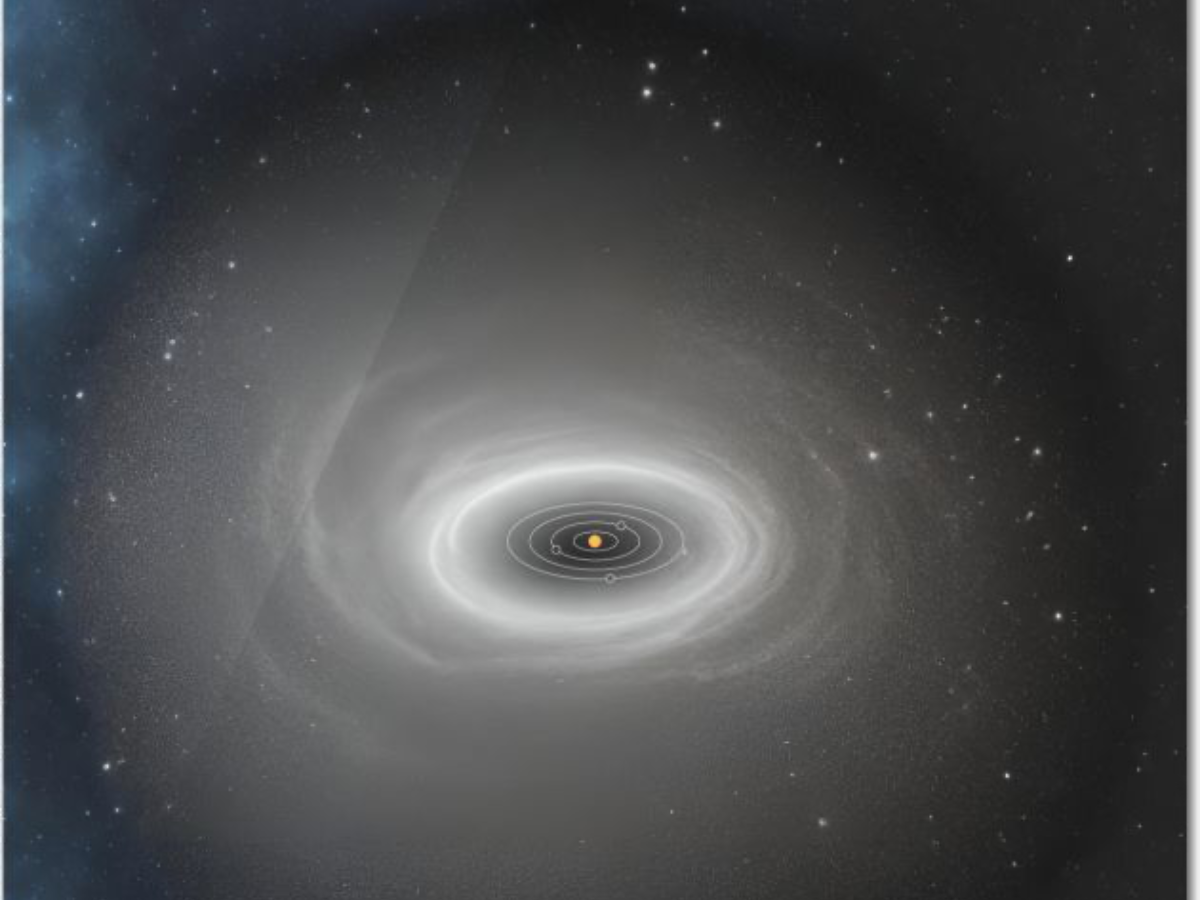
One of the most intriguing involves a star that happened to pass near the Sun long before modern humans walked the Earth and that quiet flyby might have shaken loose a wave of comets from the Oort Cloud and sent them toward our young planet. A recent study suggests this stellar brush altered Earth’s environment at a crucial moment in early human evolution.
What Is the Oort Cloud?
The Oort Cloud is a huge shell of icy remnants orbiting far beyond the planets. Dutch astronomer Jan Oort first proposed its existence, in 1950, to explain the source of long-period comets. Though no telescope has yet imaged it directly, evidence for this far-away reservoir of comets strengthens with each comet studied.
Oort Cloud Scale & Distance
This cloud begins thousands of astronomical units from the Sun and its outer boundary may stretch a quarter of the way to the nearest star. Even Voyager 1, racing outward for nearly fifty years will not reach its inner edge for centuries. The distances are so extreme that sunlight takes weeks to cross from one side to the other.
ALSO READ: Why is the Sky Blue: The Science Behind Nature’s Most Beautiful Illusion
How is Oort Cloud Formation
Scientists believe these icy fragments were born much closer to the Sun after the planets formed, Jupiter and its neighbours scattered leftover debris. Some pieces escaped the solar system entirely and others were tossed into far-reaching orbits where the pull of the galaxy gradually rounded them into a distant sphere.
Oort Cloud Orbit & Rotation
The planets or the Kuiper Belt is the Oort Cloud does not have an organized plane. Objects there move in every direction, forming a thick halo around the Sun. This is why long-period comets can appear from almost any point in the sky.
ALSO READ: Water Cycle Explained: How Water Moves Across Our Planet
Oort Cloud: Home of Comets
The Oort Cloud may contain trillions of icy bodies when one is nudged from its orbit, it begins its slow fall inward. Some blaze past the Sun once in human history and others take hundreds of thousands of years to complete a single loop.
A Star Shook Up the Oort Cloud Comets
It is now suspected that HD 7977 passed close enough about 2.5 million years ago to jolt this quiet region. The disturbance may have sent a surge of comets toward Earth, leaving a mark on the planet’s geology during its shift from the Pliocene to the Pleistocene era.
What Scientists Think on the Oort Cloud
While many mysteries remain, most scientists agree that the Oort Cloud is a key to understanding the early solar system: its icy residents preserve material from the dawn of planetary formation and rare events like stellar flybys may help explain changes in Earth’s ancient climate.
ALSO READ: Upcoming Elections in India 2025–2029: Check Which State Will Vote Next in the Coming Years
Disclaimer: This article is for educational purposes and reflects current scientific understanding, which may evolve as new research becomes available.