
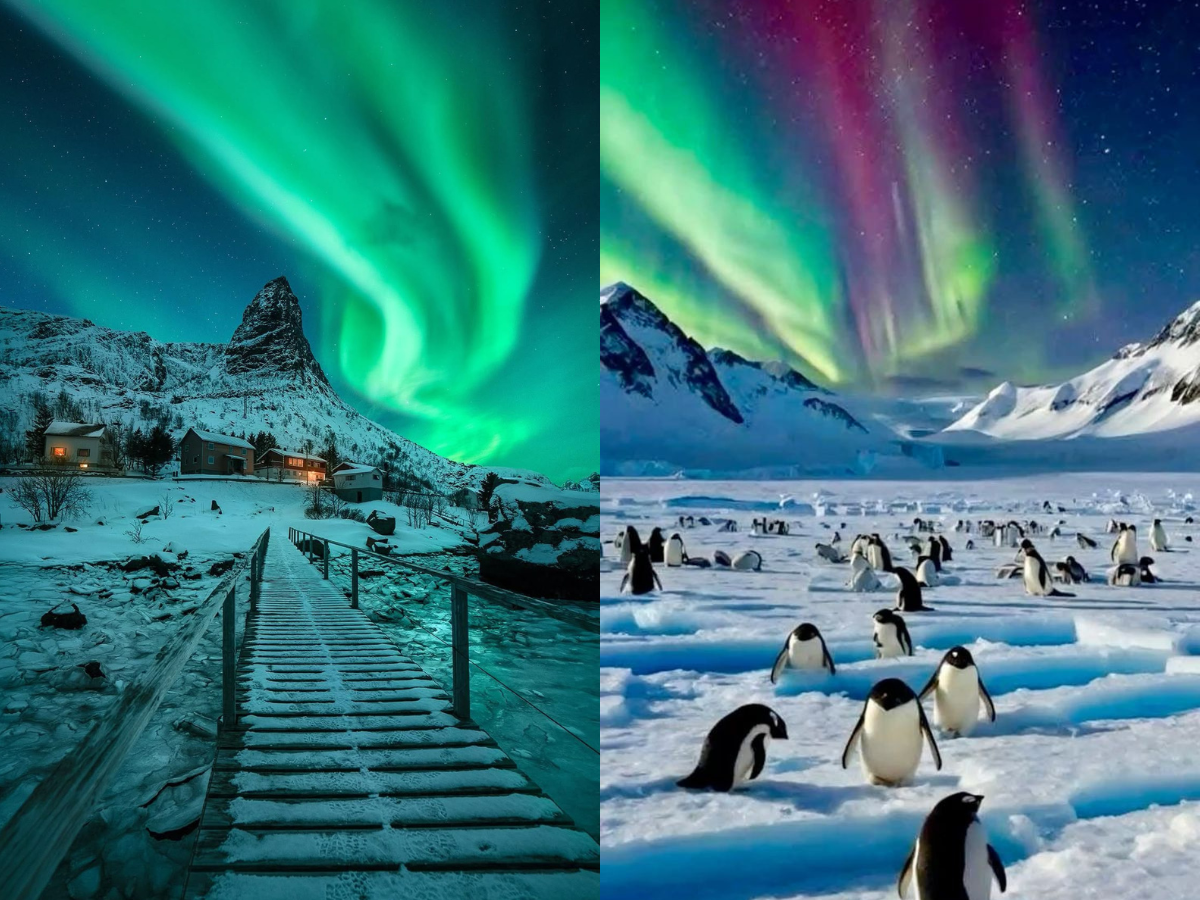
The sun is shining bright and giving beautiful, expansive skies with near and more than usual auroral displays as it enters its solar maximum. This part gives it a heightening of solar activity, describing what occurs as the Northern and Southern Lights.
The Northern Lights are more popularly called the aurora borealis which takes center stage, while to its southern sister aurora australis lies equal beauty in these more remote skies.
What are Auroras?
An aurora is an example of a natural display of light which is produced when charged solar particles collide with the upper atmosphere gases on Earth. These particles are steered toward the poles and constrict the glow due to the Earth’s magnetic field causing the discharge to release waves of glowing color and more frequently green, purple or red as they ripple across the night sky.
What are the Northern Lights?
The aurora borealis more popularly known as the Northern Lights is visible in the Northern Hemisphere this beautiful display draws many people to travel because of its frequency and the relative ease of accessibility to prime viewing areas. It gets plenty of publicity so most people think it is the only major aurora event out there.
ALSO READ: Oxygen Generation for Astronauts in Zero Gravity: The Science Behind
What are the Southern Lights?
On the opposite side of the earth there is the aurora australis which occurs in the Southern Hemisphere. It is similar in origin, but it remains less known, as the locations are more remote. Southern auroras are just as dramatic, but the few populated areas are located quite far and making it more challenging to see them.
Where to Spot the Northern Lights?
The visibility of auroras really depends on geography and geomagnetic conditions. The closer you get to the magnetic poles and the greater your chances of seeing the lights.
What are the high Spots to Watch the Northern Lights?
- Alaska-Fairbanks is particularly known for its areas of strong activity and dark skies makes for the right conditions.
- Northern Canada is the Yukon and Northwest Territories are known to have loads of auroras.
- Scandinavia-Norway, Sweden and Finland people and places where aurora display tourism occurs.
- Reykjavik, Iceland visitors will sometimes get to see an aurora on the edge of the major capital.
ALSO READ: Morning vs Evening Star: Why Planets Like Venus Change Their Celestial Role
Where the Southern Lights Can Be Seen?
- Antarctica is the best place to get views but very difficult to reach.
- New Zealand-Stewart Island & The Catlins occasionally grab a look at the lights during the season.
- Tasmania in Australia is a new place rising for hunt towards southern aurora.
- Southern Chile and Argentina are occasionally picked up with curiously clear views in Patagonia and Ushuaia.
Are They Mirror Images?
It used to be thought that the two auroras were symmetrical reflections mirror images caused by the same space weather. That has now been challenged mostly by satellite data and more recent observations.
While both occur due to solar wind, they can appear differently in patterns, shapes and intensity because of minor differences in the way Earth’s magnetosphere behaves in each hemisphere.
Comparison of Northern & Southern Lights
| Feature | Northern Lights (Aurora Borealis) | Southern Lights (Aurora Australis) |
| Hemisphere | Northern | Southern |
| Visibility | Easier Spots | Rare Spots |
| Location | Alaska, Canada, Iceland, Norway | Antarctica, New Zealand, Tasmania |
| Frequency | Higher | Lower |
| Cause | Solar Wind & Geomagnetic Storms | Solar Wind & Geomagnetic Storms |
| Color Display | Green, Purple, Red & more | Same Palette |
ALSO READ: Why Are Eyes Different Colours? Exploring the Science Behind Genetics & Light
Disclaimer: This article is for informational purposes only and is based on current scientific understanding of auroras. Viewing conditions may vary by location.