
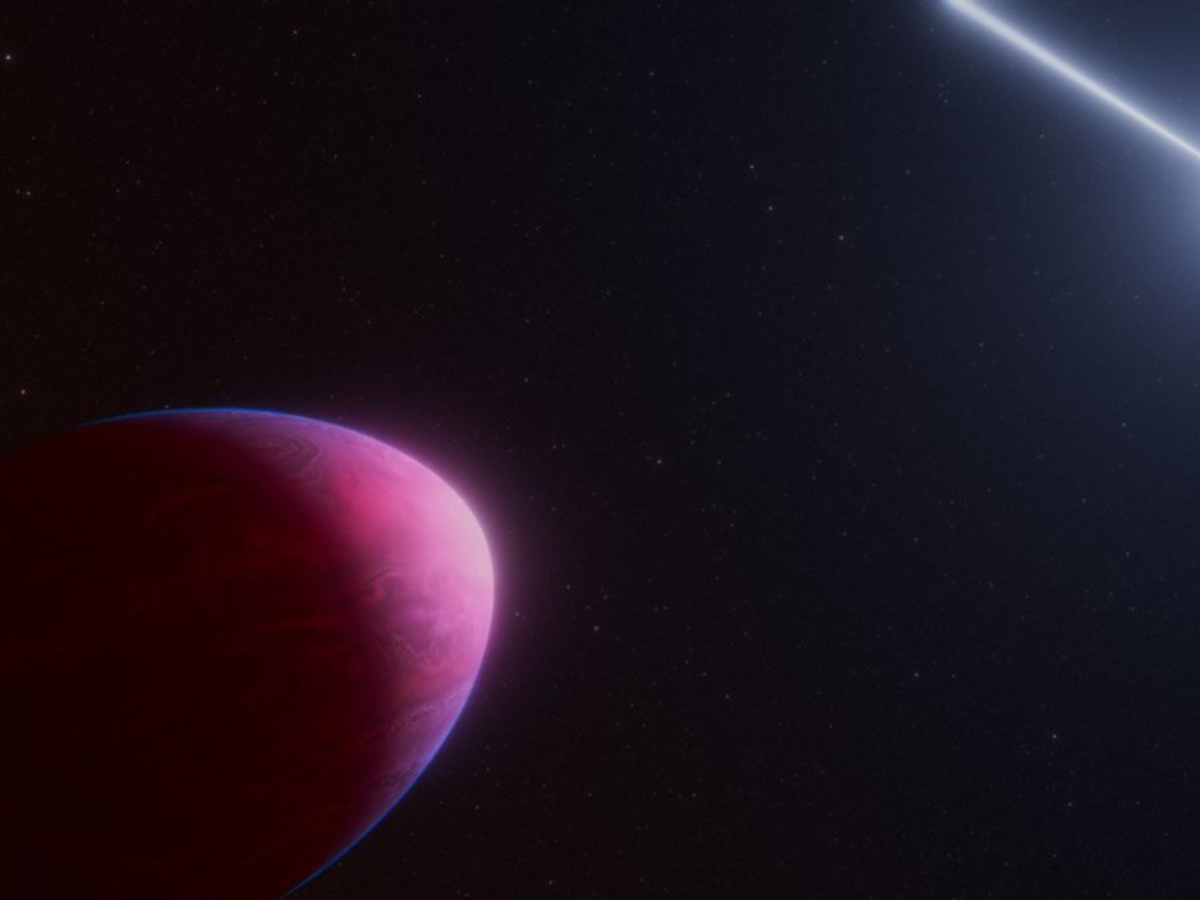
The James Webb Space Telescope has revealed an exoplanet that goes against all that is currently known about planetary science. The newly discovered exoplanet is called PSR J2322-2650b and orbits a pulsar, which is a dense and rapidly rotating celestial body that is a supernova remnant.
The observations of this alien world made by the James Webb Telescope have revealed details of its shape and atmosphere that are not compatible with current models of planetary science.
A Planet Orbiting an Unusual Host Star
PSR J2322-2650b is approximately 750 light-years away and has an orbital period of only 7.8 hours to complete an orbit around its pulsar. This is at a distance of about a million miles. For Earth’s orbit around the Sun, in contrast to this extreme world, Earth’s orbit is approximately 100 million miles.
The gravitational pull around this highly dense pulsar is so extreme that it pulls the planet into a lemon shape. Orbits around its pulsar are made possible because the gamma radiation from the pulsar does not interfere with observations made by the Webbs telescope.
ALSO READ: Alien Life Could Be Discovered by 2075, Says British Scientist Citing Exoplanet K2-18b
An Atmosphere That Defies Expectation
The atmosphere in the planet has a very unique composition. This is because the outer atmosphere is composed mostly of helium and carbon. Additionally, there is little oxygen and nitrogen in its atmosphere.
Some common compounds that are missing from the atmosphere include water vapor, carbon dioxide as well as methane gas. According to Webb’s findings, there are soot clouds moving in the atmosphere and there are layers of carbon that can form diamonds.
Challenging the Existing Model
The canonical theories on planet formation do not account well for the existence of such an object, especially one that circles a pulsar. Although there are black widows among pulsars, in which the star steals matter from a companion that is much smaller in size, PSR J2322-2650b definitely qualifies as a planet, not a star. The peculiarities of this planet indicate that current theories are not entirely accurate, and that planetary systems are much more diverse than thought.
James Web Telescope Involvement with the Discovery
The James Web Space Telescope has played an instrumental role in identifying and exploring PSR J2322-2650b. The infrared telescope enables astronomers to make observations about planets in radiation swept environments without any hindrances. The success highlights the game-changing nature of the James Web Space Telescope in exoplanetary research.
A Milestone in Exoplanet Science
Amongst the 6,000 exoplanets discovered, PSR J2322-2650b is unique for its resemblance to a gas giant orbiting around a pulsar, which is similar to a Jupiter-class hot gas planet. This exoplanet discovery opens up our knowledge of what can exist as a planet around hostile regions of space.
ALSO READ: Ice Age Paradox: How Global Warming & Rising Temperatures Might Cause Earth to Cool Rapidly
Disclaimer: This article is for informational purposes and summarizes scientific findings without altering data or drawing speculative conclusions.