
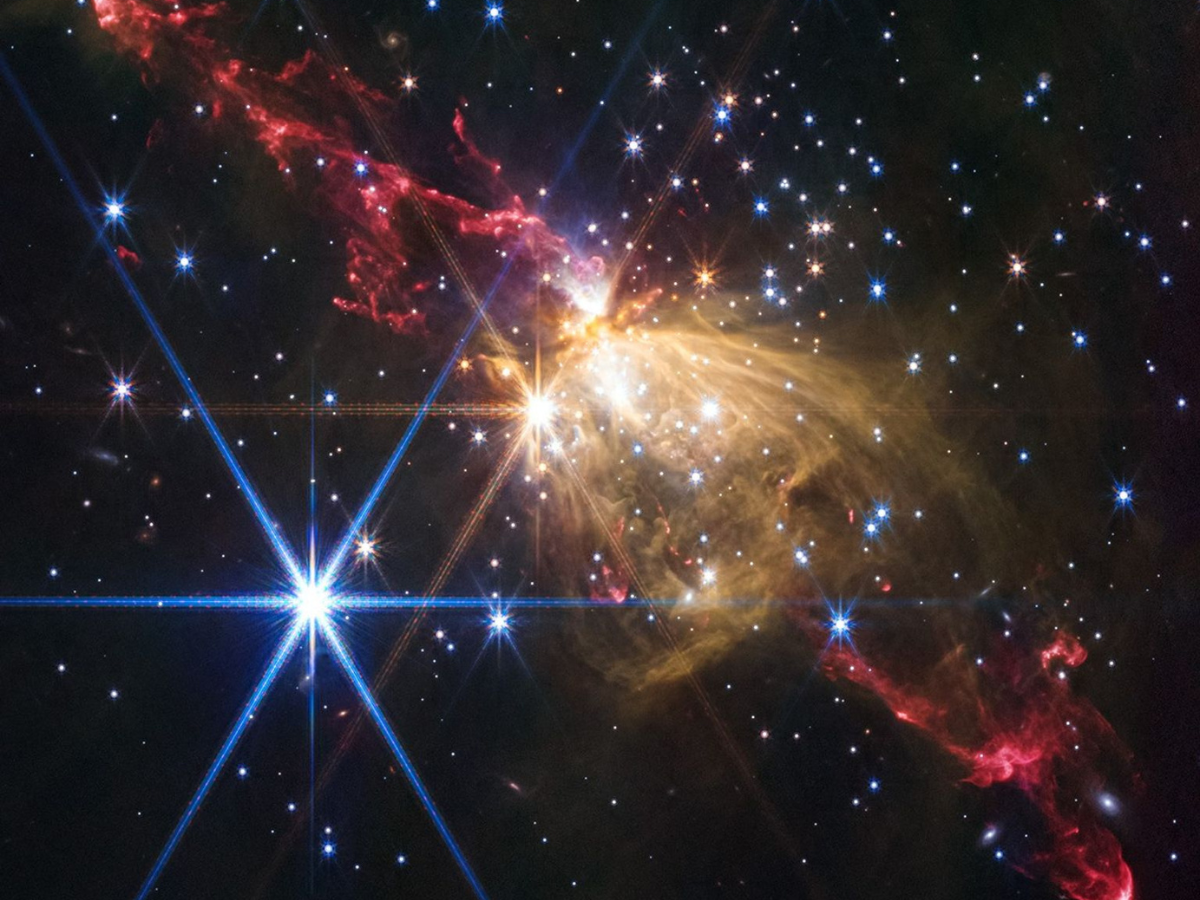
James Webb Space Telescope from NASA managed to witness an exceptional stellar jet stretching eight light-years from a massive young star in the Sh2-284 nebula.
What Did James Webb Capture?
The NASA’s James Webb Space Telescope provides an absolutely breathtaking view of this cosmic spectacle as a gigantic stellar jet flows away from a massive young star. This truly spectacular gas outflow measures over a whopping eight light years in extent.
It arises from a protostar about ten times the mass of our Sun and moves at incredible speeds in the range of hundreds of thousands of miles per hour. The star is located about 15,000 light years away inside the Sh2-284 nebula. In fact, scientists say the jet is like two blades of a lightsaber, being double the distance from the Sun to Alpha Centauri, our closest stellar neighbor.
ALSO READ: Nasa’s James Webb Telescope Spots Mysterious Red Object That May Reveal Galaxy Origins
What is Stellar Jet Discovery?
The massiveness of the stellar jet makes this discovery remarkable for one of a kind reason, whereas protostars usually have many smaller jets. Such large jets are rare, especially in this part of space and time, stated lead scientist Yu Cheng. Advanced infrared imaging by Webb allowed astronomers to capture jet structures with fine details, such as bright knots, bow shocks and aligned filaments.
These serve as tracers that unravel the formation history of the star in exquisite detail. The definition of this image represents a significant advancement in our understanding of massive star formation.
How Are the Jets Formed?
Formation of the jet appears to be closely connected to the rotation axis of the star oriented towards the magnetic forces that shoot gas at tremendous speeds. Co-author Jonathan Tan notes that the striking symmetry of the jet with both sides nearly oppositely directed at 180 degrees.
ALSO READ: New U.S.-European Satellite Launch to Monitor Sea Levels & Protect Ships at Sea
This stable is equally sided flow provides strong evidence for the core accretion theory of star formation, which postulates that massive stars gradually form from a stable disk of infalling material. There had been contests about whether these stars did form in a chaotic way, but this result aligns with the model of orderly and disk-driven growth.
What Does It Mean for Star Formation?
The implications of this sighting extend beyond this one star. Sh2-284 is in a low metallicity environment like the early universe, when heavy elements were less abundant. This allows astronomers to study star birth in such environments and reconstruct the cosmic history of star formation billions of years ago.
Other work suggests another compact star-forming core nearby, identified by Chile’s Atacama Large Millimeter Array, although this new star has yet to eject jets. The Astrophysical Journal research sets the stage for future studies that will provide refined models of how stars form and evolve across different cosmic settings.
ALSO READ: Amazon Great Indian Festival 2025: Up to 80% Off on Mobiles, Electronics & More