
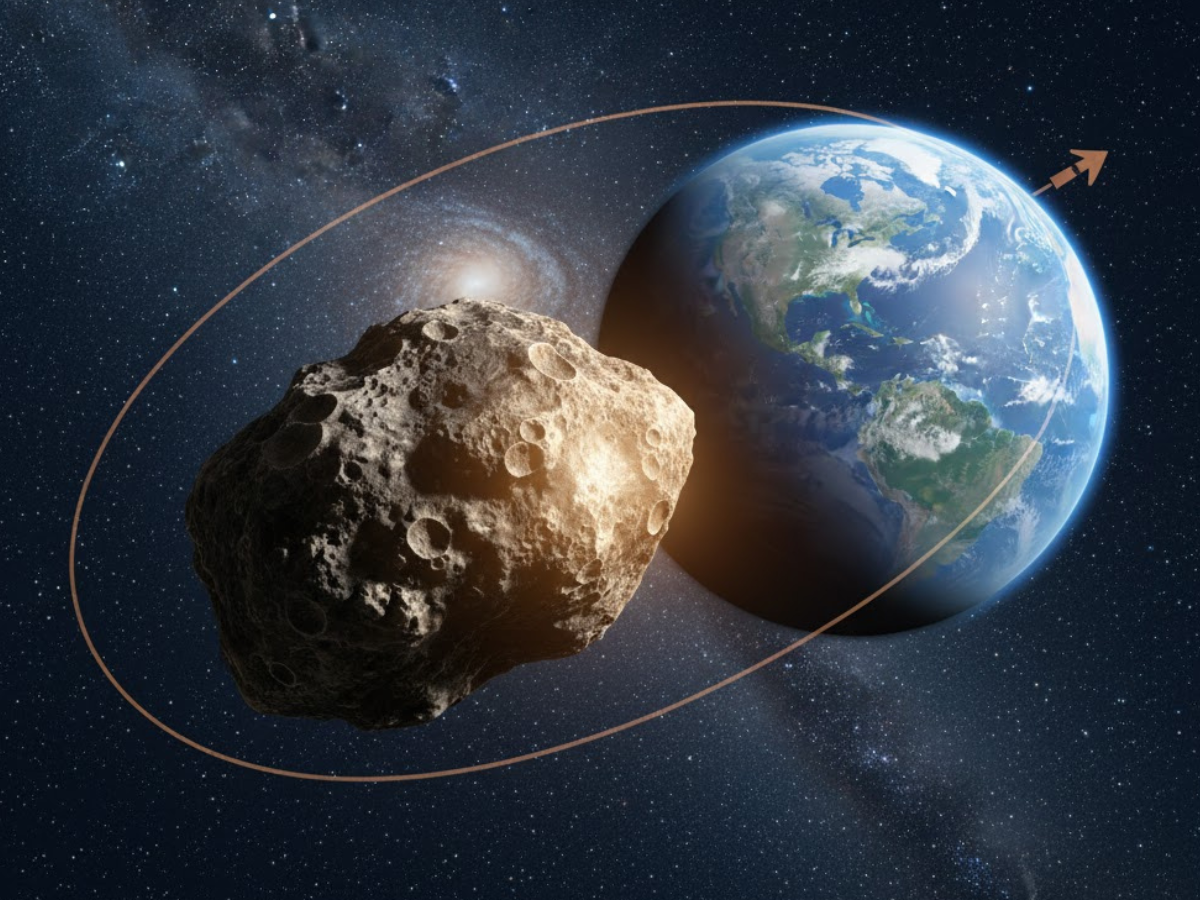
While Earth moves along in its orbit, a brief space show will take place Between October 13 and 14, 2025, four near Earth asteroids are expected to do an Earth flyby all at completely safe distances. These aliens bring no harm to us they serve as excellent targets for scientists to improve the tracking techniques and conduct some more research on planetary defense.
October 13: Meet the Asteroid 2025 TV2
Two asteroids will approach on October 13 relatively closely with the first 2025 TV2, estimated at a size of about 44 feet (13.4 meters), will pass the Earth at a distance of about 1.27 million kilometers which is over three times the distance between Earth and the Moon.
Then, later on the same day, another asteroid under the name 2025 TU1, slightly larger at 54 feet (16.4 meters) wide and will pass by but from much greater distances to the order of 2.29 million kilometers. Astronomically considered these celestial passersby are small but big enough to observe.
ALSO READ: Will Aliens Arrive on October 29? Scientists Decode 3I/ATLAS
October 14: Two More Watchful Flybys
The fun continues on October 14 with the flyby of two more asteroids. The first, 2022 AY5 is the smallest of the group at just 16 feet (4.9 meters) and will come within 2.85 million kilometers from Earth. A larger object is about 55 feet (16.8 meters) in diameter is expected to pass by at an even farther distance of 5.71 million kilometers.
None of these are dangerous by any means and the rhythm of the near-Earth cosmos just moves on.
ALSO READ: What If 31/ATLAS Is an Alien Mothership? How Earth Could Respond
Why Tracking These Space Rocks Are Important
There is no cause for alarm of the flyby is taken seriously by scientists. An event like this helps researchers to test asteroid detection systems, refine orbital prediction models and analyze composition and behavior of such objects. Each passing rock is another chance to prepare for a potential threat that could emerge decades down the road.
Strengthening Planetary Defense, One Asteroid at a Time
Planetary defense strategies-from early detection to potential deflection techniques are being developed at NASA and around the globe. These October flybys though harmless are critical for feeding into such endeavors. For the time being, they remind us of both our vulnerability and our ever-increasing capacity to keep an eye on the universe around us.
ALSO READ: Alien Tech or Cosmic Rock? The Mystery of Manhattan Sized Object 3I/ATLAS
Disclaimer: All asteroid flybys are confirmed safe with no collision risk. Data is subject to updates as new observations become available from NASA and global agencies.