NASA is in the process of gearing up for the final preparations for its groundbreaking mission destined to take place in summer 2026. The mission happens to be SunRISE which stands for the Sun Radio Interferometer Space Experiment. It is among the most innovative heliophysics missions that intend to study one of the sun’s great mysteries, solar radio bursts.
Its targeted ride will be on a United Launch Alliance Vulcan Centaur rocket with sponsorship coming from the U.S. Space Force’s Space Systems Command and it is a big step forward in space weather research and satellite protection.
Objectives of the SunRISE Mission
SunRISE’s major undertaking is the mapping of the Sun’s magnetic field by studying solar radio bursts from its outer corona to the interplanetary space. The Solar radio events are phenomena that occur when enormous amounts of energy are built within the Sun’s magnetic field and this later results in acquiring high-speed motion by particles accelerated away from the solar surface. The particles can then further leave the solar system and may affect spacecraft operating beyond the Earth’s magnetic shielding posing a danger to them. Scientists will study the mechanics of such bursts to improve protection measures for astronauts, satellites and other technologies deployed outside.
ALSO READ: Will Aliens Arrive on October 29? Scientists Decode 3I/ATLAS
Solar radio bursts are important because they herald an imminent danger of harmful particle radiation and one special feature of SunRISE is that it will pin-point the source of these bursts and determine the vector of energetic particles they release. Endeavoring to space weather forecasting the information would help predict affected areas in the heliosphere in the event of a possible radiation event.
What is the SunRISE Constellation
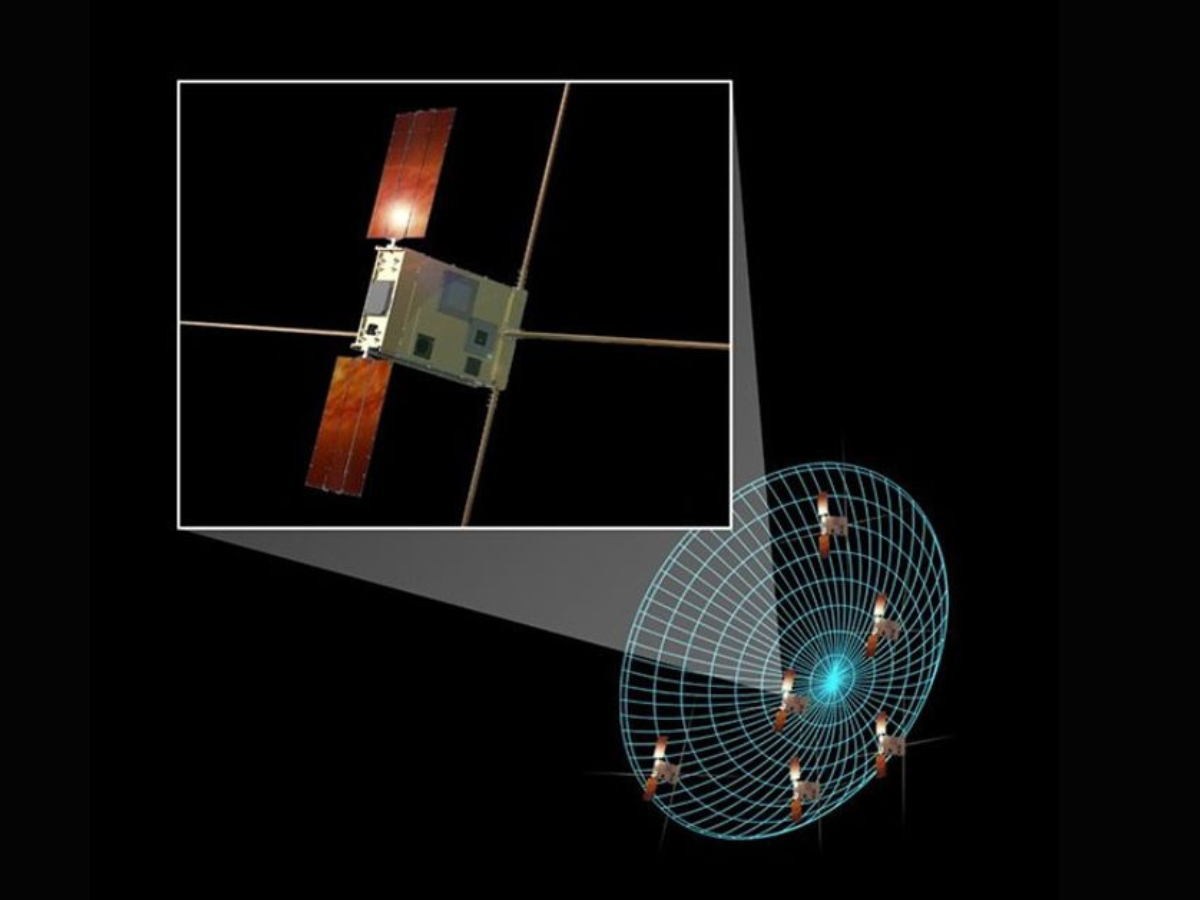
The mission will consist of a constellation of six small satellites the size of a toaster oven and collectively these SmallSats would function as one single very sensitive radio telescope about 6 miles (10 kilometers) across. The data collected will be transmitted to Earth via NASA’s Deep Space Network. The truly new thing about this is not the capability for collecting data in space but how data will later be processed, using interferometry which combines information from several satellites to behave like one much larger radio telescope.
Among the distinct advantages of this setting is observing solar phenomena in radio wavelengths usually absorbed by the atmosphere of the Earth. By assembling the SunRISE array in space, it could be possible to capture phenomena that ground-based radio telescopes are incapable of changing perspectives on solar activity.
ALSO READ: Alien Tech or Cosmic Rock? The Mystery of Manhattan Sized Object 3I/ATLAS
Complementing NASA’s Ongoing Solar Research
SunRISE together with other NASA projects such as the Solar Terrestrial Relations Observatory (STEREO), the Parker Solar Probe and the Solar Orbiter, a joint ESA mission, will strengthen this knowledge of the Sun and its influence on the whole solar system. SunRISE will provide information critical to these missions. SunRISE aims to develop understanding of the behavior and effects of the Sun in a wider context of space weather phenomena.
SunRISE’s Impact on Future Space Exploration
This represents a new beginning in the field of study and research on the space environment as well as solar activity with the groundwork is being set for understanding the relationship between solar activity and the use of space through investigating solar fountations and tracks of solar radio bursts.
This will help with potential radiation event forecasting for improved protection of astronauts and spacecraft while also advancing scientific knowledge regarding the solar system. Managed from NASA’s Goddard Space Flight Center and with leadership from the University of Michigan, the SunRISE mission stands to contribute greatly to the science of heliophysics and build our preparedness for future space missions.
ALSO READ: What If 31/ATLAS Is an Alien Mothership? How Earth Could Respond
Disclaimer: This article is based on mission details available at the time of writing and may be subject to future updates or changes by NASA.