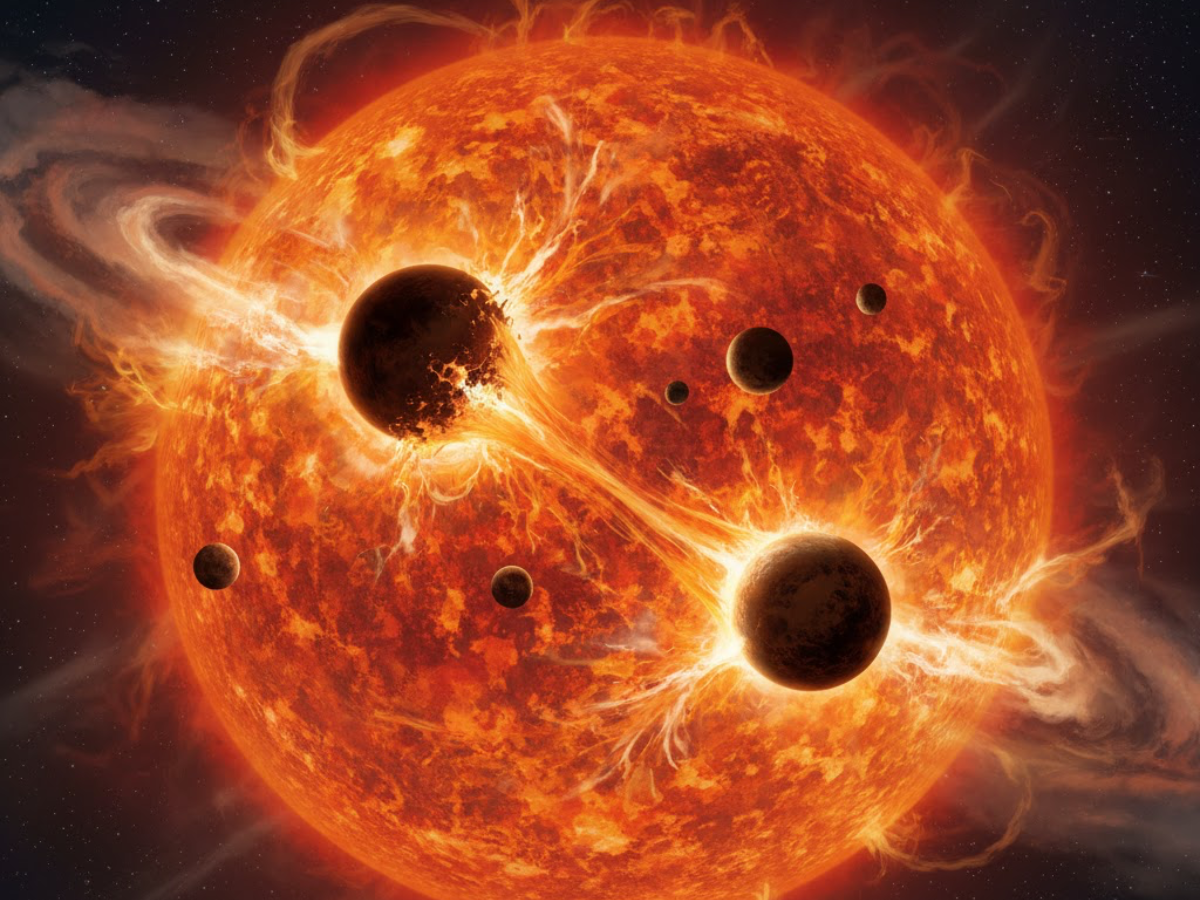
When stars like our Sun evolve to enter the red giant phase of their lives with their outer layers expand significantly and can be a major threat to any planets that orbit nearby. New research using data from NASA’s Transiting Exoplanet Survey Satellite (TESS) has shown that this can happen much more often than once thought.
How TESS Uncovered Planetary Fate
TESS investigates the faint dips from distant stars, cluing in on a planet passing in front of its host star. Using data input from almost 500,000 planetary systems, the researchers whittled that down to about 15,000 potential signals.
They homed in on stars in the process of turning into red giants and found about 130 planets in orbit-33 of which were previously unknown.
Planets Struggle to Survive
The study finds that planets close to red giants have a greatly diminished chance of survival. Edward Bryant from the University of Warwick elaborated to explain that while scientists expected some planetary destruction, it came as a surprise how effectively red giants engulf their neighbors.
ALSO READ: How New Propulsion Systems Could Send Us to the Stars Without Fuel
Many planets are either consumed by the expanding star or drawn inward through tidal interactions in which gravitational forces gradually pull them closer until they are consumed.
What is the Future of the Sun & Its Impact on Our Solar System
Once the hydrogen in their cores is used up, the stars become red giants and the main fusion process stops. The core contracts while the outer layers balloon outward, sometimes expanding a thousandfold.
When the Sun reaches this stage in about 5 billion years, Mercury and Venus will almost certainly be engulfed and Earth’s fate may also be sealed. Even if it survives physically, its atmosphere will have been stripped away and the planet will be far too hot for life.
ALSO READ: Barycenter Mystery: The Hidden Point That Keeps Our Solar System in Motion | Not the Sun
Implications for Exoplanets
The team’s calculations showed that red giant stars have only a 0.11% chance of retaining planets a sudden drop compared to main sequence stars. The fact that large planets, similar in size to Jupiter or Saturn, can survive is even less probable.
Vincent van Eylen of University College London pointed out that though smaller planets including those the size of Earth, may survive the long-term consequences of stellar evolution make them unlikely to be habitable. These results reshape our understanding of how planets are lost around aging stars and underscore the fragile balance of planetary systems.
ALSO READ: Indian Plate Is Splitting Beneath the Himalayas: What Scientists Just Found
Disclaimer: This article summarizes scientific research on red giants and exoplanets; predictions for Earth are theoretical and based on current models.