
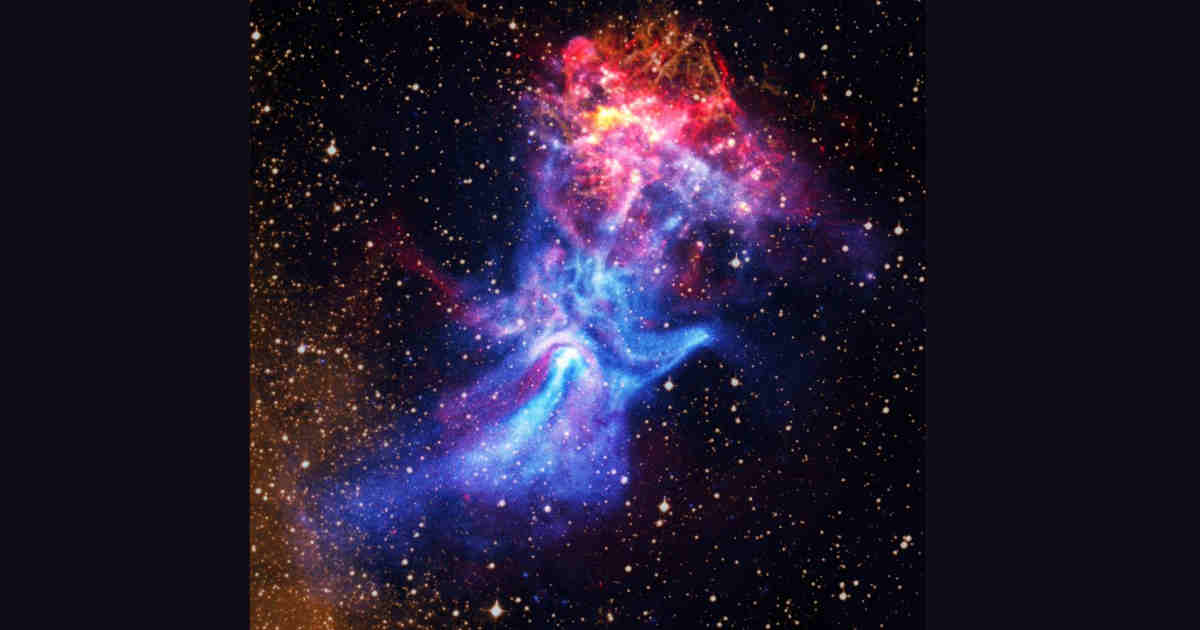
NASA has released a breathtaking new image of what scientists describe as a massive “cosmic hand” stretching across 150 light-years. The structure, created by powerful magnetic forces from a pulsar, looks remarkably like a human hand reaching through space.
Discovery and Background
The unusual formation was first spotted in 2009 when NASA’s Chandra X-ray Observatory captured images of a pulsar and its surrounding nebula. Astronomers noticed that the glowing cloud strongly resembled the shape of a “human hand.” Since then, researchers have continued to monitor the object using Chandra and other observatories.
NASA explained in a post on X (formerly Twitter): “New radio data has been combined with NASA’s @chandraxray data to provide a fresh view of an exploded star and its surrounding nebula, helping astronomers better understand this ‘cosmic hand’s peculiar properties and shape.”
A Blend of X-Ray and Radio Views
The latest image merges Chandra’s X-ray data with new radio observations from the Australia Telescope Compact Array (ATCA). Together, they reveal more intricate details of the star’s remnants and the nebula’s complex structure, offering scientists a clearer look at the system’s unusual behavior.
The Pulsar at the Core
At the heart of the formation lies pulsar B1509-58, a rapidly spinning neutron star only 12 miles (19 kilometers) wide. Despite its small size, it generates a giant nebula known as MSH 15-52, which stretches over 150 light-years. In X-ray light, this nebula resembles an extended palm with fingers pointing outward.
The pulsar rotates nearly seven times per second and has a magnetic field about 15 trillion times stronger than Earth’s. This makes it, in NASA’s words, “one of the most powerful electromagnetic generators in the Galaxy.”
Also Read: NASA Confirms Fastest Interstellar Object: Mysterious Comet Enters Solar System
What Are Pulsars and Nebulae?
A pulsar is a type of neutron star the compact remnant of a massive star that exploded in a supernova. A nebula is an enormous cloud of gas and dust shaped by energy and stellar winds. In this case, the nebula is sculpted by streams of high-energy particles flowing from the pulsar.
New Insights from Radio Data
The ATCA radio observations uncovered fine filaments that appear to align with the nebula’s magnetic field. These features likely form where the pulsar’s particle winds collide with debris left from the original supernova.
NASA noted important differences between the two sets of data: “Some prominent X-ray features, including the jet towards the bottom of the image and the inner parts of the three ‘fingers’ towards the top, are not detected in radio waves.” This finding suggests that extremely energetic particles are escaping from a shock wave similar to the sonic boom of a supersonic jet and then traveling along magnetic field lines to create the glowing “fingers.”
Link to Nearby Supernova Remnant
The study also provided new information about RCW 89, a neighboring supernova remnant. Unlike most young remnants, RCW 89 shows a patchy structure, with radio emissions overlapping closely with clusters of X-ray and optical light. This unusual pattern continues to intrigue astronomers and adds complexity to the overall system.
NASA’s new image not only provides a spectacular view of the “cosmic hand” but also deepens scientific understanding of how pulsars, nebulae, and supernova remnants interact to shape the universe.
Also Read: NASA Reaches Major Milestone: Discovers Material Older Than the Sun on Asteroid