
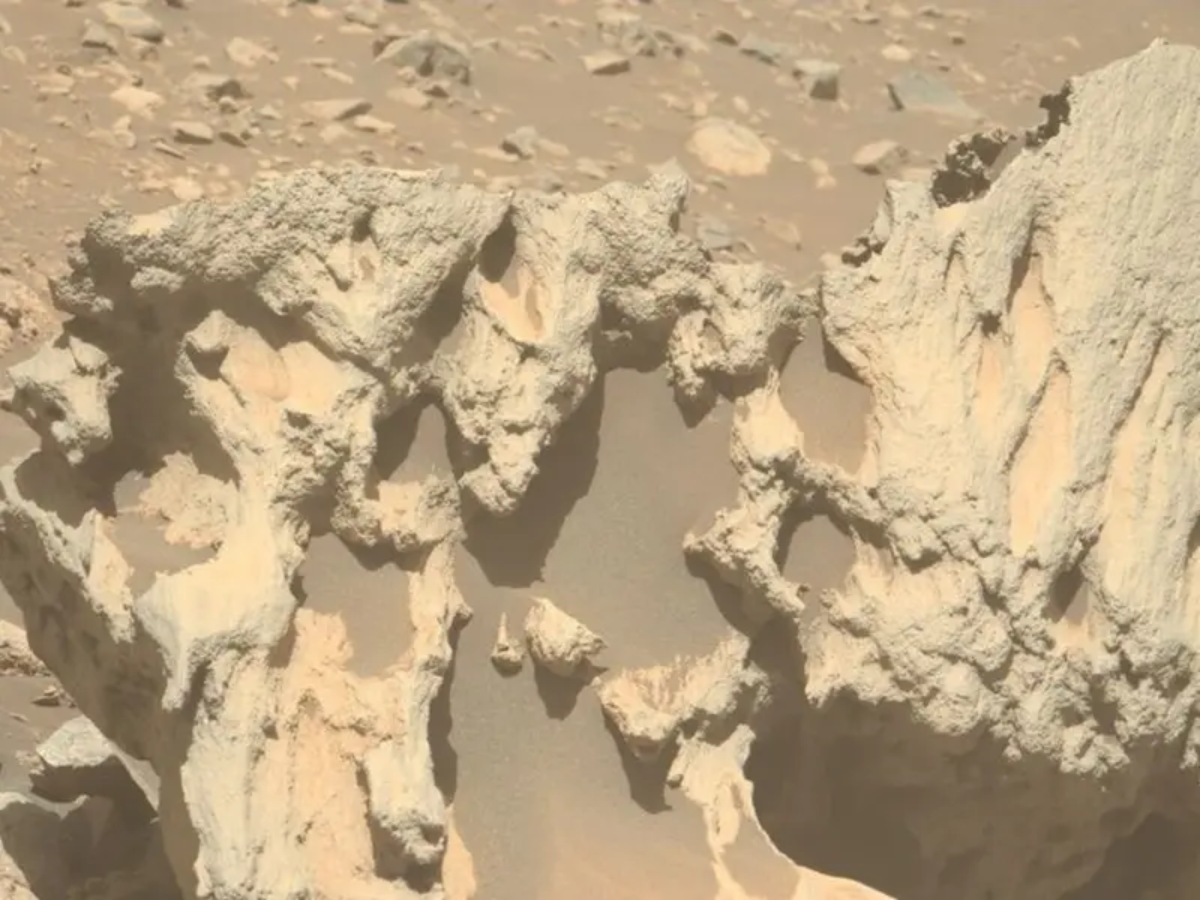
NASA’s Perseverance rover has added another mystery to Mars. While surveying the Vernodden region of Jezero Crater, the rover stumbled upon an oddly shaped boulder dissimilar from anything else in the area.
The team would later refer to the feature as Phippsaksla. At about 31 inches wide as the rock stood tall among scattered, flatter stones, making scientists wonder how it came to rest in this ancient landscape.
Clues Hidden in Iron & Nickel
The SuperCam instrument, which analyzes rock chemistry with a laser and spectrometers, showed that Phippsaksla contained unusually high amounts of iron and nickel. Those elements commonly appear in meteorites forged inside the cores of large asteroids.
That chemical fingerprint raised a remarkable possibility with the rock may not have formed on Mars at all. Instead, it might be a long-traveled fragment from another corner of the solar system.
A Pattern Spotted by Other Rovers
Metallic rocks on Mars aren’t unfamiliar to rovers. For example, Curiosity had made discoveries of iron-nickel meteorites in Gale Crater, like the famous Lebanon rock from 2014 and the Cacao meteorite discovered in 2023.
ALSO READ: India Plans 6,000-Meter Underwater Lab After Matsya-6000 Success
Opportunity and Spirit also found a couple of them during their missions. With Jezero Crater’s geologic history and plenty of small impact scars, it was well expected for scientists that Perseverance would also find one. Maybe this is the discovery that fits that expectation: Phippsaksla.
Why This Rock Stands Out
What makes Phippsaksla even more intriguing, though, is its location. It lies outside Jezero’s main crater floor, resting on bedrock shaped by ancient impacts. That suggests that it may have survived billions of years of erosion and planetary change.
ALSO READ: Headless Comet? K1 ATLAS Splits Into Four Pieces as It Speeds Toward Earth
The rock’s shape and isolation raise further questions about how long it has been exposed and whether it arrived during a period of heavy meteoritic bombardment.
Deeper Search for Martian History
Now, NASA’s team is working to confirm whether Phippsaksla is, in fact, a meteorite. The rover is studying whether this rock-or others like it-could hold clues connected with past life on Mars.
The space agency just revealed the best evidence to date for biological signatures in a sample called Sapphire Canyon and collected from a dried riverbed in the same region. If both findings stand up, they could rewrite what we know about Mars’ ancient history and its potential to have once harbored life.
ALSO READ: Last Sunset of 2025: Arctic Slips Into a 64-Day Polar Night With No Sunrise
Disclaimer: Information is based on current scientific reports and mission updates. It is intended for general insight and not for official scientific interpretation.