
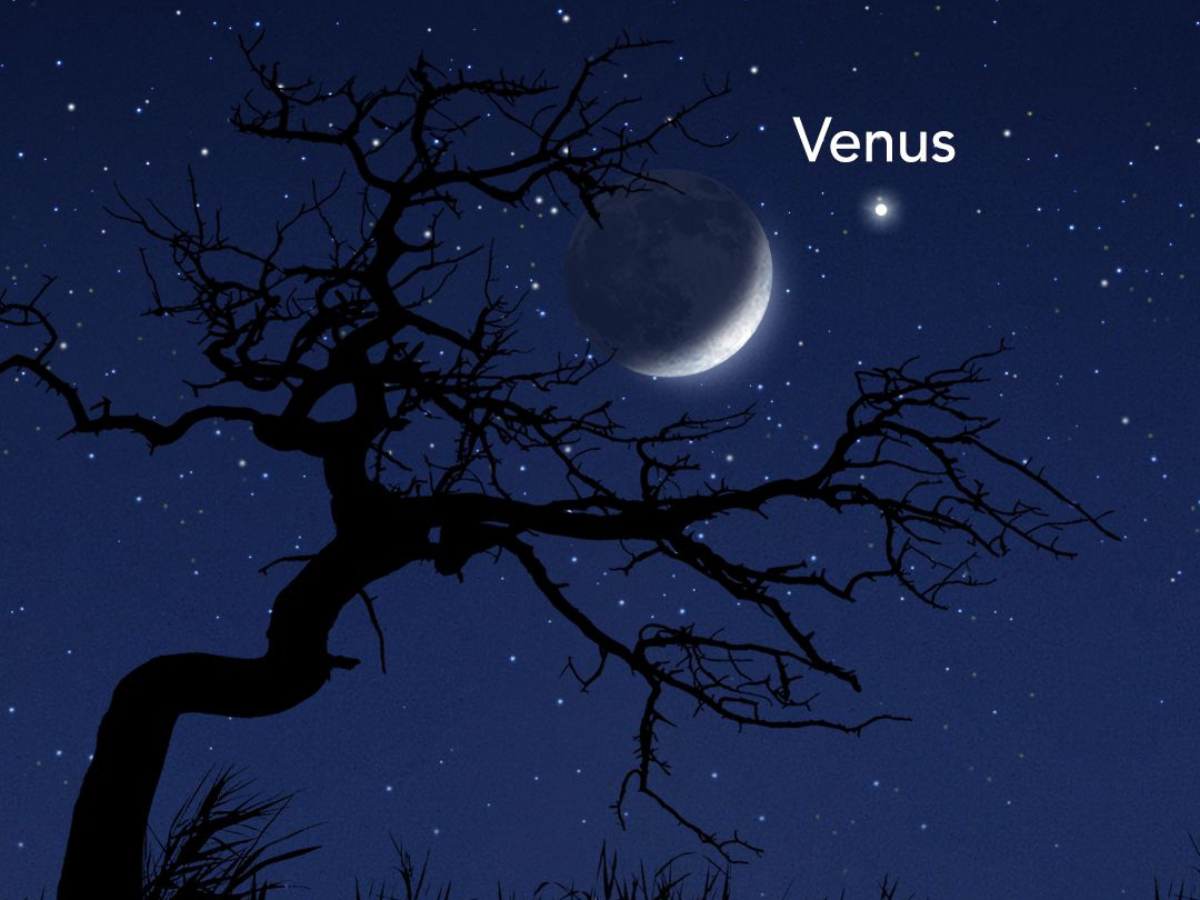
In astronomy, the labels “morning star” and “evening star” refers not to fixed stars but to planets that appear bright in the sky just before the sunrise or just after sunset. These terms are poetic but also rooted in observational history when a planet is visible in the eastern sky before dawn it’s called as a morning star.
When it shines in the western sky shortly after sunset it becomes an evening star. These shifts are caused by the planet’s position relative to Earth and the Sun.
How it Began with Venus?
Venus was the first and most famous object hailed as both morning and evening stars with its brilliance and proximity to the Sun make it stand out at twilight.
The ancient sky watchers noticed Venus disappearing in daylight, then reappearing in pre-dawn light at other times it would linger after sunset because Venus lies inside Earth’s orbit (closer to the Sun than we are), it alternates between these roles periodically. Its magnitude is steady glow and lack of twinkling distinguish it from the stars and made it the archetype for these terms.
ALSO READ: Why Are Eyes Different Colours? Exploring the Science Behind Genetics & Light
When an Evening Star is Branded as a Morning Star?
A planet’s classification can shift when Venus moves from one side of the Sun relative to Earth and it transitions from being seen after sunset (evening star) to before sunrise (morning star). This transition involves passing through a conjunction either inferior (planet between Earth and Sun) or superior (planet beyond the Sun).
The timing of that shift depends on orbital mechanics and relative motion and the evening star of today may very well become tomorrow’s morning star.
No Double Meaning for the Inner Planets
Inner planets, Mercury and Venus are special because their orbits lie within Earth’s and they are never seen far from the Sun. This restricts their appearance to twilight periods and they oscillate between morning and evening roles but they never appear high in the sky throughout the night like outer planets can. That is why Mercury and Venus historically had dual mythological names one for their appearance at dawn and another for dusk.
ALSO READ: Astrophotography Telescopes: How to Shoot the Moon, Planets & Nebulae
What is a Celestial Racetrack?
To visualize the motion, imagine the planets racing on circular tracks around the Sun with Earth as one of the racers and Earth orbits overtakes or falls behind inner planets, changing the alignment of Sun, Earth and the planet in question.
This moving geometry determines when a planet appears before dawn or after dusk. When Earth passes a planet’s orbital path or when the planet swings around the Sun’s far side we observe significant changes in the planet’s visibility timing.
How transition at opposition?
For outer superior planets such as Mars, Jupiter, Saturn another event matters is opposition when Earth is directly between the planet and the Sun. The planet rises at sunset and sets at sunrise before opposition it behaves as a morning star and after opposition as an evening star (or vice versa depending on orbital phase). The opposition represents a turning point in visibility, brightness and in the role the planet plays in our sky.
What is a Change in Venue?
Change in venue is a metaphorical way to describe when a planet switches its celestial stage from the morning sky to the evening sky or vice versa. This switch is a consequence of orbital geometry, elongation the planet’s angle away from the Sun as seen from Earth and conjunctions.
When planets pass through those special alignments, observers note that the planet has moved venue it is now to be seen in different hours of the night or day fulfilling the mysterious but ancient names of morning and evening stars.
ALSO READ: Oxygen Generation for Astronauts in Zero Gravity: The Science Behind
Disclaimer: This article is for educational purposes only and is based on astronomical observations; interpretations may vary by context or celestial timing.