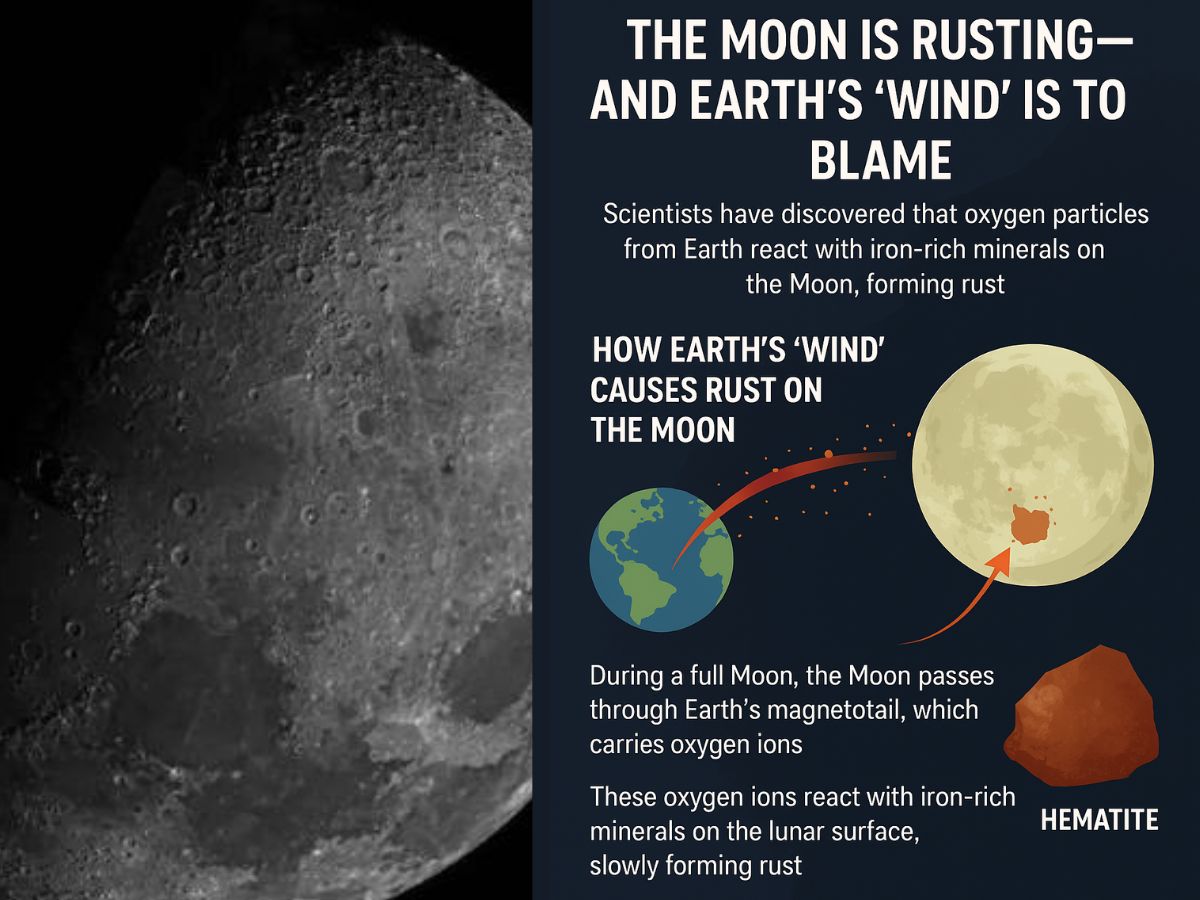
Recent research has revealed that the Moon is experiencing rust formation on its surface. Rust, scientifically called hematite, forms when iron reacts with oxygen. This discovery surprised scientists because the Moon lacks liquid water and an atmosphere, conditions normally necessary for rust to form. Scientists discover that oxygen ions from Earth travel through space, reacting with iron on the Moon to form rust, revealing new insights into lunar surface evolution.
How Earth’s ‘Wind’ Causes Rust on the Moon
The key to this phenomenon lies in Earth’s magnetosphere. The Earth’s magnetic tail, known as the magnetotail, extends into space and carries oxygen ions from Earth’s upper atmosphere.
-
When the Moon passes through this magnetotail about five days each month near the full Moon these oxygen ions reach its surface.
-
During this period, the Moon is shielded from the solar wind, which normally would prevent oxidation.
-
The oxygen ions react with iron-rich minerals on the lunar surface, slowly forming hematite.
This process is sometimes referred to as Earth wind, showing a subtle yet direct chemical interaction between Earth and its satellite.
Role of Water and Lunar Minerals
Although the Moon lacks abundant water, small amounts of water molecules or hydroxyl groups exist in lunar ice deposits or surface minerals. These molecules assist the oxidation process, making the formation of hematite possible.
Laboratory simulations confirm that iron-rich minerals exposed to oxygen ions in lunar-like conditions can rust over time, supporting the Earth-origin oxygen hypothesis.
Also Read: Apple State of India: Which State Tops the Country in Apple Cultivation?
Implications of the Moon Rusting
The discovery of rust on the Moon has significant scientific implications:
-
Planetary Interaction: It reveals a chemical connection between Earth and the Moon, showing how celestial bodies influence each other.
-
Lunar Surface Evolution: Rust presence provides new insights into the Moon’s surface changes over time.
-
Future Lunar Missions: Understanding lunar rust can help engineers design equipment and habitats that withstand oxidation on the Moon.
The Moon’s rusting highlights the complex interconnectedness of celestial bodies. Oxygen ions from Earth traveling through space show that even seemingly distant planets and satellites can influence each other chemically, opening new avenues for lunar research and space exploration.
Also Read: Which City Ranks Fifth in the Global Top 100 Food Cities List?