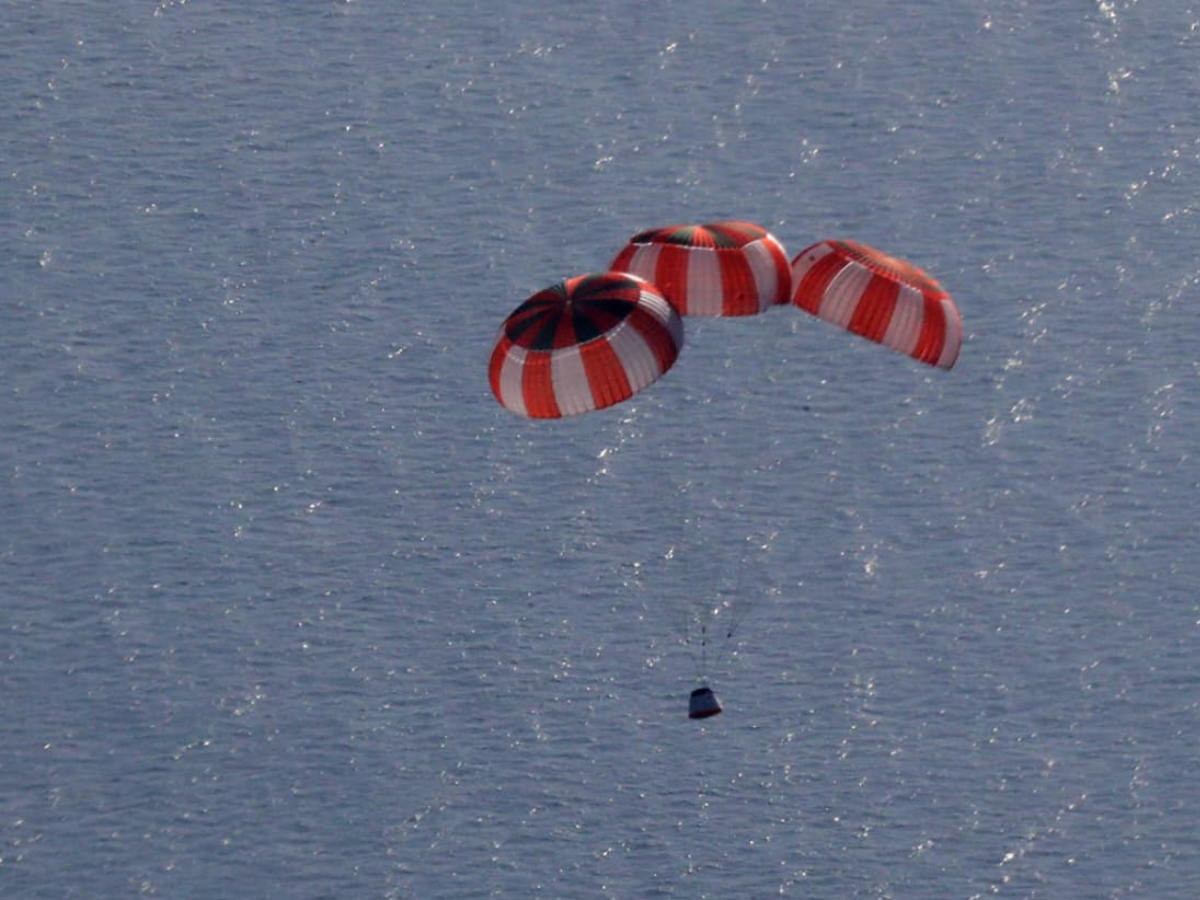
India’s ambitious Gaganyaan mission has now moved into a more cohesive phase, with the Indian Space Research Organisation (ISRO) passing another critical milestone the first Integrated Air Drop Test (IADT-01) for the overall Gaganyaan mission.
The critical test verified the parachute deceleration system, which is a lifesaving mechanism for safe return to Earth from space for astronauts. The test was conducted in close collaboration with IAF, DRDO, Indian Navy and Coast Guard and significant strides made today in India’s journey towards sending humans into space.
ISRO successfully accomplishes first Integrated Air Drop Test (IADT-01) for end to end demonstration of parachute based deceleration system for Gaganyaan missions. This test is a joint effort of ISRO, Indian Air Force, DRDO,Indian Navy and Indian Coast Guard pic.twitter.com/FGaAa1Ql6o
— ISRO (@isro) August 24, 2025
ALSO READ: From Aryabhata to Aditya-L1: Celebrating ISRO’s Global Space Leadership
Testing out India’s Return to Earth Safety Systems
IADT showed how the parachute system would work under real conditions, ensuring astronauts could safely re-enter Earth’s atmosphere.
End to end conditions were simulated, thereby validating that ISRO does not have a theoretical recovery strategy for crew but one that stands the tests of reality. This is important because both re-entry and landing are the riskiest phases of human spaceflight.
Gaganyaan Uncrewed Mission this December
The G1 test flight of Gaganyaan will be launched in December, announced ISRO Chairman V. Narayanan. The first unmanned mission of Gaganyaan will carry Vyommitra, a half-human robot that mimics physiological human sensations in space. Narayanan said that almost 80 percent testing had already been completed with more than 7,700 trials carried out. The remaining are expected to come to a close in March next year when it completes 2,300.
ALSO READ: AI’s Privacy Blindspot: What Grok’s Data Leak Means for Users
Union Minister Jitendra Singh reiterated that major milestones had been achieved from the Human Rated Launch Vehicle (HLVM3) developments to the propulsion systems being tested for both crew and service modules. Establishment of facilities such as the Gaganyaan Control Centre, crew training modules and recovery operations is already completed. Additional precursor missions including CES and TV-D1 have also strengthened confidence regarding the mission’s readiness.
Gaganyaan Aside
While that first uncrewed Gaganyaan mission is just around the corner, India’s ambitions extend well beyond that point. That timeline includes the first crewed spaceflight in 2027, a lunar mission called Chandrayaan-4 in 2028, and one to Venus shortly thereafter. It’s also hoped that the Bharat Antariksh Station will be established by 2035 and that an Indian astronaut will set foot on the moon by the year 2040 big talk, but indicative of the nation’s growing aspirations in space.
In a Press conference at New Delhi, ISRO Chairman V. Narayanan said Gaganyaan is progressing well, as 80% of tests, or around seven thousand 700 tests have been conducted so far.
He added that the remaining two thousand 300 tests are expected to be completed by March next year.
Success IADT-01 is not only a technical victory but also a symbolic victory for modern India with respect to global exploration in space. It shows the preparation of the country to move from robotic exploration to human spaceflight. Indeed, in Gaganyaan, India is entering an elite spacefaring club and, at the same time, demonstrating that the modern Indian vision extends well beyond the orbit of this planet.
ALSO READ: NASA Reveals Stunning Image of a Giant Cosmic Hand in Space