
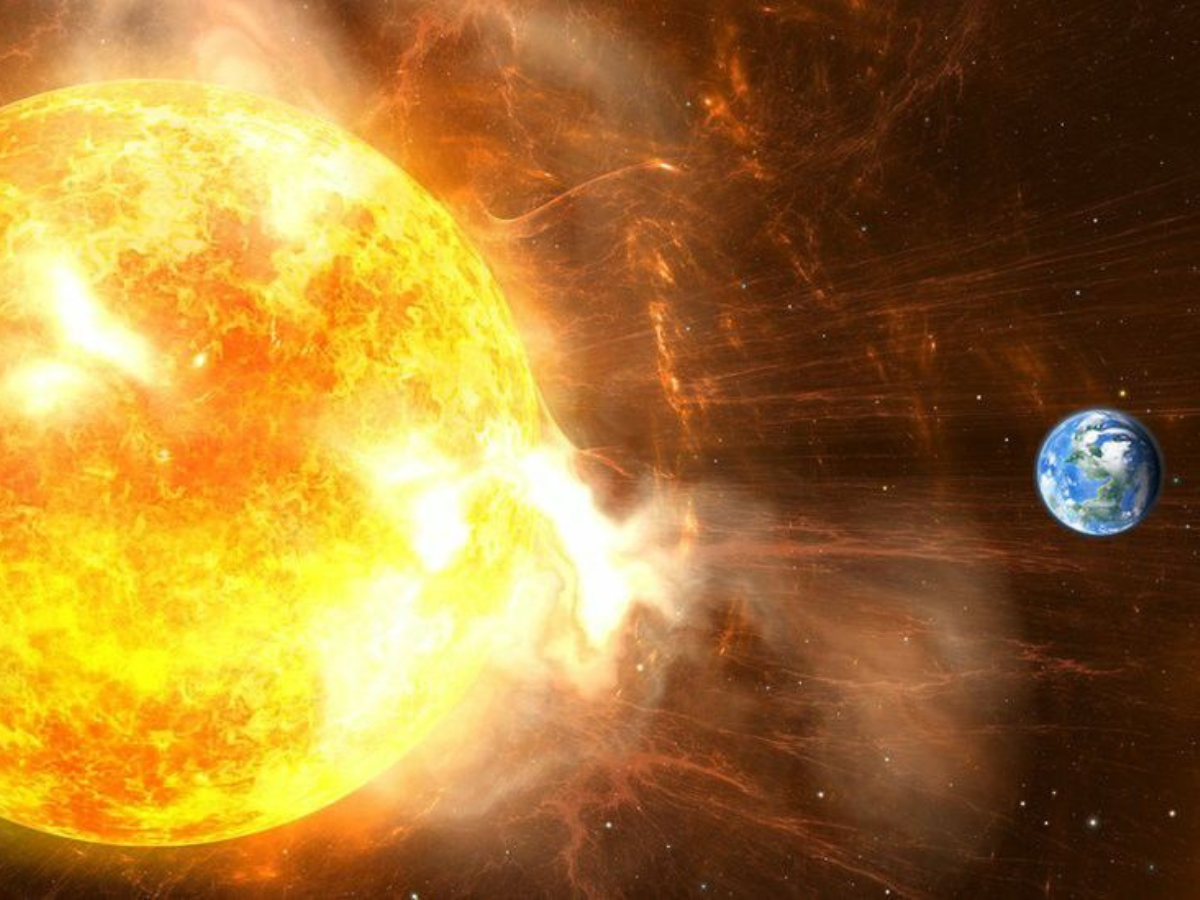
The solar eruption was detected on October 21 on the Sun’s far side. It was so explosive that shockwaves raced through the solar system. The CME slammed into Venus, striking the planet with a storm of charged particles. This was not an ordinary solar outburst experts say it was one of the fastest and most energetic of the current solar cycle.
How is the Blast Faster than Nearly Anything before
From Initial readings obtained through the U.S. Air Force, Type II radio bursts were recorded that indicated the CME was moving at almost 2,474 km/s an astonishing velocity that qualifies among the rarest and most violent CV solar explosions ever documented. Only a handful of instances recorded in history like the 1972 solar storm that disabled naval mines and the 2017 X8 class flare have exceeded this speed.
NASA’s simulations from the Moon to Mars Space Weather Analysis Office later proposed a toned-down number of 1,320 km/s, which still qualifies that as a formidable storm under any standard.
Venus Takes the Hit
NASA’s ENLIL model of space weather followed the trajectory of the shock wave and while it spared the Earth, Venus was right in the line of the solar explosion. Venus has no magnetic shield to divert incoming plasma the upper atmosphere might have been subjected to brief erosion whereby solar particles stripped ions from the clouds. Scientists argue that these types of interactions between Venus and CMEs could act as windows into how solar radiation affects planets that lack magnetic protection and even how much of the early Earth atmosphere may have evolved.
Return of AR4246: A Volatile Solar Region
The eruption originated from the remnants of sunspot AR4246, a very active and unstable region that had just rotated out of the view of Earth. Before disappearing from charts, it had produced a few smaller CMEs facing Earth that caused minor auroras at higher latitudes.
ALSO READ: Meta Lays Off 600 AI Employees Amid $14.3B Push Toward Superintelligence
Experts are warning that the complex magnetic structure of AR4246 could trigger more eruptions once it rotates back into Earth view in early November unleashing more solar storms in Earth’s direction.
Approaching Solar Maximum: A Time for Vigilance
As the Sun approaches the maximum point of Solar Cycle 25 expected around late 2025 it will be the time of reckoning for scientists as they expect to witness increasing numbers of solar eruptions with rising intensity. Agencies like NASA, NOAA and the US Space Force continuously watch over solar dynamics using missions like the PUNCH and SOHO to track CMEs in real-time.
While this latest outburst posed no threat to the Earth, it reaffirms that our star is anything but quiet and the next eruption could put our planet’s mettle against the paramour of space weather.
ALSO READ: Scientists Unveil Mysterious ‘Interstellar Tunnel’ Linking Our Solar System to Distant
Disclaimer: This article summarizes verified space-weather data and expert analysis. No claims beyond scientific observation are presented.