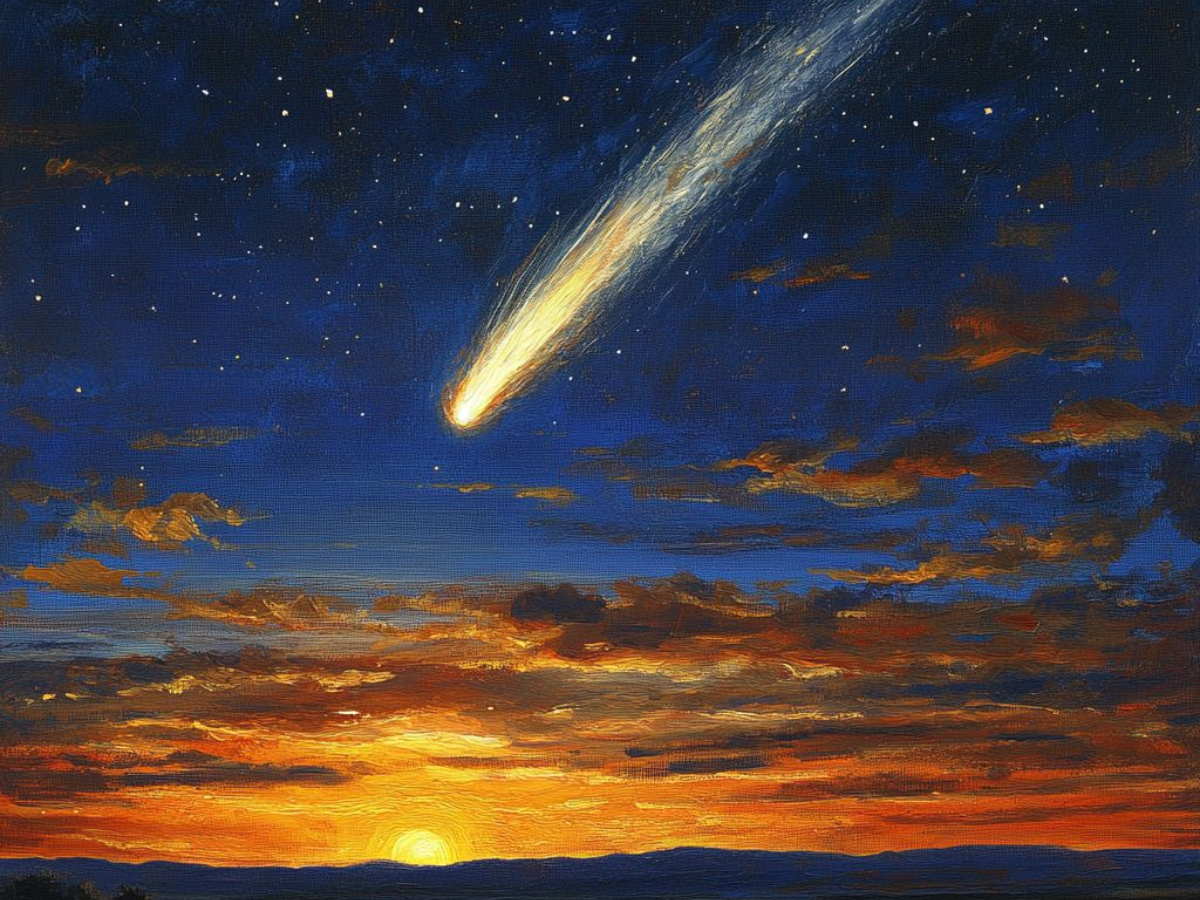
Comets are those impressive icy visitors to our skies, and which come from two major distant reservoirs from where the solar system is concerned.
Where Do Comets Come From?
The first is the Kuiper Belt a very large, donut shaped region beyond Neptune’s orbit. Innumerable small, icy bodies reside within it, including the short-period comets, whose orbits around the Sun are completed in less than 200 years.
Its discovery in 1992, when astronomers David Jewitt and Jane Luu have identified 1992 QB1, confirmed that the Kuiper Belt exists. This zone was postulated as a theory about decades earlier by Kenneth Edgeworth however, that region still challenges scientists because it offers hints at formative clues of the early solar system.
From Where Does Oort Cloud Lie Over the Kuiper Belt?
The Oort Cloud exists beyond the Kuiper Belt tens of thousands of kilometers and enshrouds the solar system by a region that is spherical. Long-period comets would reside in the Oort Cloud those comets that have orbits extending for thousands and in some cases hundreds of thousands of years.
ALSO READ: CO2 Rich Planet Birth Disk Detected 5,545 Light Years Away by NASA’s James Webb Telescope
They are beyond arm’s reach and are known in their state of near total darkness and extreme cold and waiting for a gravitational disturbance to send them tumbling into the inner solar system.
What Brings Comets Near Earth So We Can See Them?
Comets do not just wander inward on their own but are carried by dynamic changes that occur in their courses under the force of gravity. When a passing star or even a bulkily huge Jupiter or Neptune, a comet’s orbit is tugged somewhere that pulls it from some a distance toward the Sun. The gravitational interaction would be an orbit long and elliptical that drew comets closer toward Earth and the inner solar system.
The cosmic snowballs speed up as they approach the Sun, up to the point where they swing around behind it and then tumble back toward their origins. Some fly their way into the Sun and vaporize completely. They are also often visible to us and light the night sky with their characteristic glow and tails.
What Are the Parts of a Comet?
A comet is at its core anchored by the nucleus, which is a solid, icy body generally less than 10 miles (16 kilometers) wide and making it comparable in size to a small town. This nucleus is a mixture of frozen gases, dust and rock which are the remnants of that earliest portion of the solar system.
ALSO READ: NASA’s Bennu Asteroid Reveals Stardust Older Than the Sun, Revealing Early Solar System
That nucleus is all that exists when the comet is far enough away from the Sun, but as it proceeds inward and begins to warm, the ice sublimates that is, it is turned directly from solid to gas. This throws out dust and gas, forming a vast, glowing cloud called the coma, which surrounds the nucleus often thousands of kilometers wide. The expanding gases and dust in the coma constitute the comet’s visible atmosphere, which can outshine even the nucleus itself.
Why Do Comets Have Tails?
The most recognizable part of a comet is its tail. It forms as sunlight and solar wind exert pressure on the dust and gas ejected from the coma. Comets actually develop two different types of tails. Consists of very small solid particles reflecting sunlight and are seen as white or yellowish and it is more prone to curve slightly behind the comet’s path due to inertia of particles.
Completely made of ions the charged molecules of the gases-an ion tail is bluish in color and points pretty much directly away from the Sun since it is pushed by the charged particles of the solar wind. Both tails may span millions of miles across space and Earth based observers will get a beautiful show.
What Is in Comets?
The evolution of comet composition was gradual and earlier ideas like Fred Whipple’s dirty snowball model from the 1950s pictured comets as spheres of frozen water and in which almost uniform areas of ice were mixed with dust. This helped explain their activity upon being warmed by sunlight but did not account for their fragleness and often irregularity.
Two scientists suggested on the formation and concept of what a comet is that they are rubble piles which means they are loose conglomerations of smaller icy and rocky pieces bound together by gravity. Those formed through either gravitational clumping in the protoplanetary disk of the early solar system or by the gentle collisions of materials slowly drifting inward and sticking together.
ALSO READ: The Fiery “Door to Hell”: Turkmenistan’s Burning Crater Still Alive After 50 Years
Why Do Comets Have Outbursts?
Comets display sudden brightening effects called outbursts these are really rapid and very dramatic increases in brightness because of fast release of gas and dust. One of the examples was that in 2007 when Comet 17P/Holmes increased in brightness by up to 14 magnitudes and making it visible to the naked eye after decades of being too faint.
These explosive episodes happen when some volatile substances that are trapped beneath the surface quickly vaporize under the action of sunlight penetrating cracks or structural changes in the nucleus, followed by gas and dust erupting forth, sometimes producing a temporary increase in the size and brightness of the comet.
ALSO READ: Astra Missile: India’s Silent Sky Warrior That Strikes First