
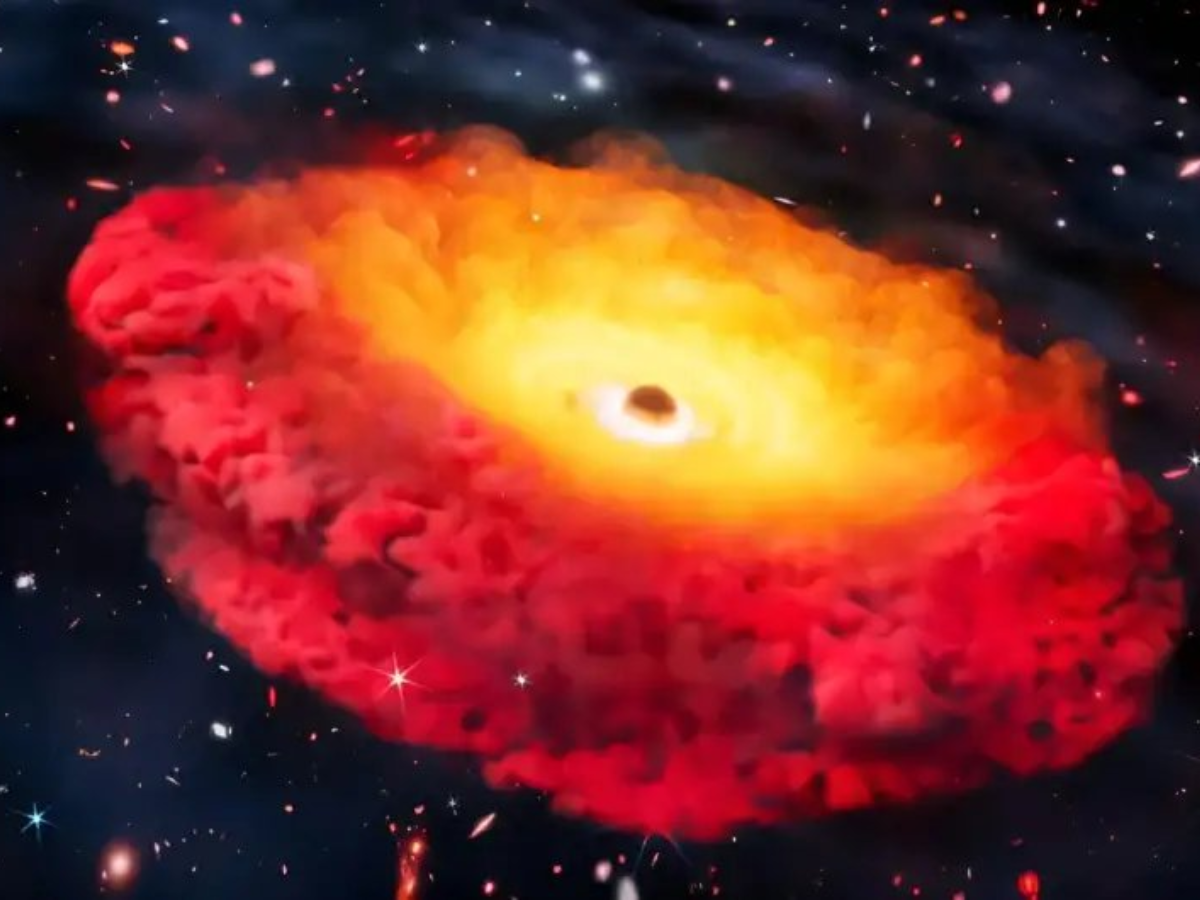
The researchers had discovered one of the rare cosmic discoveries of our time and the earliest and most distant black hole ever directly seen. Using the James Webb Space Telescope (JWST), scientists identified a supermassive black hole residing in a galaxy very young in our view the galaxy CAPERS-LRD-z9, which was formed about 13.3 billion years ago.
This suggests that it existed just 500 million years after the Big Bang when the universe itself was still a young toddler. Even more remarkable is the size the estimates put this monster anywhere between 38 million and 300 million times the mass of our Sun, a mind-boggling dimension for such an early stage in cosmic history.
The Breakthrough Discovery
CAPERS discovery reported in Astrophysical Journal Letters, comes from a JWST key project known as the CANDELS Area Prism Epoch of Reionization Survey (CAPERS). With the support of the Cosmic Frontier Center at the University of Texas at Austin and researchers employed JWST’s formidable spectroscopic capabilities to follow faint vestiges of light emitted from the ancient galaxy.
Observations traced gas swirling in streams at remarkable speeds, a hallmark signature of material spiraling inside the black hole’s accretion disk. This provided the astronomers with the final pieces of evidence needed to confirm that CAPERS-LRD-z9 hosts the oldest known supermassive black hole.
ALSO READ: Planet Y Mystery: Astronomers Detect Signs of a New Planet Beyond Neptune
Mystery of Little Red Dots
Galaxy that hosts the giant black hole belongs to a species of galaxies that astronomers refer to as Little Red Dots (LRDs). In telescope images they look like tiny glowing red dots. Their coloration comes from two basic factors.
First, there is the cosmic redshift effect that stretches light from objects that are so distant toward longer and redder wavelengths on account of the expansion of the universe.
Second, dense clouds of gas and dust obscure shorter wavelengths of light, allowing only a deep red glow to seep through. The infrared capabilities of the JWST allowed it to look through these layers and extract the hidden signatures from the light of the galaxy and ultimately exposing the black hole within it.
Why This Changes Everything
The discovery raises deep questions on how the universe’s earliest black holes formed. The traditional theories suggest black holes should grow slow over billions of years as they accrete mass. But this supermassive object existed when the universe was but a fraction of its current age. Now, scientists are debating two possible scenarios: either black holes acclimatized considerably quicker than presumed in the past, or they came from massive seeds, that is immensely large collapsed stars or dense gas clouds that formed just after the Big Bang. These two possibilities challenge traditional ideas of galaxy formation and cosmic evolution.
ALSO READ: WISPIT 2b: Astronomers Capture First Baby Planet Growing Inside a Cosmic Ring
This is more than just one remarkable find it marks a new chapter in our quest to understand the universe’s origins. As Steven Finkelstein, the director of Cosmic Frontier Center, stresses, “The discovery of Little Red Dots was a major surprise from early JWST data. Now we’re figuring out what they are and how they came to be.”
The Significance of the Discovery
The JWST will pursue the long-term survey of distant galaxies hoping to find more of these enigmatic Little Red Dots. Each find may lead to more ancient black holes providing keys to how the early universe evolved from a gas sea into the rich tapestry of galaxies and structures we see today.
For now, the black hole in CAPERS-LRD-z9 stands as both a cosmic relic and a scientific puzzle reminding us that the universe still holds mysteries so great that they can put even our most advanced theories in jeopardy.
ALSO READ: Pegasus Constellation Reveals a Cosmic Canvas of Stars, Dust and Galaxies