
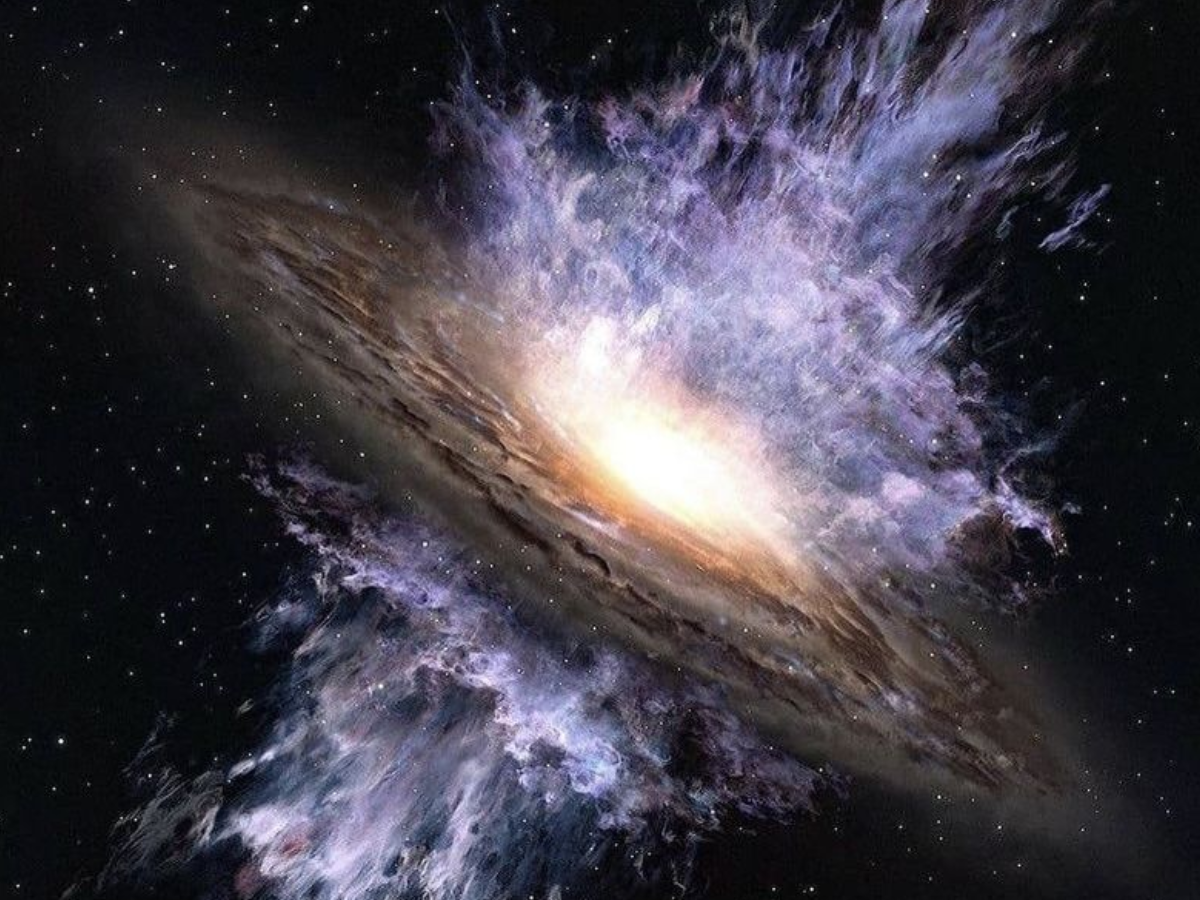
NASA’s James Webb Space Telescope (JWST) has made another monumental finding. A well-lived cosmic mystery has been revived the existence of primordial black holes, hypothetical entities that arose within the first moments following the creation of the universe.
In a recent study, to be peer-reviewed astronomers report observing what could be the oldest black hole seen so far and one that may have formed just after the Big Bang some 1 second after the event before the first stars or galaxies formed.
How is a Black Hole Without a Galaxy?
In JWST’s deep space scans, it appears as a small red dot the target is a chemical mystery called QSO1. It is not so much its age that makes this black hole so intriguing as its position it seems to exist all alone, with no galaxy accompanying it.
“This black hole is nearly naked,” said co-author of the study Roberto Maiolino, cosmologist at the University of Cambridge. How could cosmic models be challenged with galactic structures and leading to their crises being solved in stars collapsing to form black holes which gall stars to be in existence in the first place.
ALSO READ: Science of Color: How Light, Vision & Brain Create the World we See
Primordial or Something Else Entirely?
It has been said for decades that primordial black holes are ultra dense regions of subatomic matter that may have formed in the billions of years just after the completion of the cosmic history. They had solely existed in models of theoretical physics. The earlier observation by JWST showing that those surprisingly massive early galaxies hinted that there should be some such objects in existence to explain the speed of formation of galaxies made it even more compelling.
Now, the latest observation may be the most promising evidence. By using gravitational lensing, the team measured the motions of matter around QSO1, concluding that the black hole’s mass is around 50 million times that of our Sun which is an even more astonishing figure, considering that nothing around it has any proof of a galactic host.
It is even more interesting because it contains about twice the mass of the environment that immediately surrounds it an observation very different from anything seen in the modern universe and where black holes are usually much smaller than their host galaxies.
ALSO READ: NASA’s Upcoming Launch | Triple Spacecraft Missions to Decode the Sun’s influence on earth
What is Hydrogen, Helium and a Lonely Corner of the Universe?
What really marks this black hole from other black holes is the surrounding environment. According to the study, the area surrounding QSO1 contains only hydrogen and helium, the first elements of the post universal earlier forms.
Their absence from heavier elements formerly inside stars-makes this black hole likely residing in a starless and primordial void. As Maiolino explained this points to a part of the universe untouched by stellar activity and reinforcing the possibility that QSO1 is a true relic from the dawn of time.
ALSO READ: India-Japan High Speed Rail Revolution with AI-Powered Transport | From Tracks to Tech