
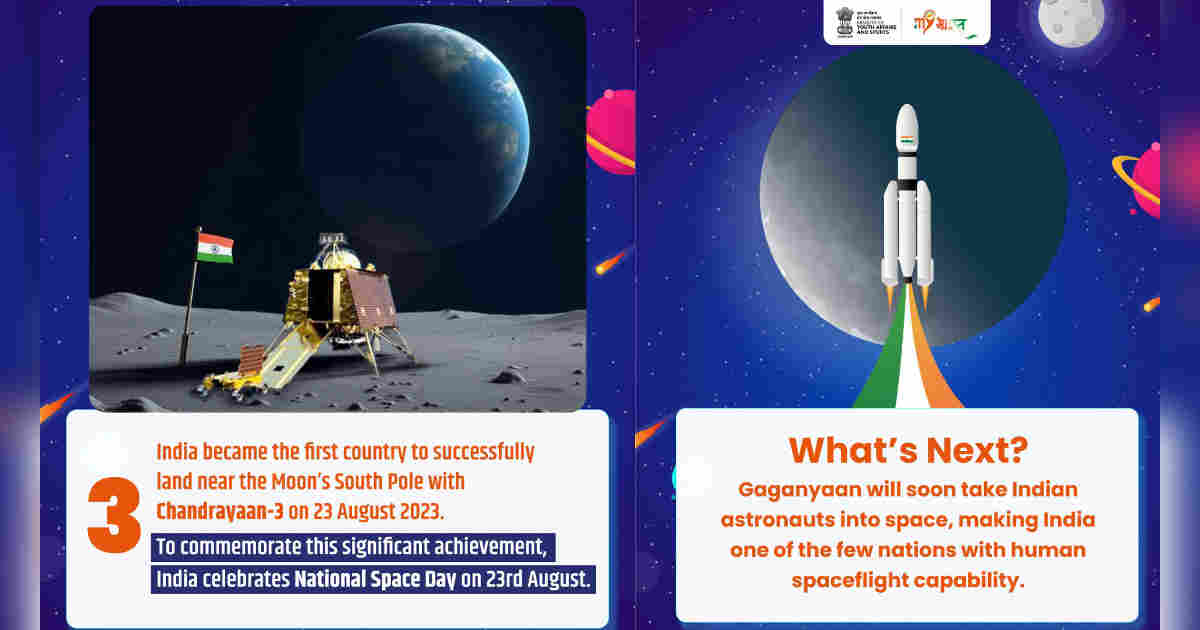
The National Council of Educational Research and Training (NCERT) has launched special educational modules highlighting India’s remarkable rise as a spacefaring nation. The modules, titled “India: A Rising Space Power”, trace the country’s journey from carrying rockets on bicycles and bullock carts in the 1960s to becoming one of the world’s most cost-effective space powers, achieving missions like Chandrayaan-3 and Aditya-L1.
Designed with photographs, diagrams, and timelines, the modules aim to make India’s space history engaging and easy to understand for students at different levels.
Evolution from INCOSPAR to ISRO
The modules explain how the Indian National Committee for Space Research (INCOSPAR), established in 1962 under Vikram Sarabhai, evolved into the Indian Space Research Organisation (ISRO). They highlight ISRO’s unique approach: “Our missions are low-cost and simple but high-tech and robust; self-reliant in most space programmes; these are synergetic and focused,” the module notes.
Celebrating Indian Astronauts
The modules pay tribute to India’s astronauts, including Squadron Leader Rakesh Sharma, the first Indian in space (1984, Soviet mission), and Group Captain Shubhanshu Shukla, who in June 2025 became the first Indian to stay aboard the International Space Station (ISS).
Key Milestones in India’s Space Programme
The modules cover early achievements such as the launch of Aryabhata (1975), India’s first satellite, and the Satellite Instructional Television Experiment (SITE), which brought television to villages across the country. These early milestones are contrasted with modern feats like Chandrayaan-3’s historic south pole landing in 2023, making India the first nation to reach that region of the Moon.
Other landmark missions highlighted include:
-
Chandrayaan-1: Discovered water molecules on the Moon.
-
Mangalyaan (2013): First Asian country to reach Mars on its maiden attempt.
-
Chandrayaan-2 (2019): Orbiter continues to provide critical lunar data.
-
Aditya-L1 (2023): India’s first solar observatory at Lagrange Point-1, studying the Sun’s outer atmosphere and solar storms.
-
NASA-ISRO NISAR (upcoming): Will scan Earth every 12 days, offering high-resolution data on ecosystems, ice cover, and natural disasters.
India’s Human Spaceflight Programme
The modules also describe Gaganyaan, India’s human spaceflight programme, aiming to send a three-member crew to a 400 km low Earth orbit for three days. Future plans include Chandrayaan-4, a Moon sample return mission, and the Bharatiya Antariksh Station (BAS), approved in 2024, which will serve as India’s own space station for long-duration missions and microgravity research.
Also Read: India Eyes Deep Space Glory: ISRO Plans Moon Sample Mission and Bharatiya Antriksh Station
India as a Global Space Service Provider
The modules highlight India’s growing role as a global space services hub. ISRO has completed 131 spacecraft missions and 101 launch missions, including the launch of over 430 foreign satellites from 35 countries, earning a reputation for reliability and cost efficiency.
Space Applications Impacting Daily Life
India’s space programme is not limited to exploration. The modules emphasize practical applications, such as:
-
NavIC: India’s navigation system, recognized internationally for maritime use.
-
Tele-education and telemedicine.
-
Disaster management and real-time information services.
-
Weather forecasting, agriculture support, education, and health initiatives.
Future Prospects and Startups
Looking ahead, the modules note that over 200 space startups are emerging in India, collaborating with ISRO and international agencies. The government aims to capture 8% of the global space economy by 2035, leveraging this momentum to further India’s position as a leading space nation.
Also Read: When Chandrayaan-3 Made India the First to Reach the Moon’s South Pole?