
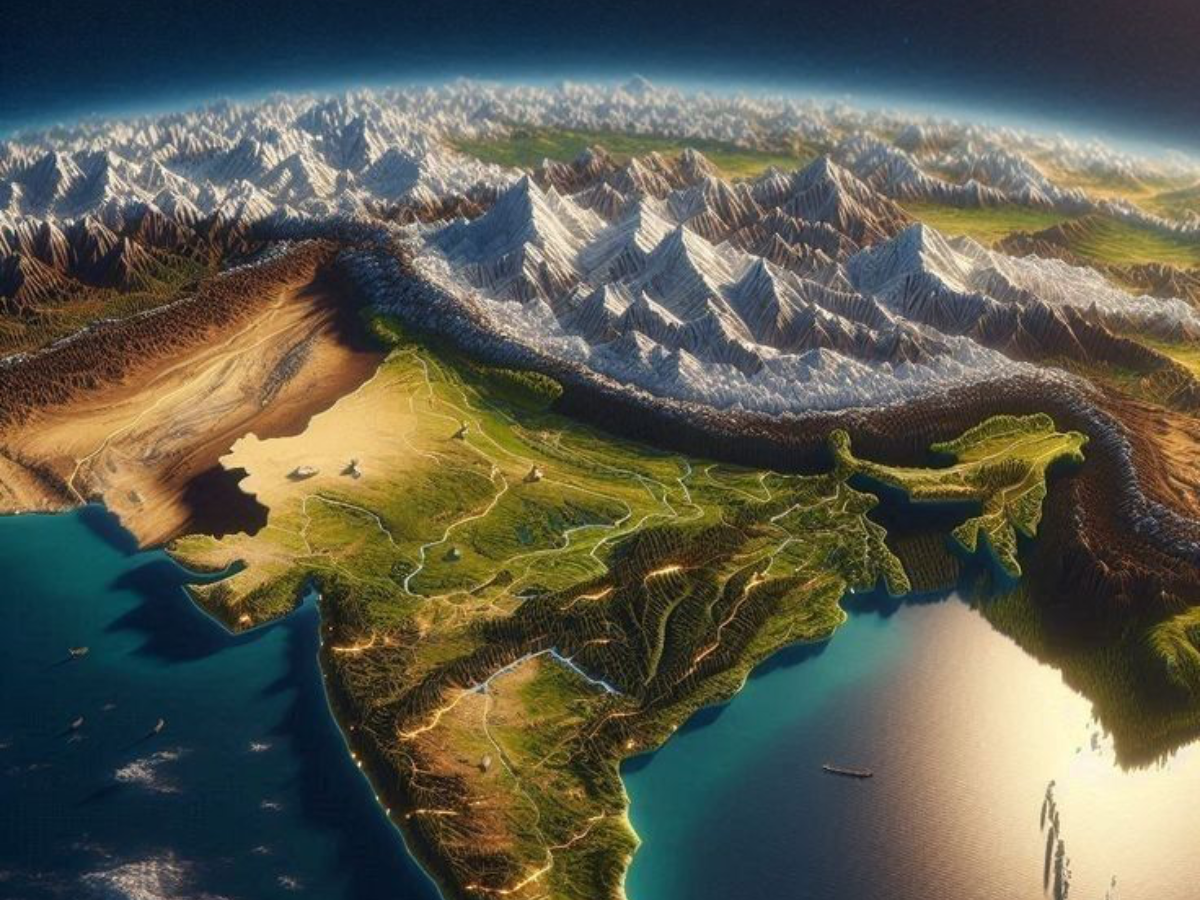
A pioneering geological study has found that the Indian Plate with the colossal piece of Earth’s crust responsible for creating the Himalayas is not acting as a single, solid mass. It is tearing and warping deep beneath the mountain range.
The new finding provides fresh insight into the titanic forces that are still shaping the Himalayas and the Tibetan Plateau, offering a more detailed picture of how Earth’s most spectacular landscapes are being sculpted beneath the surface.
How the Himalayas Were Formed
About 50 million years ago, the Indian Plate started to collide with the Eurasian Plate forming the Himalayas, a process which is still happening today. For decades, the scientific view had been that the plate moved in under the Tibetan crust in a continuous motion, in a process called subduction. New 3D seismic imaging has now revealed a decidedly more complex picture.

In the western Himalayas, the Indian Plate remains largely intact, moving steadily beneath the Tibetan crust. But in eastern regions, it is very different and dramatically so.
ALSO READ: How New Propulsion Systems Could Send Us to the Stars Without Fuel
Where the Indian Plate Is Tearing
Recent seismic data suggest that the lower part of the Indian Plate known as the lithospheric mantle, has started peeling away from the upper crust and is sinking further into the Earth. This process is called delamination and has led to the intrusion of a molten layer, an asthenospheric wedge, between the two.
The most significant deformation appears between 90° and 92° east longitude, near the Yadong-Gulu and Cona-Sangri rift zones. These regions show clear evidence of tearing, bending, and intense underground stress.
ALSO READ: NASA’s ESCAPADE Mission to Mars Set for Launch on Blue Origin’s New Glenn Rocket
What the findings mean for the region
This tearing may explain why certain parts of the Himalayas experience frequent and powerful earthquakes. It also suggests that Tibet’s base with the Tibetan lithosphere is still growing and evolving. The discovery challenges long-held assumptions that continental plates behave as rigid, unified structures during mountain formation.
A Living, Breathing Mountain Range
The Himalayas are anything but static. Every tremor, rift, and uplift tells the story of a planet still in motion. This slow-motion collision between the Indian Plate and Eurasia continues to build and reshape the world’s highest mountains not just from erosion and uplift at the surface, but through powerful tectonic processes deep within the Earth.
ALSO READ: Dharmendra Singh Deol Net Worth: Health Update & Wife Hema Malini’s Wealth
Disclaimer: This article is based on recent geological studies and seismic data; findings are subject to further research and scientific verification.