
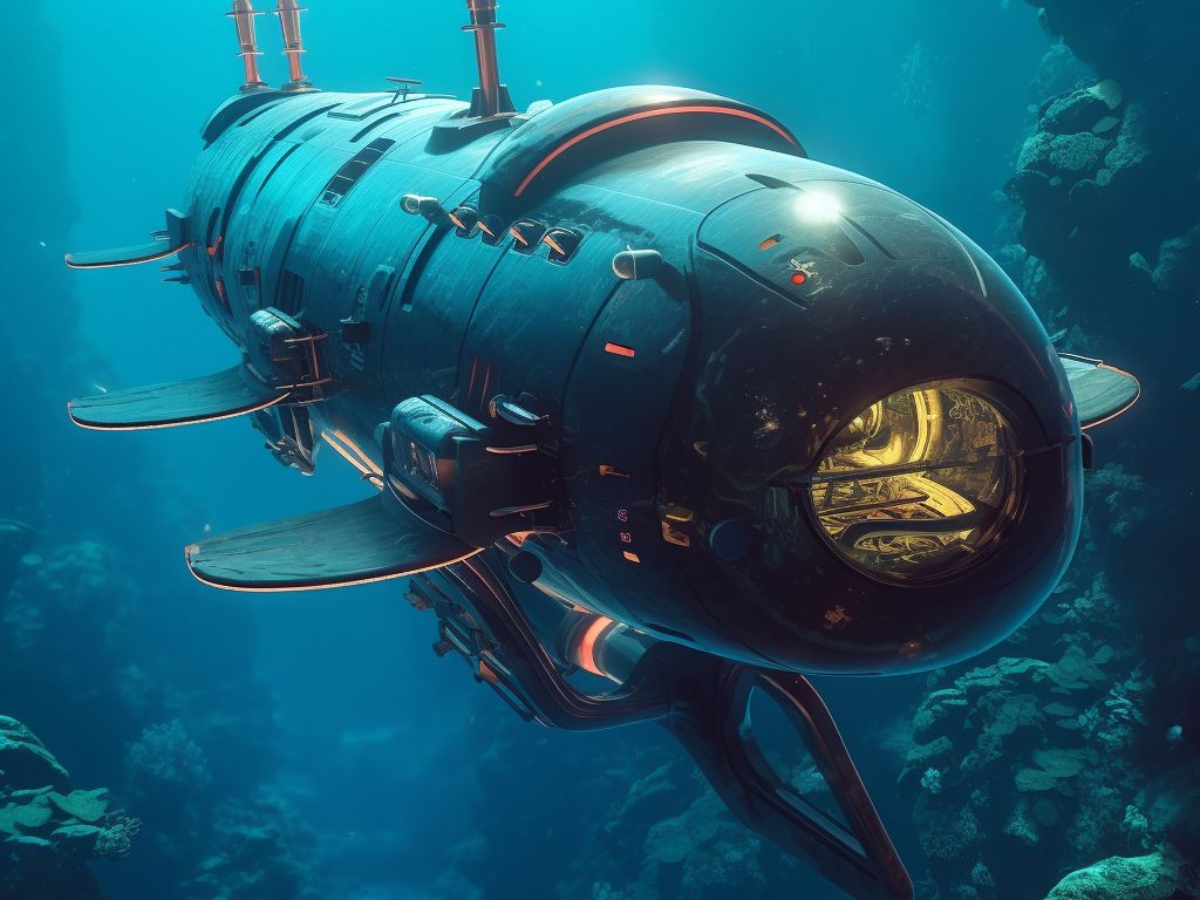
India’s deep-sea ambitions are entering a defining phase as NIOT pushes forward with the Deep Ocean Mission. The Matsya-6000, a crewed submersible designed to reach the remotest recesses of the ocean, is at the center of this effort.
Working in tandem with it scientists have now begun to explore an even more radical idea-a long-term underwater laboratory located 6,000 meters beneath the surface.
Matsya & the Road to 6,000 Meters
Matsya-6000 is designed to carry three crew members on a 12-hour journey that features a four-hour descent, four hours of deep-sea research and a four-hour ascent. After successful harbour tests, NIOT plans a human mission down to 500 meters by mid-2026. The project also includes advanced underwater robots and autonomous vehicles capable of navigating extreme ocean conditions.
India Vision for a Deep-Sea Laboratory
NIOT is now studying the possibility of building a permanent underwater research station by 2047. This laboratory would be an oceanic equivalent of the International Space Station where scientists could live, work and conduct observation of the deep ocean in real time.
ALSO READ: Google Launches Gemini 3 With Smarter Reasoning & Developer-Ready Feature
Experts say such a habitat would improve deep-sea research drastically, thus enabling immediate decision-making and experiments which could not be done through machines alone.
What are the Problems of Life at 6,000 Meters Pressure
It takes a leap in engineering to create a livable structure in total darkness, near-freezing temperatures, and crushing pressure. The lab has to have steady power, oxygen, carbon-dioxide removal, and safe docking for submersibles.
Housing researchers long-term also means addressing psychological stress, mobility restrictions and health concerns associated with such isolation. NIOT’s continuing work in autonomous systems, docking technology and underwater robotics may form the backbone of such habitats in the near future.
ALSO READ: Last Sunset of 2025: Arctic Slips Into a 64-Day Polar Night With No Sunrise
Possible Sites & Scientific Benefits
Experts identify several high-value locations for placing such a laboratory:
- Krishna-Godavari basin – 1,000 m for gas hydrates studies.
- Hydrothermal Vents (3,000 m) – for sulphide deposits and unique ecosystems.
- Central Indian Ocean (5,500 m) – for poly-metallic nodules.
A permanent lab would accelerate discoveries pertaining to tectonic science, climate processes, biodiversity, and deep-sea resources-all areas of pivotal importance for India’s future scientific and economic progress.
ALSO READ: Headless Comet? K1 ATLAS Splits Into Four Pieces as It Speeds Toward Earth
Disclaimer: This article is based on publicly available information and expert inputs. It is intended for general awareness and should not be taken as official policy guidance.