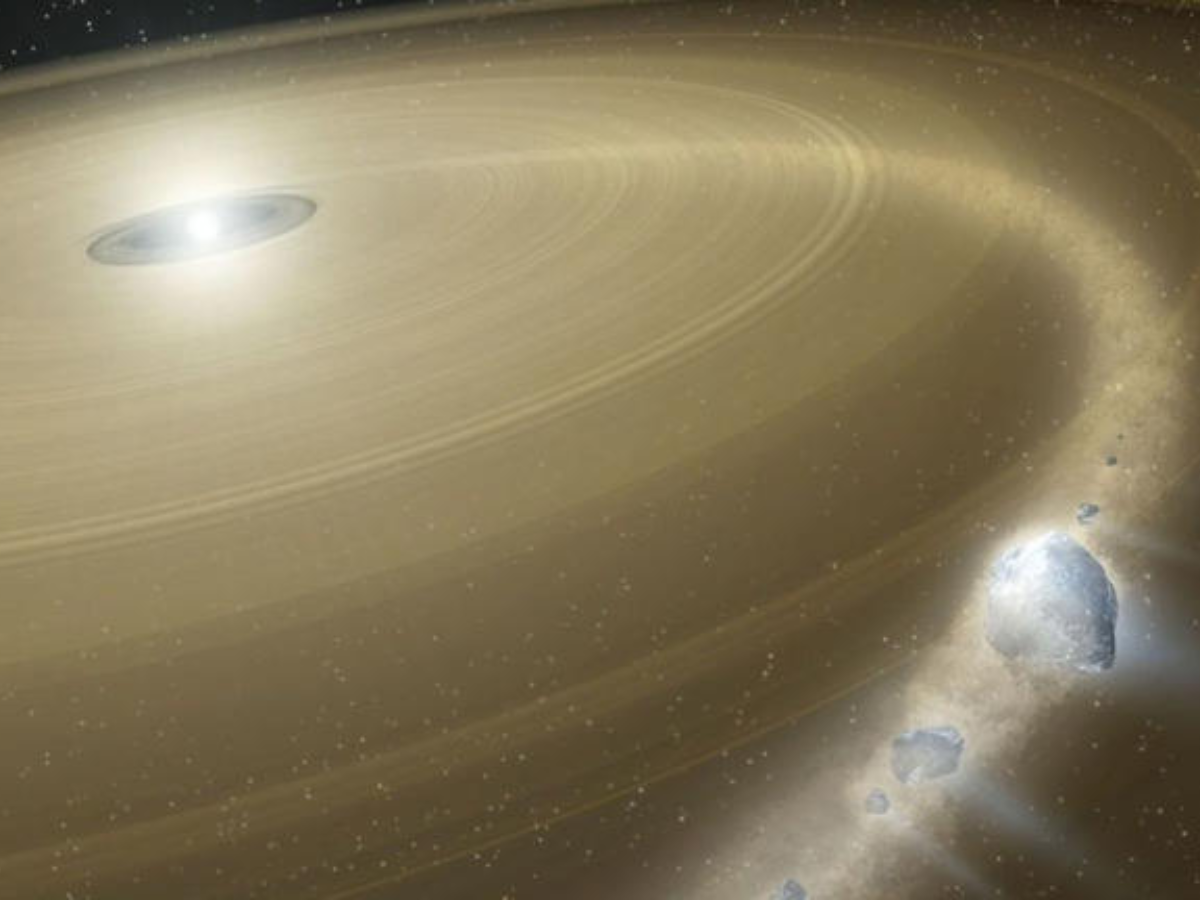
A star is similar to our Sun and nearing the end of its life after its fuel is exhausted then it collapses into a dense white dwarf supernova remnant with gravity. Recently, the astronomers have witnessed a cosmic drama about 260 light-years away with observations of a white dwarf star munching up debris from an icy body like Pluto.
What Hubble Space Telescope Sees rare Celestial Event?
The Hubble Space Telescope was instrumental in witnessing this rare event by looking at the ultraviolet light from that distant star system, scientists detected the chemical fingerprints of a shattered world’s remains.
This observation provided a perspective into the makeup of a celestial object torn apart by the white dwarf’s extreme gravitational field an event scarcely witnessed in such detail.
ALSO READ: James Webb Space Telescope Reveals Mysterious Beads & Star-Shaped Pattern in Saturn’s Atmosphere
What an Icy World Revealed?
The analysis suggests that a bulk of this destroyed object contained ice with slightly less than two-thirds of the mass in water also detected were nitrogen, oxygen and sulfur elements typically found in comets and icy bodies of our Solar System.
This discovery paints a vivid picture of the Sun’s far distant future when it is expected to become a white dwarf that might swallow icy objects at reaches of our system Pluto.
ALSO READ: NASA’s Parker Solar Probe Hits 687,000 km/h in Historic 25th Sun Flyby
What is the future role for the James Webb Telescope?
The James Webb Space Telescope in contrast to Hubble, observes infrared light, allowing the scientists to study the star and the debris around it with such a fine-detailed study, they hope to peep into the life cycles of planetary systems and gain a better perspective on how water and other necessary compounds survive or perish under the extreme conditions surrounding dying stars.
This cosmic event not only gives insight into the violent last throes of stars but also serves as a preview for the distant demise awaiting our Solar System. The continued study of such events will further our understanding of planetary evolution and the survival of water and the essence of life as we know it.
ALSO READ: Oxygen Generation for Astronauts in Zero Gravity: The Science Behind
Disclaimer: Information based on current astronomical observations; future studies may provide updated findings on white dwarf stars and planetary debris.