
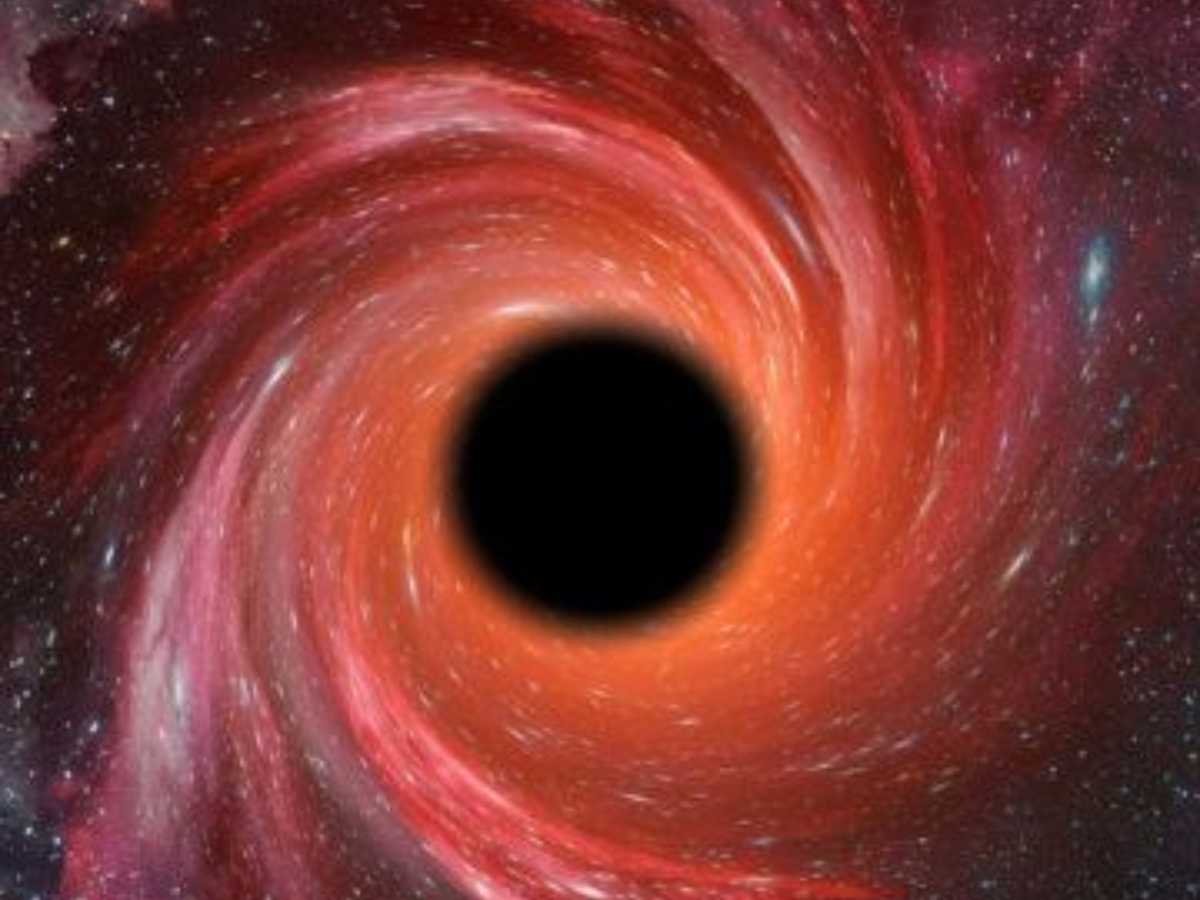
A black hole is a region of space where the gravity is strong and nothing, not even light can escape from it. This strong gravity is the result because an enormous quantity of material is compressed into an incredibly small region and normally formed when a very large star implodes towards the end of its life.
When Were Black Holes First Predicted?
The idea of the black holes goes back over two centuries, and it existed long before the phrase itself was ever used. Though we now associate them with the dark corners of the cosmos where gravity is so intense that nothing can break free, the first such indication of their existence manifested itself over nearly 240 years ago.
Even though it wasn’t until the 20th century that advances in science brought form and content into early speculation and transformed it into one of the prime focus areas of astrophysics.
Who Origin of the Name Black Hole?
Black holes appear after 1967 and it took nearly 30 years since Albert Einstein’s pioneering theories for the scientific community to finally settle upon this descriptive name. The hesitation mirrors the length of time it took for there to be a transition from prediction by theory to evidence through experience.
ALSO READ: Do the Pacific & Atlantic Oceans Really Mix: The Science Behind
What is John Michell’s Concept of Dark Stars?
The first who proposed the possibility of what we now call black holes was John Michell, an English natural philosopher and theologian. In the year 1783, with the aid of classical Newtonian physics the existence of dark stars colossal cosmic entities whose gravity could prevent light from escaping them. He laid the foundation of understanding such dark cosmic entities decades and centuries ahead of the era of modern physics.
What is the Work of Pierre Simon on Black Hole?
Michell was not alone in this early thinking, French mathematician and astronomer Pierre Simon Laplace independently theorized about massive stars whose gravity was strong enough to trap light. His ideas complemented Michell’s embedding the concept of invisible powerful objects within the scientific discourse of the 18th century.
ALSO READ: Did ‘Oumuamua Originate from an Ancient Exo-Pluto: Scientists Suggest
What is Einstein’s Prediction of the Event Horizon?
Albert Einstein’s general theory of relativity presented in 1915, was a paradigm shifter. The spacetime warped around very massive objects and creating a border that is the event horizon. This intangible surface separates the region where nothing including light can break free of the pull. Einstein’s equations therefore gave the world a theoretical explanation for the possibility of black holes as distorted spacetime regions.
How Black Holes hypothetical?
The black holes were considered hypothetical until the work presented by Roger Penrose in the year 1965 confirmed the possibility of such entities occurring through collapsing stars. This evidence contributed to the official labeling of the black hole by physicist John Wheeler in the year of 1967 with initiating broader belief and within the scientific community.
What is Cygnus X-1?
The first black hole occurred with the discovery of Cygnus X-1 in 1971. Paul Murdin and Louise Webster recognized the X-ray source as the first generally accepted black hole candidate. In the Cygnus constellation the Cygnus X-1 hosts a stellar mass black hole weighing roughly 20 times more than the Sun.
The dark entity is the blue supergiant star HDE 226868 which systematically sheds material toward the black hole and producing intense X-ray emissions observable from our planet.
ALSO READ: Why Do Some Planets Spin Clockwise: The Science Behind Retrograde Rotation