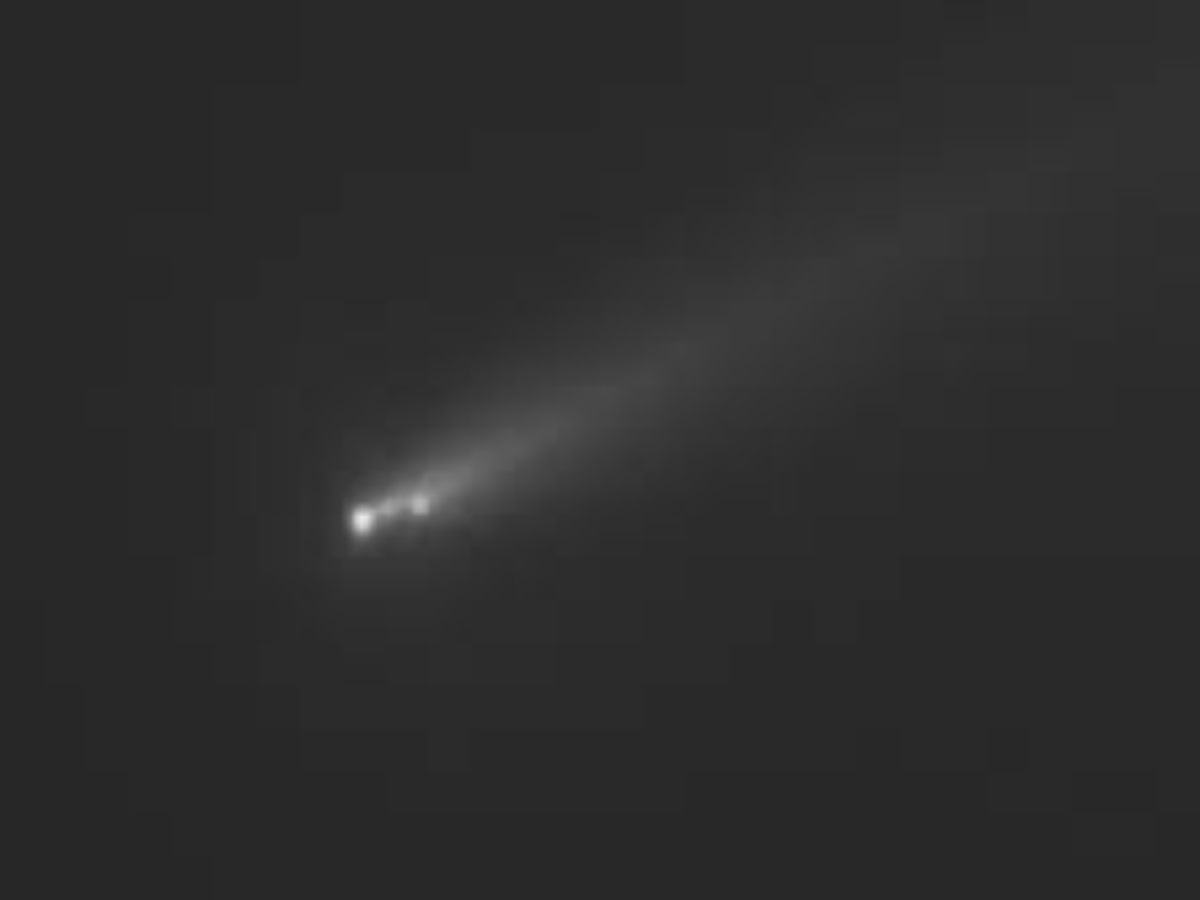
Comet C/2025 K1 ATLAS is putting on a dramatic show in the skies, but not for reasons astronomers would have wished. The “other Atlas,” once hailed for its rich golden glow, is now steadily falling apart.
Fresh observations from the Virtual Telescope Project suggest the comet has broken into as many as four fragments, raising the very real possibility that it may not survive its journey much longer.
Signs of a Crumbling Visitor
The latest image is a composite of several long-exposure frames, reveal that the nucleus is no longer stable. Given that astronomers noted two major outbursts earlier this month, images from the Hubble Telescope captured four bright pieces lodged within the surrounding coma.
These are likely fragments of internal explosions caused by its passage near intense solar radiation. If this rate of fragmentation continues, K1 ATLAS will soon become what astronomers refer to as a headless comet, wherein the disappearance of the nucleus leaves behind only a diffuse tail.
Where & When to Spot K1 ATLAS
The comet is still sufficiently bright to be observed around 2 am on the morning of the date, skywatchers can look in the direction of Ursa Major, where this 10th magnitude object climbs high. By the 20th it ought to stay above the horizon all night and provide a rare opportunity to view a comet in mid-breakup.
ALSO READ: Last Sunset of 2025: Arctic Slips Into a 64-Day Polar Night With No Sunrise
Its Close Brush With the Sun
K1 ATLAS began its journey from the far reaches of the Oort Cloud, looping inward and sweeping past the Sun on October 8. Few thought it would survive that solar encounter, considering the incredibly high temperatures and gravity at that distance.
To the surprise of many, it made it through, its brilliant golden color now reflecting sunlit radiation from the dust. But this was brief. Racing toward Earth now, astronomers watching the comet fear the nucleus may soon disappear completely, leaving just a trailing plume of dust and gas.
ALSO READ: How the Sun Escaped Its Birth Cluster: New Clues from the Solar System’s Edge
What Will Happen
It will be roughly 60 million kilometres away from the Earth by November 25, which is when the Virtual Telescope Project has a live stream scheduled for anyone hoping to learn its fate.
It’s not clear if K1 ATLAS completes its passage or breaks down into a dust tail, but the slow breakup of the comet already proves to be one of the most compelling events taking place in the skies this year.
ALSO READ: Nasa to Unveil New Images of Interstellar Comet 3I/ATLAS Entering Our Solar System
Disclaimer: This article is for informational purposes only and does not offer scientific judgment or predictions on comet stability or observational safety.