
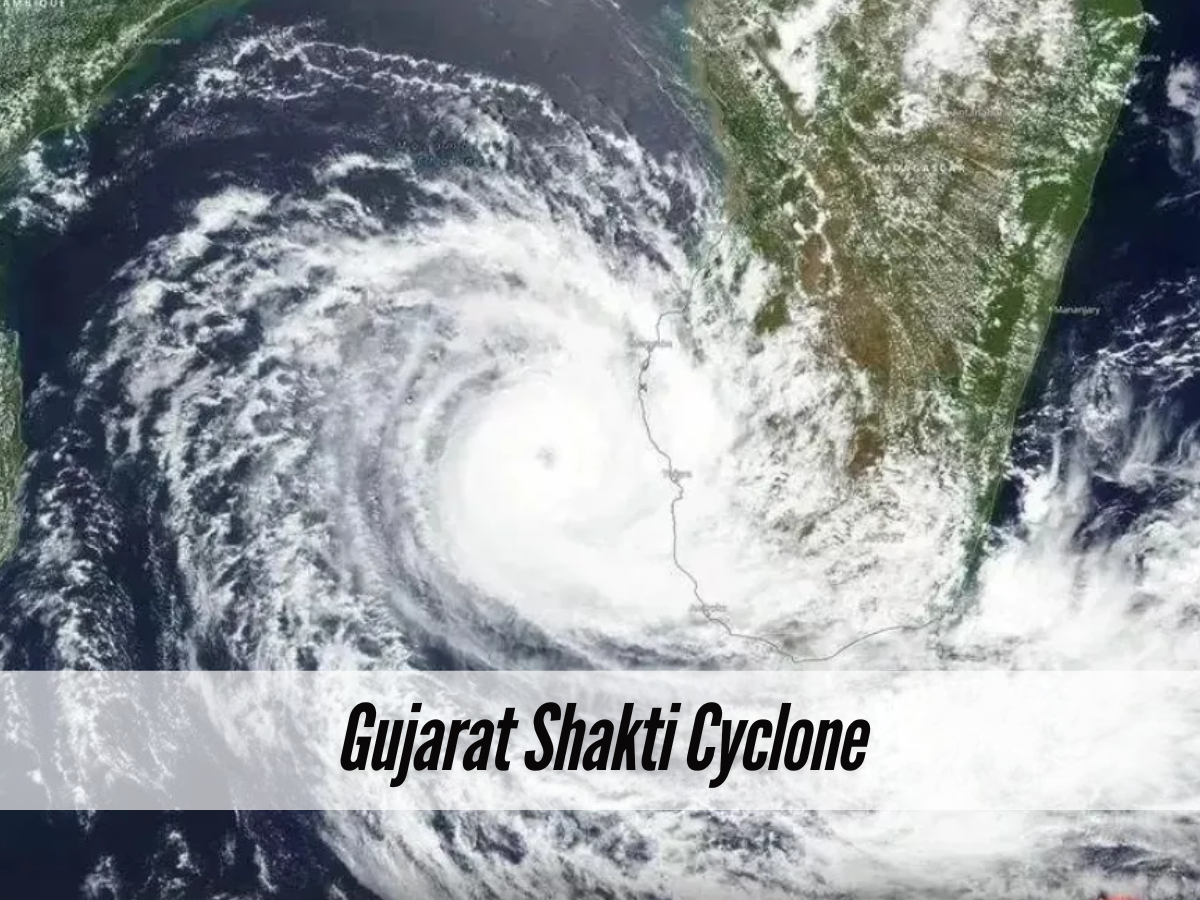
Cyclone Shakti is the season’s first severe cyclonic storm in the 2025 Arabian Sea. It developed on October 4, 2025, and intensified rapidly into a Severe Cyclonic Storm (SCS) with 130–145 km/h winds.
As of the latest reports, the India Meteorological Department (IMD) indicated that the storm was about 420 km from Dwarka, Gujarat. The cyclone presents possible dangers to coastal areas, especially along Maharashtra and Gujarat, leading officials to issue warnings and preparedness protocols.
Why Is Gujarat Cyclone Named Shakti?
The name “Shakti” was submitted by Sri Lanka under the regional naming convention for cyclones in the World Meteorological Organization (WMO) and the ESCAP Panel on Tropical Cyclones.
The word “Shakti” in Sanskrit translates to power or strength, signifying robustness and vitality. Cyclogenesis is the purposeful naming of cyclones, facilitating easier communication between authorities, the media, and residents of impending storms. The name suits the cyclone particularly well considering the ferocity of the cyclone and the possible effects it may leave.
Where Did Cyclone Shakti Develop and How Did It Form?
Shakti Cyclone developed over the east-central Arabian Sea, approximately 21°N latitude and 66.8°E longitude. The region of the Arabian Sea has conducive conditions for cyclone activity in the form of warm sea surface temperatures over 27°C, low vertical wind shear, and high atmospheric moisture.
These reasons drive the convection that is required for cyclone formation. The system initiated as low pressure, eventually gaining rotation because of the Coriolis effect. With sustained outflow in the upper troposphere, the cyclone strengthened into a Severe Cyclonic Storm.
States that might get affected by Cyclone Shakti?
Gujarat: The IMD has said that the effect on Gujarat is going to be minimal. While squally winds and rough seas are expected off the coastal areas, mass destruction is not expected. The authorities have warned fishermen not to venture out until the storm had subsided.
Maharashtra: The state has been put on red alert as a result of heavy rainfall, gusty winds, and possible flooding predicted from October 4 to 7. Coastal areas such as Mumbai, Thane, Palghar, and Raigad are likely to be worst hit by the cyclone, prompting authorities to order evacuations in low-lying and susceptible areas.
How Is India Preparing for Cyclone Shakti?
The government of India has adopted several disaster preparation strategies:
- Evacuations: The vulnerable populations along the coast in Maharashtra are being shifted to safer locations.
- Maritime Warnings: Fishing operations have been stopped along the coasts of Gujarat and Maharashtra.
- Disaster Response Teams: Emergency and relief services are at a ready state, waiting to extend help wherever necessary.
- Monitoring and Forecasting: IMD continues to monitor the progress of the cyclone, updating the situation frequently to issue warnings in time to the people and the authorities.
Cyclone Shakti emphasizes the rising trend and ferocity of intense cyclones over the Arabian Sea, primarily due to rising ocean temperatures and shifting climatic patterns. Experts stress the need for sustained research, effective early warning systems, and stringent disaster preparedness to reduce the human, economic, and environmental damage caused by such storms.