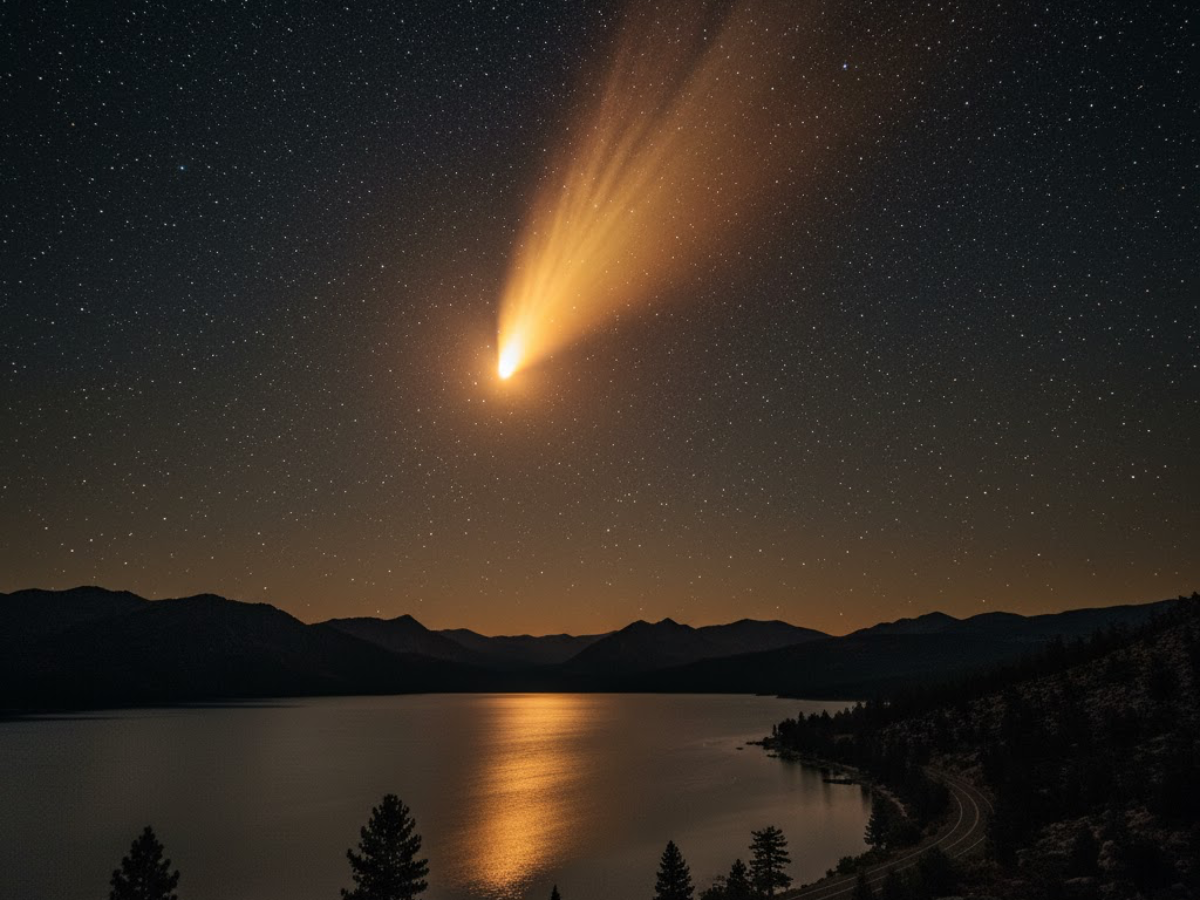
The newly discovered comet, C/2025 K1 named after the ATLAS project, has come out unscathed from its close encounter with the sun and has been transformed into this scintillating golden spectacle.
Many astronomers expected the comet to get destroyed as it approached the sun on October 8, coming within 31 million miles or 50 million kilometers. Instead, it survived and most surprisingly, it took on a striking golden hue that has captured the attention of sky enthusiasts and scientists.
Discover & Travel with Us Through Space
Discovered in May 2025 by the Asteroid Terrestrial impact Last Alert System, C/2025 K1 came with little fanfare initially. ATLAS operates telescopes in Hawaii, Chile and South Africa to scan for near Earth asteroids.
ALSO READ: What Is a Supermoon 2025? The Science Behind the Moon’s Close Approach to Earth
At the time of its emergence, other high-profile discoveries were announced including 3I/ATLAS, an interstellar comet and Comet Lemmon, currently bright enough to be seen by naked eye observers in recent weeks. Overshadowed at the time of its discovery, K1 earned new fame by surviving its precarious solar encounter.
What is the Mystery Behind Its Golden Glow
Astrophotographer Dan Bartlett, meanwhile captured this remarkable image of C/2025 K1 from June Lake, California with a brilliant, golden ribbon stretching across the night sky. Scientists say that the rare coloration is connected to the comet’s composition, which is unusual.
Whereas most comets appear in shades of green or blue because they contain abundant molecules such as dicarbon, cyanide or carbon monoxide, K1 displays an unusual lack of carbon bearing compounds altogether.
ALSO READ: ISRO’s ‘Bahubali’ Rocket Launches India’s Heaviest Satellite CMS-03
According to Lowell Observatory astronomer David Schleicher, only two other comets known have such a chemical profile. This paucity of carbon-based molecules along with its proximity to the sun, may be what gave the comet its amber brilliance.
A Celestial Show Worth Watching
Now shining at a brightness of magnitude 9, C/2025 K1 is now about as bright as 3I/ATLAS but still too dim to be visible to the naked eye. On the other hand, it’s visible with telescopes or powerful binoculars for those eager to see this cosmic survivor.
Currently, the comet lies between the constellations Virgo and Leo and is best seen just before sunrise. As it approaches its closest distance to Earth on November 25, sky enthusiasts only have until early December to witness one of modern astronomy’s rarest golden comets.
ALSO READ: NASA Faces Scrutiny Over Withheld MRO Images of Interstellar Comet 3I/ATLAS
Disclaimer: This article is based on verified astronomical observations and expert reports; interpretations reflect ongoing scientific analysis.