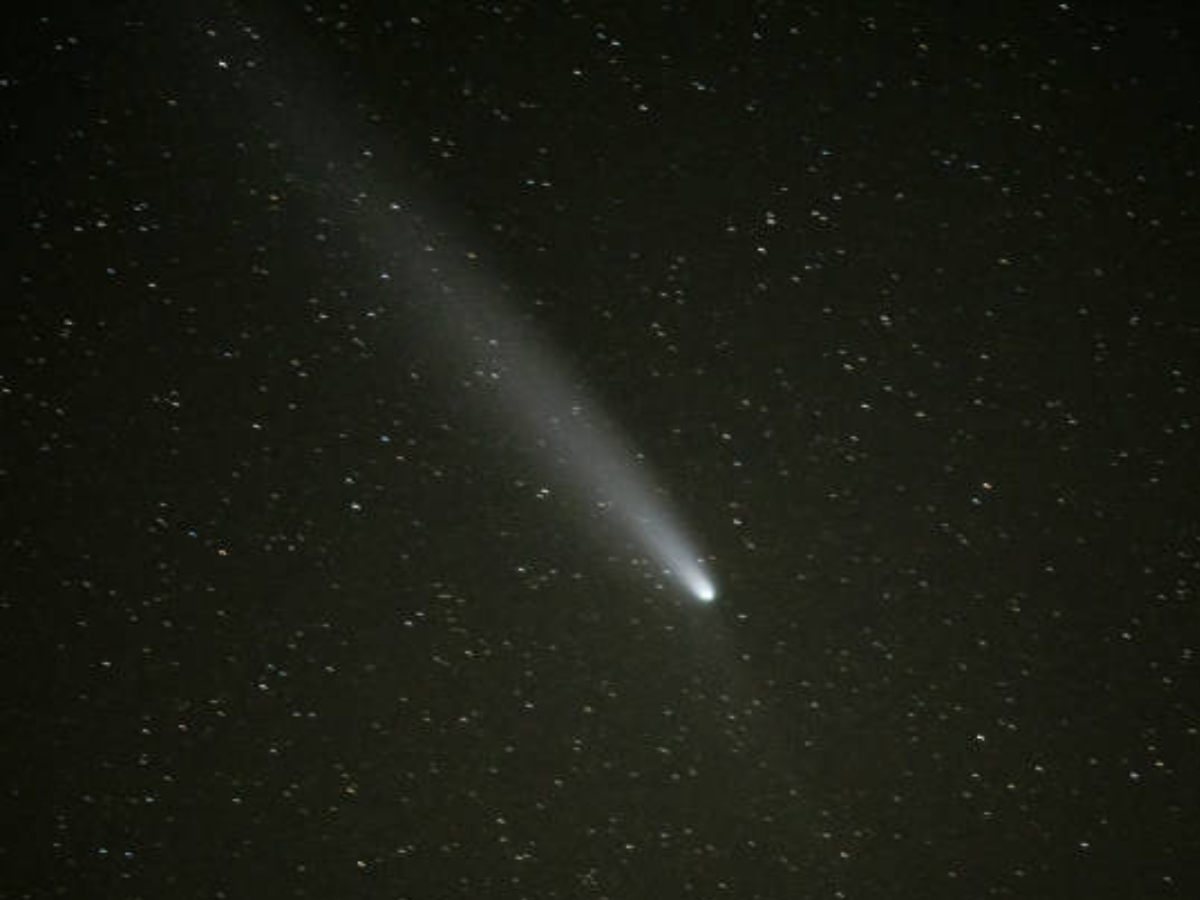
For the next few months, heaven will become a stage for one of nature’s rarest spectacles. Five comets will pass near Earth, one by one, giving much to be anticipated by the amateur and professional sky watchers. Most will require small telescopes or binoculars to see viewing, while one Comet Lemmon could become bright enough to be observed with the bare eye.
Five Visitors from Afar
The cosmic scenario will start with Comet C/2025 A6 (Lemmon) being closest to the Earth on October 21, 2025. Straight in after that, C/2025 K1 (Atlas) is expected in 24-25 November, interstellar visitor 3I/Atlas on December 18-19, thus continuing on into the year 2026 with Comet 24P/Schanmasse on January 4 and amply ending up with C/2024 E1 (Wierzchos) on February 17, 2026.
ALSO READ: From Saltwater To Electricity: Japan’s Osmotic Plant Sparks An Clean Energy Revolution
That series of occasions permits the observers to hunt down the celestial trails across the sky’s multiple times.
Reasons Why Comet Lemmon Is Special
Comet Lemmon is getting the most attention amongst the arrivals. First noticed in Arizona on January 3, 2025, it has an orbit of nearly 1,400 years. Its previous visit was in the early 7th century, and after its appearance now, it will return next in the year 3421.
Lemmon has already brightened very significantly from magnitude 16.5 to around 11 and might further brighten. Japanese comet expert Seiichi Yoshida predicts further possible brightening. If these predictions prove true, it could reach magnitude 5 or even 4 and thus become visible without aids.
ALSO READ: SpaceX Marks Milestone with Starship’s 10th Test Flight
Uncertainty Is About Its Brightness and Viewing Tips
Still, note that astronomers caution that such comets tend to be terribly unpredictable. The recent brightening may only stand for a transitory outburst, and some estimates have suggested that the brightness might peak at around magnitude 7.5 easily within reach of small telescopes, but not visible for the unaided eye.
Due to closest approach on October 21, 2025, with the perihelion on November 8, visibility it will appear after sunset, will require an unobstructed horizon.
Monitoring the Cosmic Guests
Some astronomical guides like Stellarium Web along with other sky mapping tools have already started offering charts for observation of the comets. These all require constant monitoring, since they tend to be anywhere from mildly unpredictable to wildly so.
This event is more than just noteworthy; it is an occasion for enthusiasts to view what should be a once in a lifetime cosmic alignment. Five comets will dance across our skies, setting the stage for an engaging late 2025 and early 2026 period for skywatchers all around the world.
ALSO READ: Starlink to Roll Out in India by the End of 2025, MoS Confirms