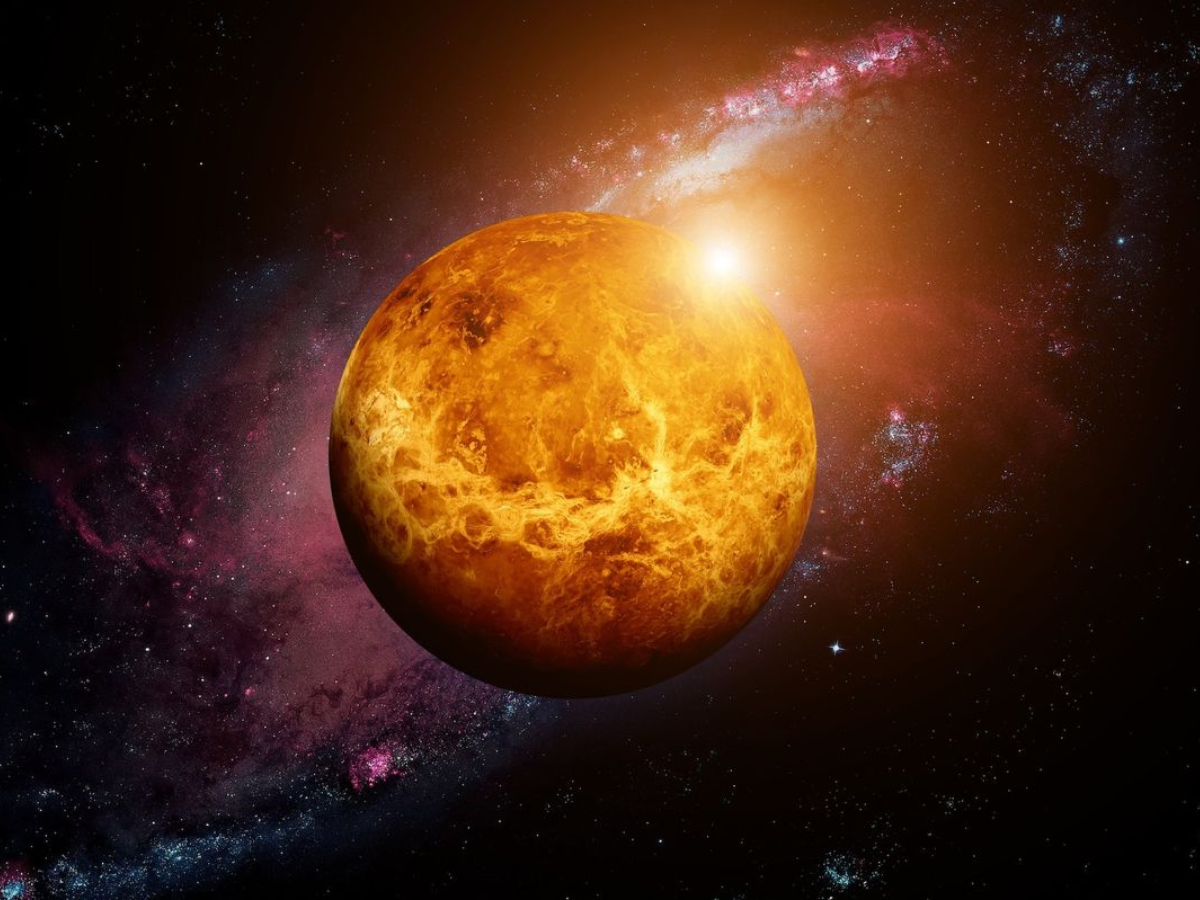
Venus has long been regarded as Earth’s volatile twin, but new science indicates it might be even more unpredictable than was believed. Fresh observations from NASA show its upper atmosphere is shifting fast.
Because of this, new concerns have been raised regarding the safety and design of upcoming missions that will head to the planet from the United States, Europe and India.
NASA’s Parker Solar: A Faster Changing Ionosphere
NASA’s Parker Solar Probe recently discovered surprise natural radio emissions during a close pass over Venus. The signals are surprisingly enough suggest that the ionosphere considered previously harsh but steady has changed a lot more rapidly than earlier models showed.
Solar activity seems to be able to expand or thin this layer within short spans, creating conditions that spacecraft designers may not be fully prepared for.
Engineering Risks for Future Missions
Spacecraft bound for Venus already have to battle temperatures in the order of 475°C, crushing pressure, and corrosive clouds. This becomes a new challenge the growing unpredictability of atmospheric density.
ALSO READ: Oort Cloud Mystery: Scientists Trace Ancient Comet Storm to a Wandering Star’s Close Call
Small changes thus far can lead to the intensification of heat build-up around incoming probes, straining heat-shield materials and shifting descent paths. Equally, scientists describe increasingly erratic cloud formations and storm movements that make entry aerobraking manoeuvres more complex than foreseen.
Venus as a Solar-Storm Early Warning
The latest findings reveal how exposed Venus is without its magnetic field to deflect solar storms. A coronal mass ejection recently slammed directly into the planet, stripping gases from the upper atmosphere. Parker captured rare, high-resolution data on how fast Venus reacts to such blasts.
With the Sun approaching its next peak in activity, researchers warn that stronger events are coming. What happens to Venus today might preview what’s waiting for Earth from future solar events: satellite disruptions and grid stress.
Why Scientists Continue Watching
Despite the increasing hazards, Venus remains key to planetary science. The forthcoming missions from NASA, namely DAVINCI and VERITAS, ESA’s EnVision mission and ISRO’s Shukrayaan, all depend on credible atmospheric modeling.
If the planet is proved more volatile, additional testing or design updates might be in store for mission teams. Even so, Venus holds vital clues to climate evolution and runaway warming offering insights that could refine Earth’s climate projections.
ALSO READ: Who Is Pearl Kapur, India’s Youngest Billionaire? Age, Career, Education, Net Worth & More
Disclaimer: This article is based on current scientific observations and does not predict mission outcomes. Details may change as new data becomes available.