
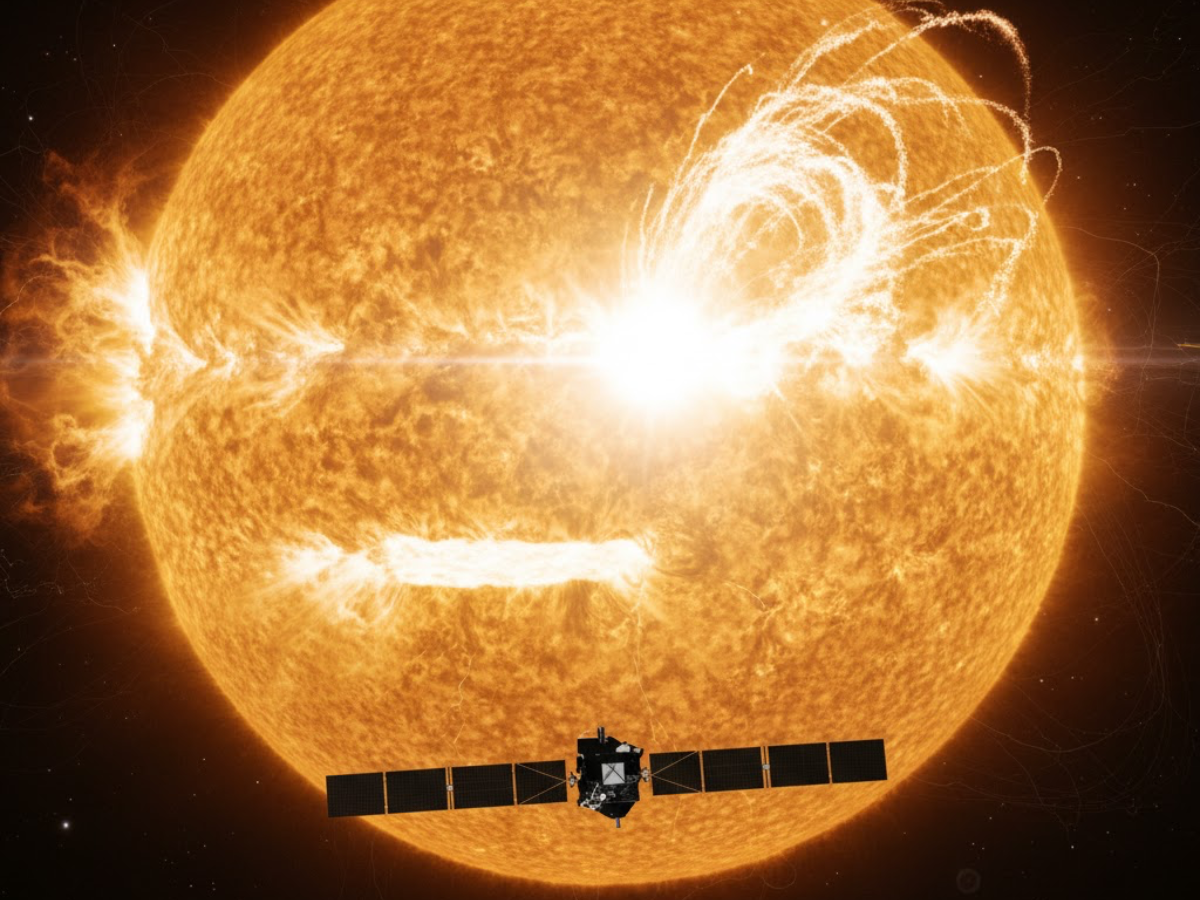
On November 11, 2025, the Sun had its most powerful solar flare of the year, an X5.1 class flare that lit up from the highly active sunspot region AR4274.
The blast is recorded at about 5 am EST today or 10:00 GMT, is the most intense flare since late 2024. Within minutes, it let loose huge bursts of energy that coursed through Earth’s upper atmosphere, briefly disrupting communications around the world.
Global Communication Disruptions
The flare caused a radio blackout rated R3 is a strong event which can impair high-frequency radio communications on the sunlit side of the Earth, centered over Africa and Europe.
Disruptions usually impact aviation routes, maritime communication and emergency networks which all use shortwave signals. Early monitoring reports indicated that several satellite and radio systems had some interference but most returned to normal within hours.
ALSO READ: Barycenter Mystery: The Hidden Point That Keeps Our Solar System in Motion | Not the Sun
What is the Cannibal CME Threat
The active region AR4274 has been unusually volatile in the last couple of days, generating several high-intensity flares including X1.7 and X1.2 class eruptions on November 9th and 10th. The earlier events generated CMEs enormous clouds of charged particles now heading toward Earth. Scientists are still checking to see whether the latest X5.1 flare also produced another Earth-facing CME.
If it does, then it may run into previous CMEs already in space and create what scientists refer to as a Cannibal CME. When CMEs merge, in some cases, this can give them extra strength, causing strong geomagnetic storms.
ALSO READ: 3I/ATLAS Shows 7 Jets: Are They Linked to Pyramids of Giza?
Geomagnetic Storms & their Possible Effects
Space weather forecasters foresee that two CMEs are likely to hit Earth’s magnetic field on November 12, probably merging beforehand. The interaction of the two could cause a G3-class geomagnetic storm that might interfere with satellite systems, navigation signals, and even parts of electrical grids.
A similar event in April 2025 produced a rare G4 class storm which caused power fluctuations and made for bright skies as far south as France.
What is the Solar Cycle 25
These powerful eruptions mark the rising peak of Solar Cycle 25 is a phase particularly noted for increased solar activity with more sunspots coming, the likelihood of strong flares and coronal mass ejections rises which requires vigilance by space agencies and infrastructure operators.
As the scientists continue to monitor the on-going activity, spectacular auroras could appear in the skies over northern latitudes the dazzling side effects of the Sun’s hot temper.
ALSO READ: NASA Study Shows Red Giant Stars Can Wipe Out Surrounding Planets