
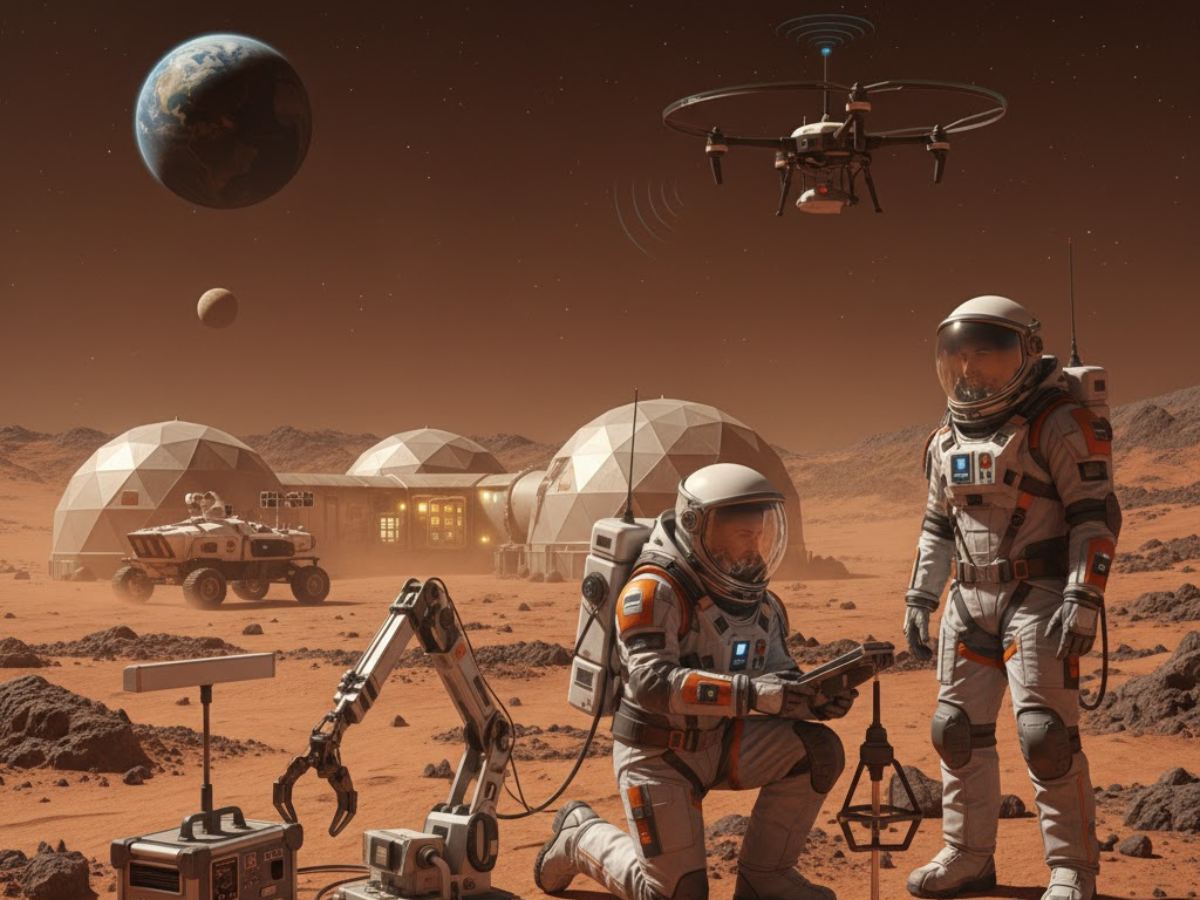
In recent evidence presented, the researchers attach some hope to the argument that microscopic remnants of life could possibly lie dormant under Mars frozen surface.
In a move away from previous beliefs regarding radiation and extreme Martian conditions, they came to know that pure water ice could preserve the traces of molecular relics of ancient organisms for many more years than this has been supposed to be the case. These are open new avenues to pursue for any future missions searching for evidence of life on the Red Planet.
Simulating Mars in the Laboratory: The Science Behind the Discovery
To test the endurance of life’s building blocks, scientists devised Mars like conditions in a controlled environment. The study encased E. coli in pure water ice and cooled the samples to −60°F, subjecting them to radiation levels simulating millions of years of cosmic exposure on Mars.
The results defied expectation more than 10 percent of the amino acids building blocks of proteins remained intact. This opens the door to the possibility that biological evidence may still exist just underneath the icy surface of Mars in areas where ancient ice is preserved, said Dr. Christopher House of Penn State.
ALSO READ: Will Aliens Arrive on October 29? Scientists Decode 3I/ATLAS
Why Pure Ice Matters More Than Soil or Rock
One of the most revelatory aspects of the study was its demonstration of how clean ice could confer protective qualities. When mixed with Martian soil or minerals, radiation induces reactive species that rapidly decompose organic material.
In solid ice alone, these damaging particles were immobilized stopping chemical destruction and clay minerals such as montmorillonite probably did not protect molecules but instead may have enhanced decay by forming thin films of water that aid in spreading radiation damage.
ALSO READ: Comet C/2025 R2 (SWAN): How to See Rare Sky Event on October 21
Implications for Future Mars Exploration
Running in the direction supported by NASA Planetary Science Division, this research will turn the scientist’s insight toward searching in ice rather than rock. Deep ice deposits are thought to have the potential to preserve delicate organic molecules for 50 million years or as opposed to soil or mineral-rich environments, where radicals and oxidants could move freely.
This period is longer than that of some Martian surface ice by estimation. In essence, if there was ever life on Mars, chemical signatures reflecting that life may still be waiting to be found and frozen in time beneath a frozen crust.
ALSO READ: Why 3I/ATLAS Is So Mysterious: Strange New Clues Detected by Four Telescopes
Disclaimer: This article is based on current scientific research and findings. Future discoveries may enhance or revise these insights about Mars and potential life.