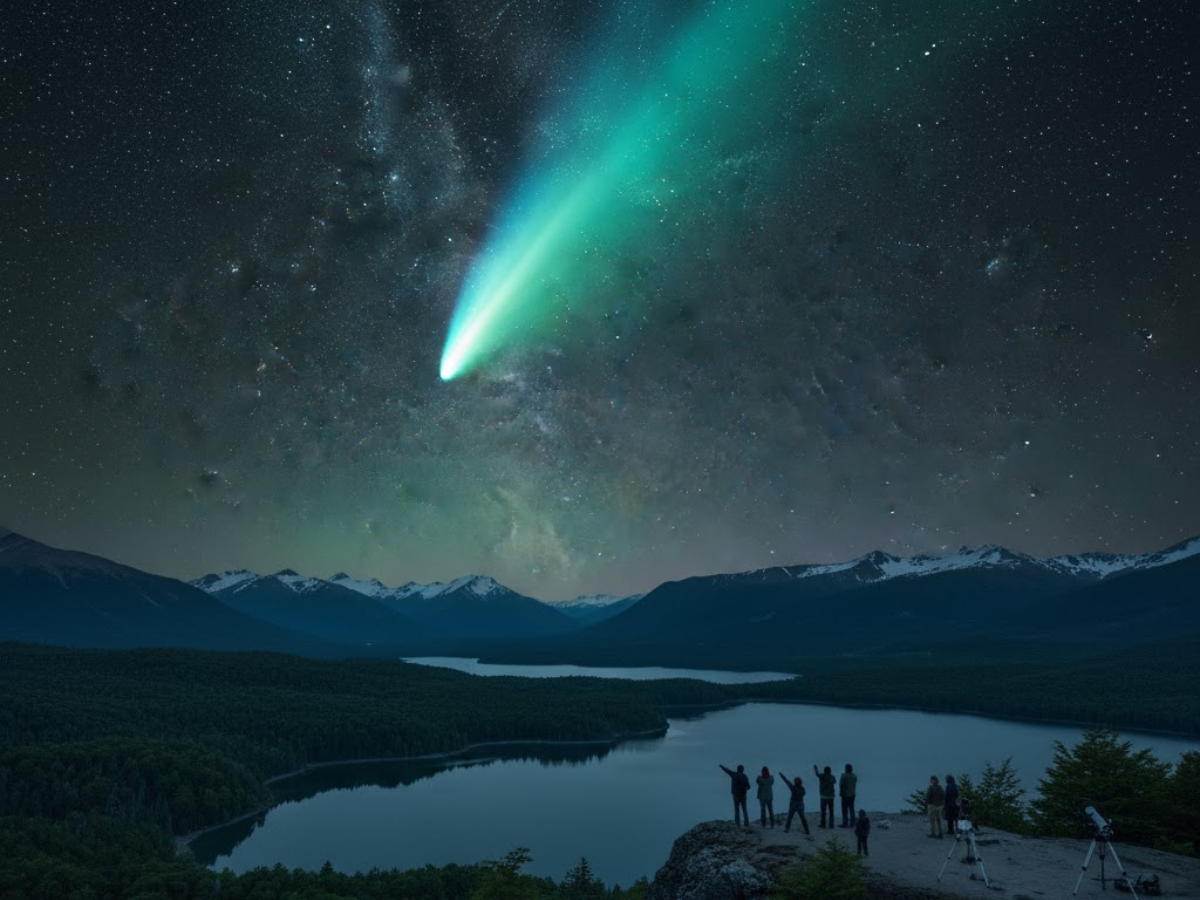
The dazzling view from the earth was onward to Monstrous 2025 October, when Comet C/2025 R2(SWAN) passing nearby. The discovery of the comet was made by Vladimir Bezugly, an amateur Ukrainian astronomer and it was so brightening that one would need to keep his eye on it on 21 October 2025 when it’s expected to pass closest to Earth a rare treat for all of those who see from below and stars of the sky.
When & Where to Watch the Comet
During the month of October, Comet SWAN will be a sight in the evening sky, and hence, frequent opportunities for observation are available. The comet should be spotted shortly after sunset and stars intending to leave from clear skies will easily trace it to the southwest sky.
As it advanced on October 16, the celestial object was perceived somewhere in the eastern half of the Serpens Constellation and roughly five degrees to the left of Xi Serpentis, which is the only bright star in the area of interest and the closest passage to our planet is on October 21.
ALSO READ: Will Aliens Arrive on October 29? Scientists Decode 3I/ATLAS
Why is it Glowing So Bright?
It brightens due to the phenomenon of sublimation with the heat of the sun causes the frozen material of the comets nucleus to escape in the form of gas as they approach the sun closely. The release of gas and dust forms the glowing coma around the nucleus and an elongated tail extending away with the sunlight scattering on this gas and dust tail gives the comet its bright glow creating a spectacular scene as seen from earth. This brilliant display lasts as long as the weather cooperates with low rain and light pollution.
Tips on Observing Comet C/2025 R2 (SWAN)
Good observance is a must on clear evenings with less light pollution for Comet SWAN to make its best appearance. The comet’s path will proceed across the sky and therefore appear quite reasonably backward towards the southwest right after sunset. Stargazers looking forward to any forecasts should make sure clouds are not forecast for that night. Regularly, obtaining a much darker site will give terrific insights into the observing of this sky specimen far away from city lights.
ALSO READ: Alien Tech or Military Game-Changer? How Quantum Radar Might Spot Stealth Jets & UFOs
What is the Story of the Discovery
On September 10, 2025, Comet C/2025 R2 (SWAN) was officially declared to have been found by amateur astronomer Vladimir Bezugly. The comet has commanded special attention because of its abnormal brightness and closeness to Earth and the perihelion passage of the comet on September 12 marked its closest approach to the Sun within about 47 million miles (75 million kilometers). This marked period of greatest brightness of the comet and created frenzy among astronomers and sky-watchers across the world.
What was into the Past of Comets
These unique comets like SWAN offer a glimpse into the early solar system with these very icy bodies are remnants formed during the formation of the planets and hold within chemicals that are supposed to have been frozen carbon dioxide, methane and even water vapor. They give one opportunity, tumultuously near the Sun, to see some of the primordial material that may have contributed to molding our Solar System some billions of years ago. They give the magnificent show a thick tail on sublimation by which this infernal gas goes to vapor before the push of solar wind. For scientists, Comet SWAN is not just a beautiful interest but also a scientific object to study for a way deeper into the origins of our planetary system.
Comet C/2025 R2(SWAN) presents another rare opportunity for the observation of a natural spectacle merging science with beauty. It will surely attract and inspire both the most serious of astronomers and the most casual of sky-clad observers.
ALSO READ: What If 31/ATLAS Is an Alien Mothership? How Earth Could Respond
Disclaimer: This information is based on current astronomical predictions; the comet’s brightness and visibility may change due to unforeseen factors.