
China’s new developments in humanoid robotics were in the limelight at the World Artificial Intelligence Conference (WAIC) in Shanghai, with technology giants, robotics companies, and AI makers highlighting their technology and aspirations for real-world applications.
The exhibition, which ended on Tuesday, showcased humanoid robots developed by leading local companies like AgiBot, Unitree Robotics, Fourier Intelligence, Keenon Robotics, Galbot, Deep Robotics, Robotera, and the National and Local Co-Built Humanoid Robotics Innovation Centre. These robots showcased diverse skills from chat and dance performances to physical exercise like kickboxing.
Society is calling for robots to be extensively used in practical applications,” stated Zhang Zhengyou, chief scientist at Tencent’s Robotics X Lab, at a WAIC panel. However, he added that satisfying the stringent requirements of various use cases demands innovation in fundamental technologies as well as strong engineering.
That reality has not put a damper on China’s effort to further develop its robotics industry. With government support and increasing demand from state-owned companies, various firms are now transitioning to mass production. TrendForce, an industry market research firm, said in April that six of 11 local humanoid robot companies are planning to produce more than 1,000 units each this year. They are AgiBot, Unitree, Galbot, Engine AI, and Leju Robotics.
Evidently, AgiBot, which is a Shanghai unicorn worth more than 15 billion yuan, took up the biggest booth at WAIC. Its humanoid robots conducted interactive operations, interacted with visitors, and even danced. Unitree Robotics from Hangzhou, on the other hand, attracted huge crowds with its G1 humanoid robots conducting remote-controlled kickboxing exercises.
Health robotics company Fourier showcased its next-generation GR-3 robot, which features a soft casing to make human contact more comfortable. The company is set to roll it out next month.
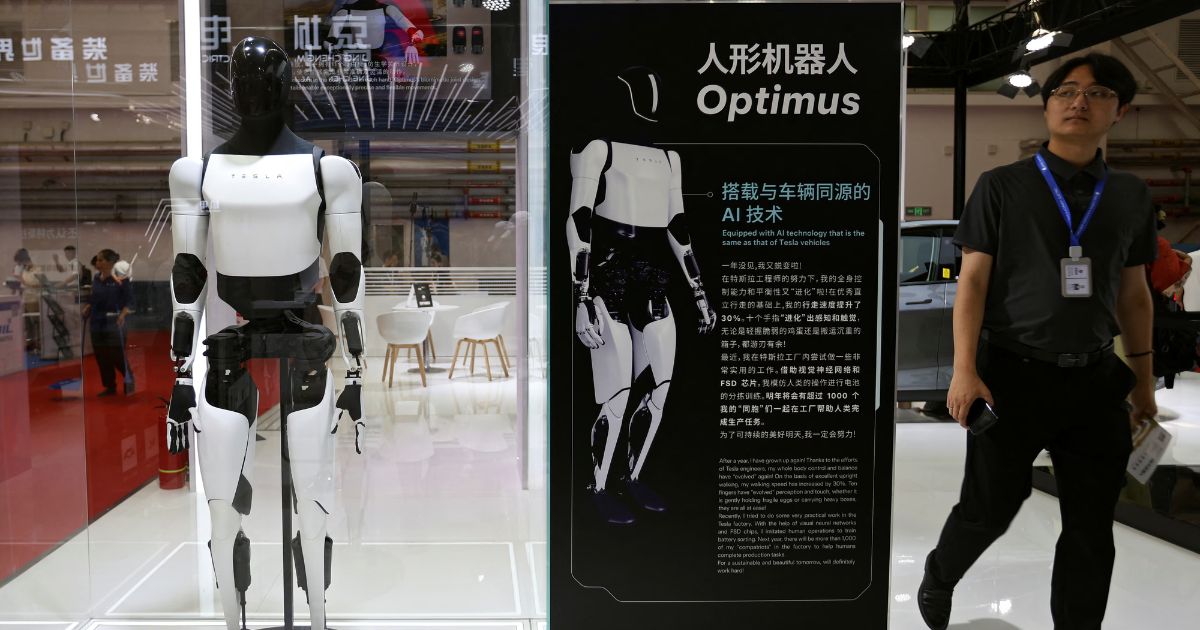
Tesla’s humanoid Optimus robot, aka Tesla Bot, was exhibited behind glass, much like its appearance at Beijing’s recent Supply Chain Expo. But most visitors seemed to be more interested in the exhibit of Tesla’s Cybertruck, which has yet to be launched in China.
On the software side, several firms launched new platforms to support robotics development. Tencent unveiled Tairos, a developer platform offering AI tools, large language models, and data services. SenseTime introduced its own platform focused on perception, interaction, navigation, and language capabilities. Huawei’s CloudRobo platform supports AI training through synthetic data and computational power.
Keenon CEO Li Tong underscored that the actual change in robotics is brought about by AI innovation that allows for new jobs. Deep Robotics unveiled its quadruped robots applied in high-risk environments such as construction sites, power inspection, and fire extinguishing.
“Most of the demand in China is for hazardous environments,” stated Deep Robotics’ Susanna Luo. “Aging populations and declining workforces around the world drive digital transformation and greater testing opportunities for our robots.”