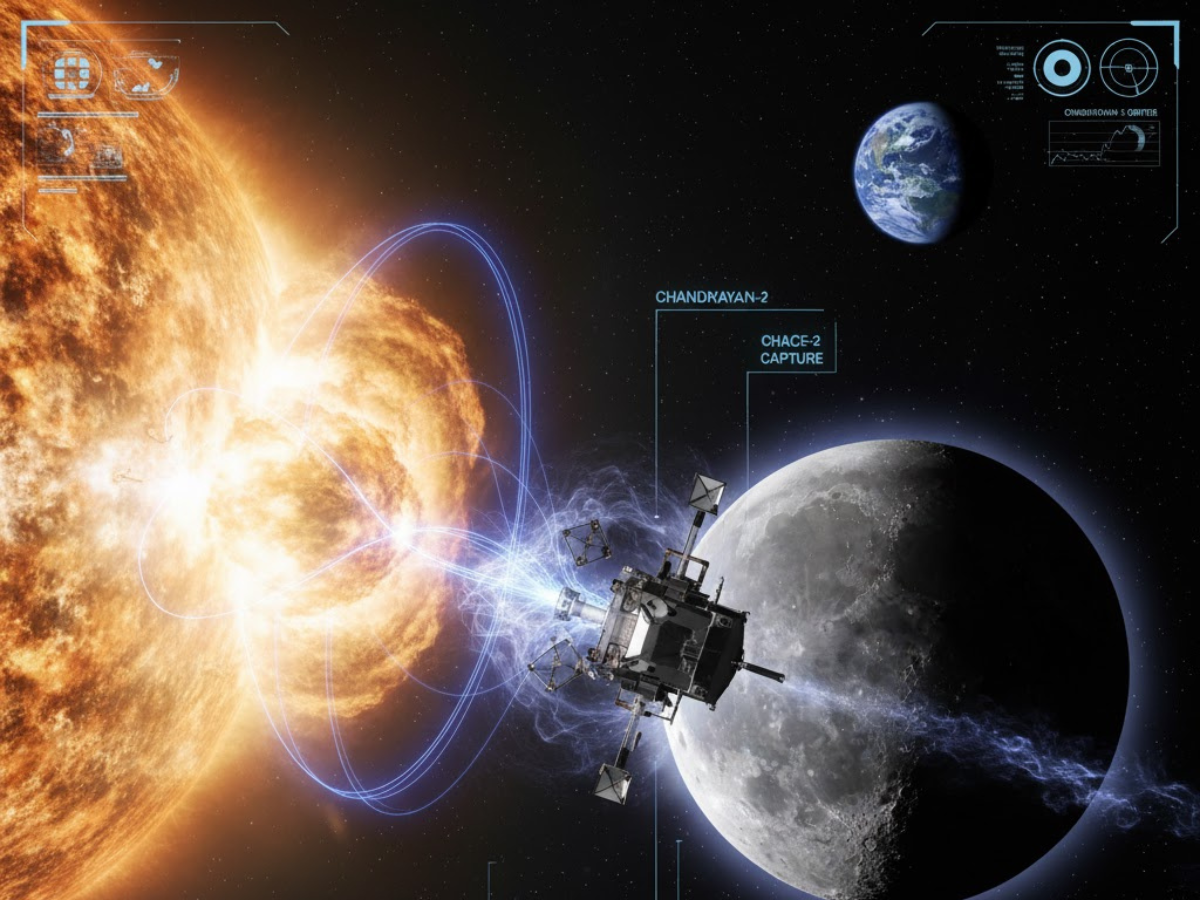
India’s Chandrayaan-2 mission achieves a significant scientific milestone by being the first to observe the effects of solar Coronal Mass Ejections (CMEs) on the Moon’s exosphere. This achievement restates a significant chapter in our understanding of space weather and Moon-atmospheric dynamics as the world looks ahead to exploring the Moon much more vigorously.
What is the CMEs
Coronal Mass Ejections are powerful bursts of charged particles released from the outer layer of the Sun with such explosive phenomena can eject billions of tons of plasma into space, often at speeds nearing millions of kilometers per hour.
Whenever these CMEs reach the Earth, they create havoc, throwing satellites out of service, forcing power grids to shut down and disrupting communication systems, collectively referred to as space weather. The CMEs is crucial toward ensuring that technologies are safeguarded and that human space missions are carried out in safety putting more importance on Chandrayaan-2’s findings.
Importance of the Observation by Chandrayaan-2
On this occasion of a very strong CME on May 10, 2024, scientists had the chance to examine the interaction of solar particles with the Moon’s tenuous exosphere. The Chandrayaan-2 orbiter equipped with an instrument called Chandra’s Atmospheric Composition Explorer-2 (CHACE-2) observed an unprecedented build-up in pressure within the Moon’s exosphere, thereby confirming the theoretical predictions that solar coronal mass ejections could alter the exosphere’s composition.
The exospheric particle density suddenly peaked, allowing the first-ever direct assessment of such an event. The ramifications of this find impact lunar science and exploration because it legitimizes the long-held models for solar disturbing the Moon.
Exosphere of the Moon: A Special Laboratory
Moon’s exosphere is one of the most rarefied environments in the solar system and it is rarified to such an extent that individual molecules of gas seldom collide with each other. Mainly composed of those atoms and molecules that were released from the lunar surface due to solar wind bombardment and impacts by micrometeorites, exosphere is exceedingly sensitive to external forces.
The absence of a thick atmosphere and global magnetic field on the Moon leaves it completely unshielded from solar winds and CMEs. It serves as a natural laboratory for studying space weather devoid of the protecting stratifications found on Earth.
Implications for Future Lunar Exploration
The importance of this finding goes beyond science. Understanding the Moon’s response to solar activity is critical from the perspective of long-term lunar missions being planned by an increasing number of space agencies and private entities.
The increase in exospheric density from the CME may have repercussions for lunar operations in regard to equipment performance and astronaut safety on the surface. With plans for lunar habitats in the near future, the results of this research will be crucial to help scientists formulate plans to mitigate possible impacts solar phenomena may have on the environment of the Moon.
Chandrayaan-2: The Quiet Unsung Hero for Lunar Science
When India placed in orbit Chandrayaan-2 in 2019, it was held as a daring intervention in lunar exploration despite Vikram’s lander failure in achieving a soft landing, the orbiter continued to triumph as a scientific investigator, giving pristine data worthy of millionaire funding.
Now, this mission has placed India as the face of lunar science with Chandrayaan-2’s contributions thrusting her to the limelight of space research. The lately detected impact of CMEs on the Moon stands as testimony to the success of this orbiter and eternally engraving itself in the pages of history as one of the most advanced lunar laboratories to have been built.
Chandrayaan-2’s breakthrough provides more knowledge about lunar space weather, while on the other hand, it sets the stage for future lunar exploration. With the world focused on making a sustainable human presence on the Moon, the lessons derived from missions like Chandrayaan-2 will be pivotal in ensuring the safe passage of subsequent missions.
ALSO READ: Why the Ocean Is Salty: The Hidden Science Behind Every Drop
Disclaimer: Based on ISRO and public reports; scientific data and interpretations may evolve as new research emerges.