
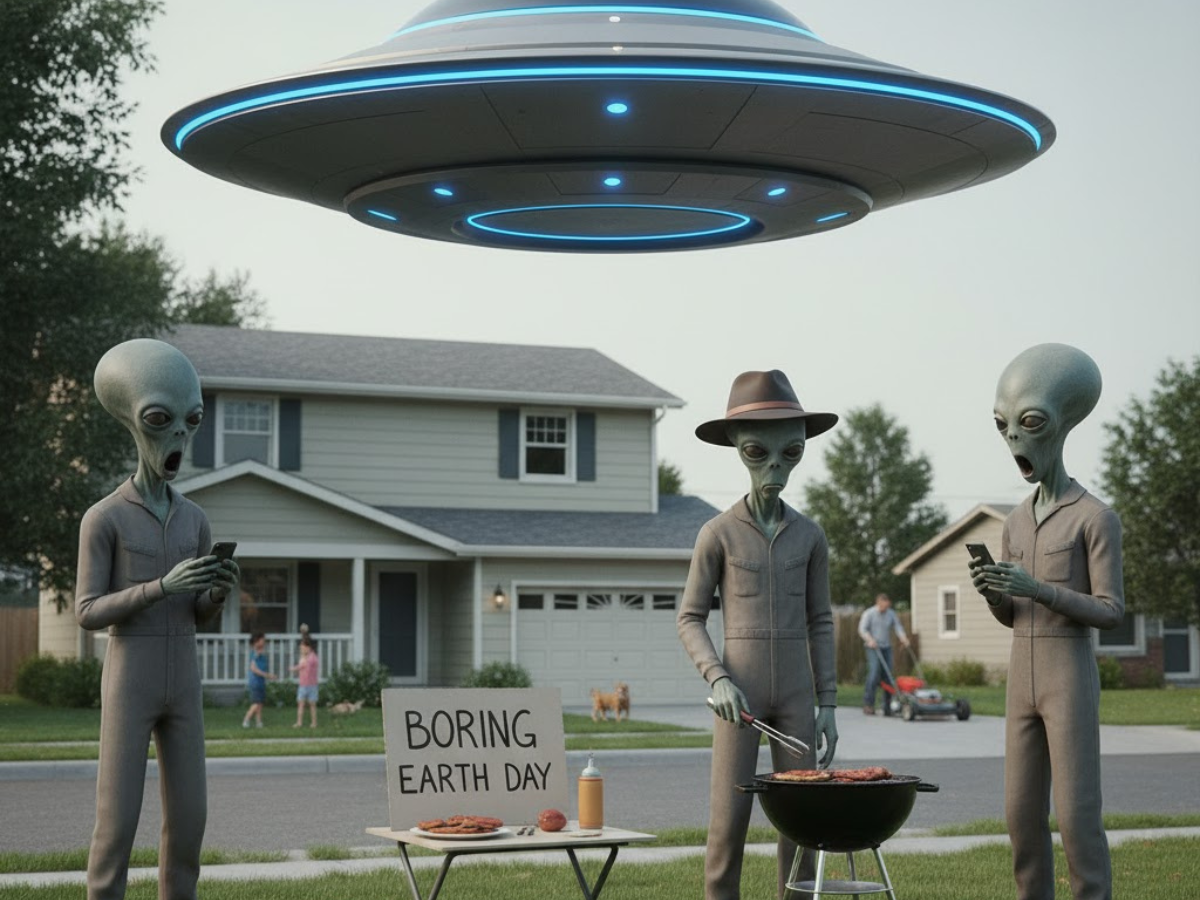
It’s been a long speculation for centuries why we have not encountered other space populations or alien civilizations with such a vast distances within the universe and thereby enhanced possibilities for intelligent life out there, we find ourselves seemingly alone in the cosmic void. A NASA astrophysicist has proposed a fresh and rather bizarre explanation: Perhaps the aliens are just not all that keen.
Dr. Robin Corbet, senior scientist at NASA & Goddard Space Flight Center, believes powerful alien civilizations may not be as far advanced as we think all in fact, they could have all but lost interest in coming to talk with Earth. His theory titled radical mundanity presents a plausible account for Fermi’s paradox and total absence of alien communication.
What is the Radical Mundanity of Alien Life
Dr. Corbet challenges the mainstream idea that alien civilizations are much more advanced than humanity. He hypothesizes that these civilizations are “technologically ordinary, not some vastly superior”. Corbet states that alien civilizations might only be a technological step or two ahead of humans, capable of communicating but not godlike in their advancement.
“It’s like having an iPhone 42 instead of an iPhone 17,” Corbet says to illustrate how the difference in technological development might not be as dramatic as we all expect with these civilizations might just have come to a plateau with their technology, where the advancements become incremental rather than revolutionary.
ALSO READ: Will Aliens Arrive on October 29? Scientists Decode 3I/ATLAS
Why Aliens Might Have Lost Interest in Us
If this goes by Corbet’s theory, it would explain why we have not heard much from alien civilizations due to the distances involved, communication efforts are resource hungry use of probes or signals that could travel light-years requires enormous power and time.
After a few unsuccessful attempts to establish meaningful contact, aliens might have understood that these were futile attempts to make and even if they did decide to intervene, Earth might not even be interesting enough to grab their attention with so many planets out there in the galaxy and our planet could seemingly pass for just another ordinary rock in space, as any other.
Revisiting the Fermi Paradox
Another angle from which to view the Fermi paradox is the probability of alien life is high consideration of the evidence put forth for its existence is low. Corbet theorizes about radical mundanity instead of vast interstellar empires, there might be civilizations of modest means scattered across the galaxy each with their own constraints.
Such constraints and a lack of faster than light travel would make it exceedingly rare for a meaningful contact to occur between these civilizations. This theory paints a quieter, more mundane portrait of the universe where contact by aliens is not impossible and just highly improbable.
ALSO READ: What If 31/ATLAS Is an Alien Mothership? How Earth Could Respond
Double-edged Receipts for the Theory
Many have not only embraced Dr. Corbet’s hypothesis but have also raised pointed criticisms against it. According to some scientists, this view attributes on alien civilizations a distinctly human like sense of indifference. On the other hand, Professor Michael Garrett from the Jodrell Bank Centre for Astrophysics has said, a fresh perspective while also admitted its speculative nature.
Some researchers see unexplained aerial phenomena (UAPs) as evidence that advanced possibly alien technology may already be here. These opposing views highlight how complicated the search for extraterrestrial life is and how much it is colored by our personal hopes and fears.
Comfort in Ordinary Aliens
Corbet’s view, despite mixed responses is a much more comforting one instead of fearing weak alien empires or advanced species able to perform god like feats, we could well be looking at ever so mundane civilizations that are just as limited, curious and imperfect as we are. According to one interpretation, the universe is silent not for want of indifferent or hostile forces but because it is, in many ways, drastically mundane.
Corbet further observes that when alien contact is realized if at all, it may turn out to be quite anticlimactic and involve quite somewhat Earth. Radical mundanity may be the universe’s true character, vast but awful ordinary and perhaps that very thing really perks it.
ALSO READ: Alien Tech or Military Game-Changer? How Quantum Radar Might Spot Stealth Jets & UFOs
Disclaimer: This article summarizes hypotheses and commentary on extraterrestrial life; views are speculative and reflect ongoing scientific debate.