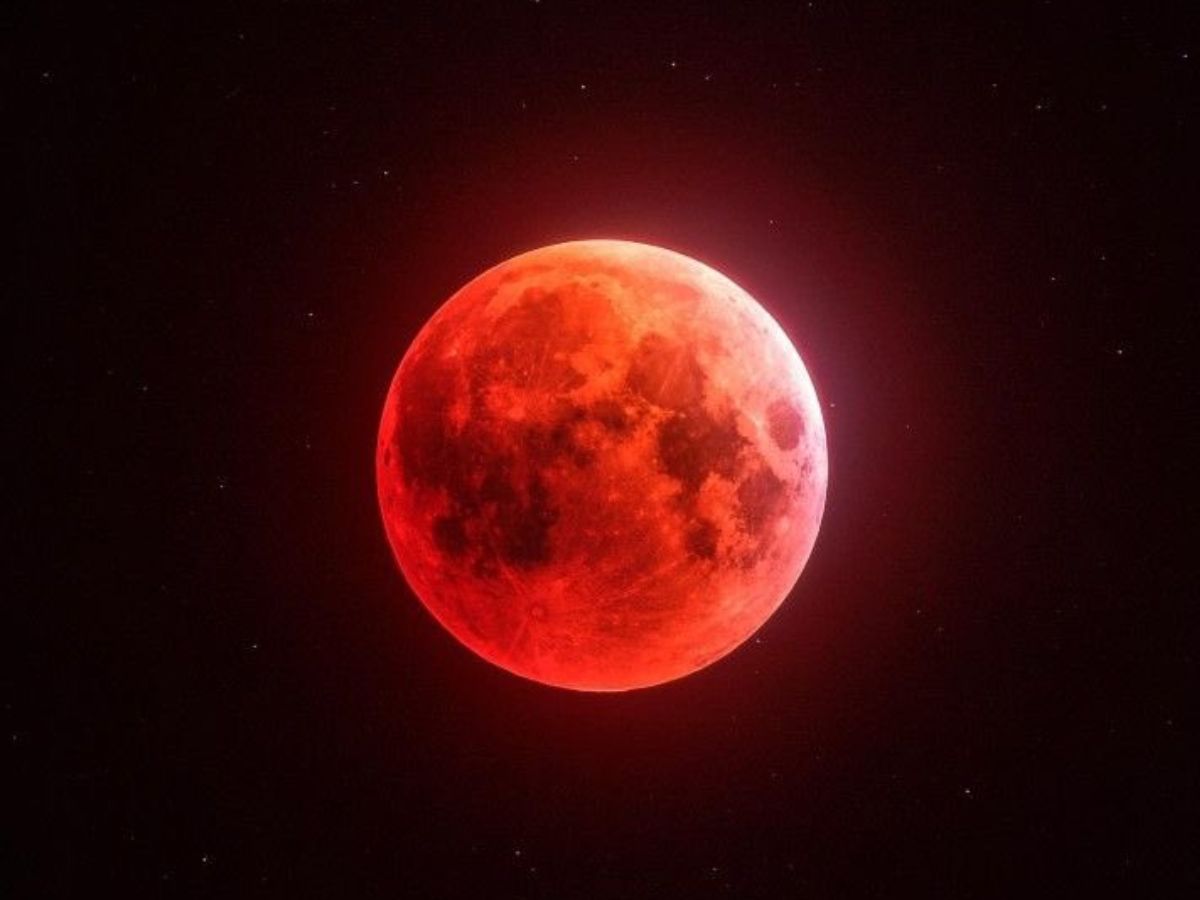
The sight of a “Blood Moon” has fascinated people across the world. This event happens during a total lunar eclipse when the Earth moves directly between the Sun and the Moon. Instead of fading into darkness, the Moon glows in shades of red or copper. This glow occurs because Earth’s atmosphere bends sunlight scattering away the blue light and allowing red wavelengths to light up the Moon’s surface. Across cultures, this fiery appearance has been seen as a symbol of change, divine power, or even warnings of war, making the Blood Moon more than just an astronomical event.
What is Blood Moon?
What to Expect in September 2025
On the night of September 7–8, 2025, a total lunar eclipse will turn the full Moon into a striking Blood Moon for around 82 minutes. This eclipse is special because it will be visible to over 7 billion people worldwide, covering Asia, Africa, Europe, Australia, and Oceania.
In India, the event coincides with Pitru Paksha, a period of paying tribute to ancestors, giving the eclipse additional spiritual importance. Many traditional families will also observe the Sutak period, a time when religious activities are restricted during eclipses.
Also Read: Blood Moon 2025: List of Cities in India to Witness the Rare September Eclipse
Timings of the Eclipse
Here are the global timings (UTC):
-
Penumbral eclipse begins: 15:28 UTC
-
Partial eclipse starts: 16:27 UTC
-
Total eclipse begins: 17:30 UTC
-
Maximum eclipse: 18:11 UTC
-
Total eclipse ends: 18:52 UTC
-
Penumbral eclipse ends: 20:55 UTC
Timings in India (Delhi as example):
-
Eclipse starts: 8:58 PM IST
-
Total eclipse begins: 11:00 PM IST
-
Peak of eclipse: 11:41 PM IST
-
Ends: 2:25 AM IST (Sept 8)
The entire event will last 5 hours 27 minutes, with the red Moon phase visible for over an hour.
Visibility Around the World
-
UK and Europe: The Moon will rise already in eclipse around 19:30 BST, just after sunset. Skywatchers will see the later stages of the eclipse, glowing red as it climbs higher.
-
Eastern Africa, Middle East, Asia, and Western Australia: Lucky observers will be able to see the entire event from beginning to end.
-
United States: Most of North America will not see this eclipse, but parts of South America will catch glimpses.
The last time the UK saw a total lunar eclipse was in 2022, making this one a long-awaited celestial show.
Why the Moon Turns Red
A lunar eclipse happens when Earth blocks sunlight from reaching the Moon. Depending on how much shadow is cast, eclipses are divided into:
-
Total lunar eclipse – Entire Moon is in shadow, turning red.
-
Partial lunar eclipse – Only a part of the Moon darkens.
-
Penumbral eclipse – A faint shading when the Moon passes through Earth’s lighter shadow.
The red glow comes from a process called Rayleigh scattering. It’s the same reason our skies look blue during the day and sunsets appear red. As sunlight travels through Earth’s atmosphere, the shorter blue light scatters away, while the longer red light bends and lights up the Moon.
How to Watch the Eclipse
-
Best viewing: Find an open spot with a clear horizon or climb to higher ground.
-
Time to be ready: In the UK, the Moon rises in eclipse at 19:30 BST; in India, totality starts from 11:00 PM IST.
-
Equipment: No protective glasses are needed. Unlike solar eclipses, lunar eclipses are safe to watch directly. Binoculars or telescopes, however, will make the view sharper.
-
Check the weather: Cloudy skies may block the view, so planning ahead is essential.
What’s Next After 2025?
If you miss this Blood Moon, the next total lunar eclipse visible in the UK will occur on 28 August 2026. Globally, several partial and penumbral eclipses will also occur in between, but the September 2025 event remains one of the most widely visible and spiritually significant in recent years.
Also Read: Blood Moon on Sept 7: Lunar Eclipse Timings in the US and How to Watch Live