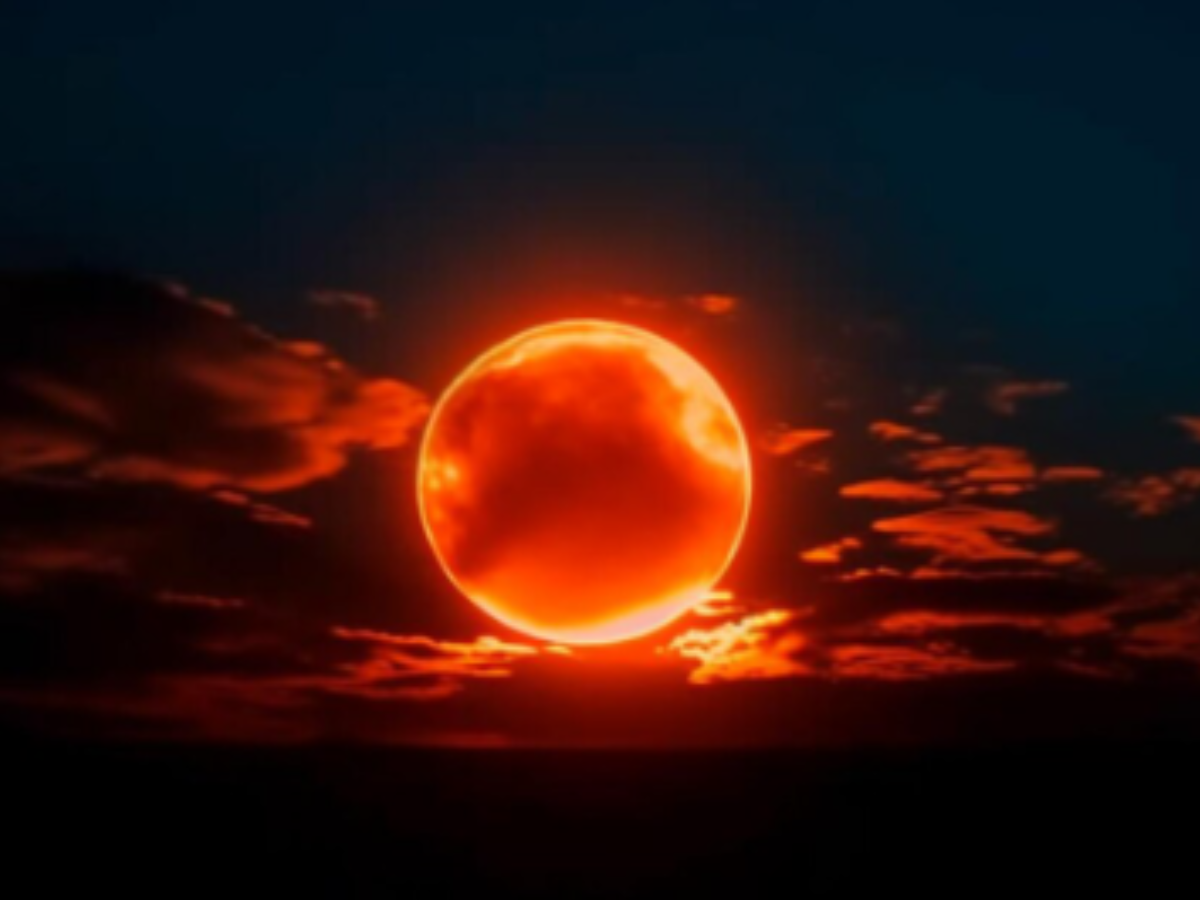
It will be one of the most breathtaking phenomena for sky watchers in India and across several continents when total lunar eclipses make the Moon a luminous red ball on 7 September 2025. The areas that will witness the eclipse include India, Russia, China, Eastern Africa and Western Australia. Some of the most favorable cities in India to witness the event, provided the skies are clear, are Delhi, Mumbai, Kolkata, Pune, Lucknow, Hyderabad and Chandigarh.
An event begins at 8:58 pm and ends somewhere around 1:25 am on 8 September. The most striking aspect the Moon changing to deep crimson will happen between 11:00 pm and 12:22 am.
What Turns the Moon Red
A total lunar eclipse occurs when the Earth passes directly between the Sun and the Moon and casts its central shadow, the umbra, on the surface of the Moon. Instead of disappearing into darkness, the Moon glows red because sunlight bends through Earth’s atmosphere.
ALSO READ: Why is the Sky Blue: The Science Behind Nature’s Most Beautiful Illusion
Because Rayleigh scattering removes shorter wavelengths such as blue and violet while letting longer red and orange wavelengths reach the Moon, the effect is this Imagine a celestial lantern glowing red, copper or orange around a “Blood Moon.”
How to Safely Watch the Eclipse
Unlike solar eclipses, you can watch lunar eclipses without a telescope with the naked eye. No protective glasses are necessary, although binoculars or a telescope can enhance the experience.
It will however, view most clearly in open spaces along with the new moons away from artificial light, pollution and thick cloud cover. Long sleeved and high-capacity shooters will find this eclipse golden as it will allow the capture of long exposure shots of one of nature’s most dramatic displays.
ALSO READ: Five Bright Comets Set for Dazzling Sky Show From Lemmon to Atlas
What Makes This Eclipse Special
A lunar eclipse would happen after every approximately two and half years of occurrence; however, the one in September 2025 is special because it would serve as an example of a highly visible, lengthy Blood Moon. Fully 82 minutes of its totality would stand among the longest eclipses in recent decades. Some 87% of the world’s population would have a chance to witness this event, thus truly making it global in nature.
Throughout history, beyond the scientific explanation, Blood Moon has borne myths, stories and even spiritual beliefs and meanings. Yet in modern times, it is a very romanticized version of this very complex dance between our planet, the Sun and the Moon. For the onlookers, it is not about the stereotypes but more about savouring a rare work of craftsmanship in the sky.
ALSO READ: Teen’s suicide lawsuit puts OpenAI’s ChatGPT under legal Scrutiny