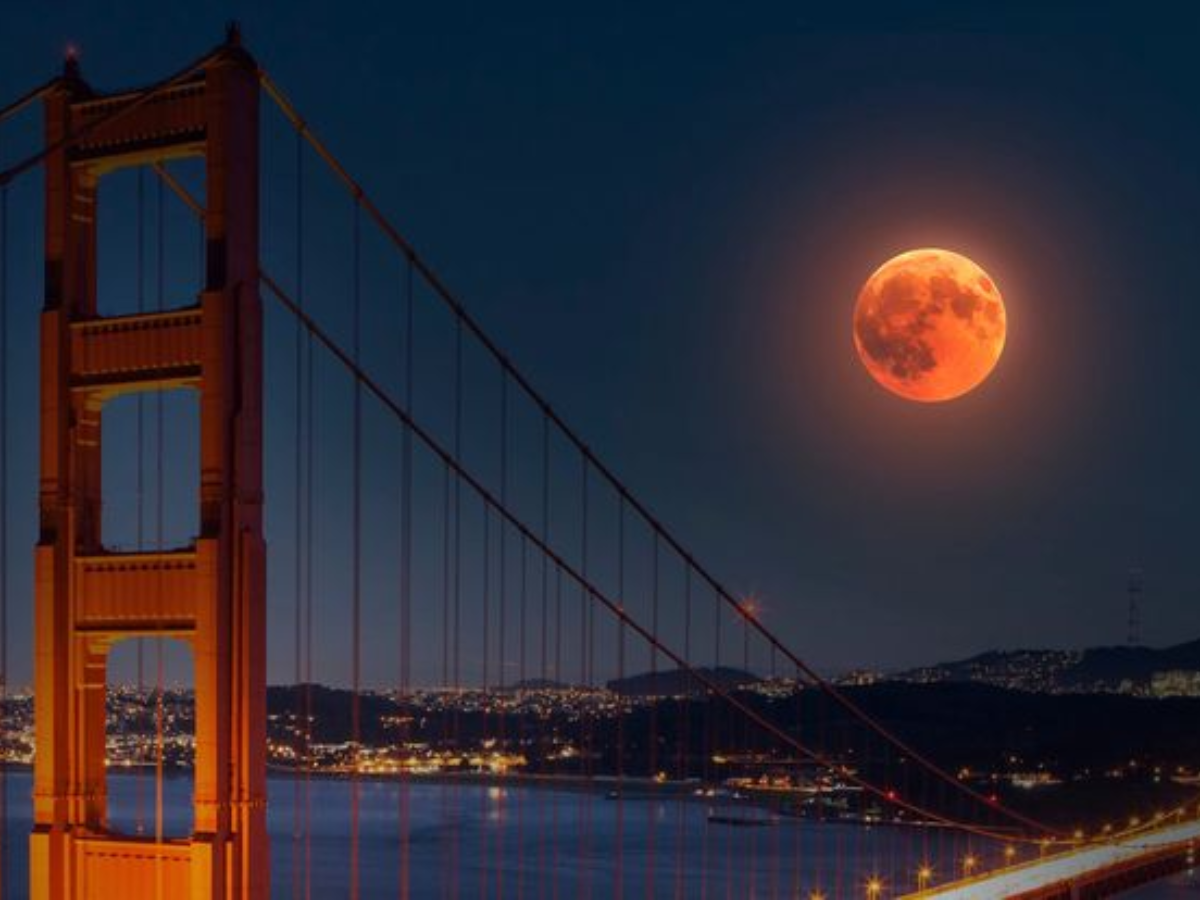
On September 7-8, within the next few days, the world will be illuminated by one of the most spectacular natural phenomena a total lunar eclipse. Unlike solar eclipses, whereby special eye protection is required, this can be viewed without any assistance from an optical device, and it can be appreciated as plain, ordinary sight. It occurs as the Earth passes directly in between the Sun and the Moon, casting its shadow over the lunar surface and turning it into a glowing orb of deep red and orange hues an effect usually called the Blood Moon.
How Come the Moon Becomes Reddish Lit
Magic or science it’s the latter for red lit moon during an eclipse. Eclipses don’t happen every month, as astronomers say because the orbit of the moon is a little bit inclined. The sun, earth and moon must be perfectly aligned.
When the moon enters earth’s darkest part of the shadow, the umbra, it looks red because of Rayleigh scattering and just as sunsets are painted in rich reds and oranges.
ALSO READ: Area 51 Secrets Revealed: NASA Breaks Silence Why UFO Myths Still Won’t Die
When and Where to Watch
In India, the eclipse begins at 8:58 p.m. IST on September 7, with totality beginning at 11:00 p.m., when the moon will be completely covered for 82 minutes until 12:22 a.m. on September 8. The entire show will conclude at 2:11 a.m. IST.
Although viewers from Europe, Africa and Asia enjoy the celestial miracle, it will not include observers in America this time around. Those suffering from cloudy skies can take advantage of the streams from space agency and astronomy websites to witness events in real-time coupled with expert commentary.
Eclipse Sequence (UTC)
- Beginning of Penumbral Eclipse: 15:42
- Beginning of Partial Eclipse: 16:39
- Beginning of Total Eclipse: 17:31
- Maximum Eclipse: 18:11
- End of Total Eclipse: 18:52
- End of Partial Eclipse: 19:44
- End of Penumral Eclipse: 20:41
ALSO READ: Asteroid 2025 QY4 to Fly Past Earth: NASA Confirms Safe Passage at 2.81 Million Miles
A Sky Show not to be Missed
Whether from the comfort of a backyard, a rooftop or a beautiful open space, the experience of the lunar eclipse is one not to be missed. A golden opportunity for the photographers is provided by the unrepeatable dramatic evolution of the Moon. For stargazers, it’s a reminder of the unmatched bond each of us shares with the cosmos-check everyone around us even from Earth, we witness some grandiose performances of celestial mechanics played against the black canvas of night.
ALSO READ: Earth’s Magnetic Mysteries: 5 Zones Where Compasses Don’t Work