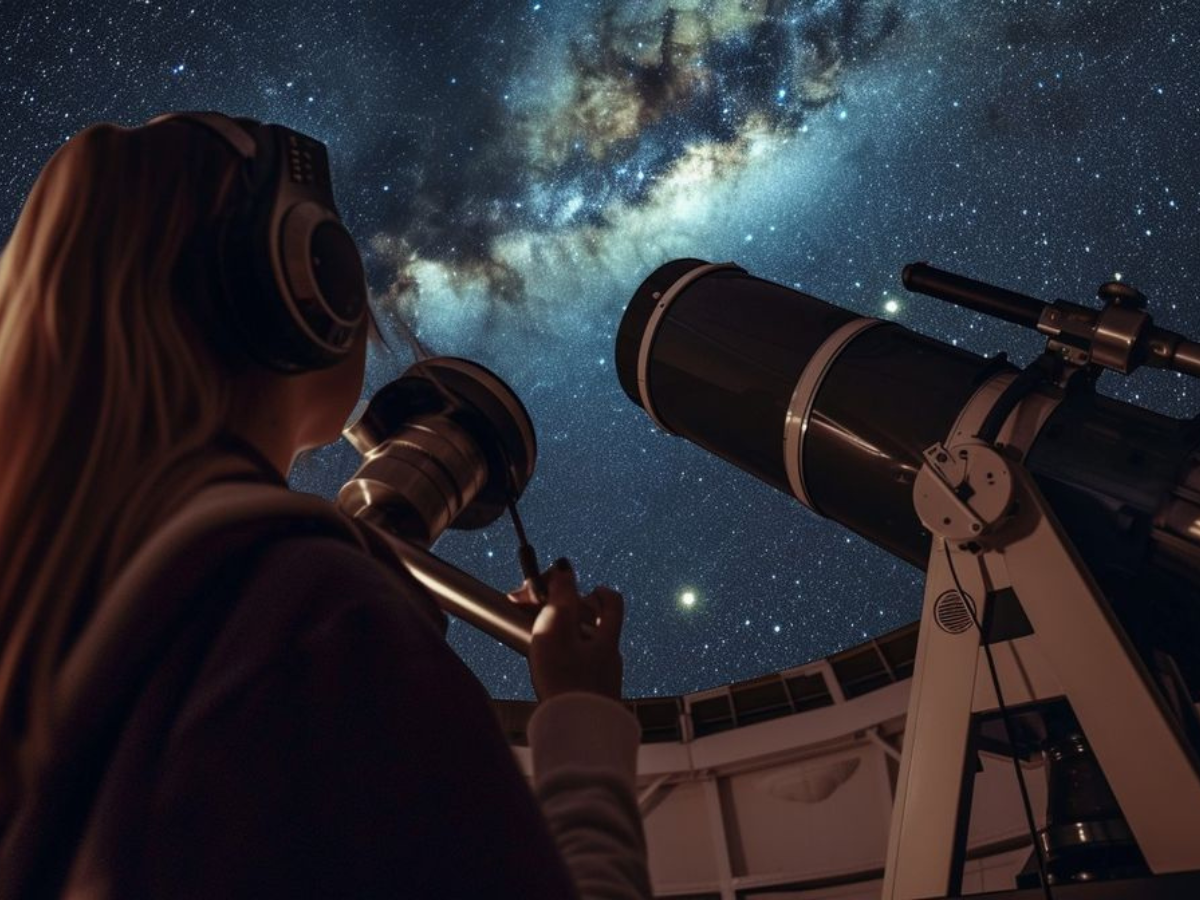
Hunting details in the Moon, storms on the planets or distant galaxies glow with the proper telescope, the journey of your astrophotography will be taken to the next level. What will ultimately matter be knowing your perfect goal and finding a telescope that fits your vision of the cosmos.
What are Astrophotography Telescopes?
These are sophisticated optical devices designed specifically to obtain images of celestial objects in close detail and visual observation telescopes, these models are devoid of complications with clarity, focus and light transmission for long-exposure photography.
The entire system should balance optical performance and camera compatibility so that everything from the Moon indeed through very far galaxies can be photographed.
Understanding the Focal Ratio
Focal ratio commonly denoted by f/number is the most important specification for astrophotography and its measurement signifies the focal length of a telescope divided by the size of its aperture.
Lighter focal ratios (f/4 or f/5) facilitate faster imaging while being best suited to capture wide-field shots, such as those of nebulae. The higher ratios (f/10 or more) are preferred for detailed imaging of planetary surfaces and the Moon since the fields of view are quite narrow.
ALSO READ: Best Compact Mirrorless Cameras in 2025: Top 5 Picks for Travelers & Creators
Telescopes for Photographing the Moon
To capture craters and shadows on the Moon with a moderately sized aperture with good contrast as Refractors and Maksutov-Cassegrains are both among the most popular types because they are very sharp in terms of optics and they require almost. A stable mount with basic tracking is sufficient to photograph the Moon.
Telescopes for Photographing Planets
Planetary photography requires high magnifications and fine details with long focal lengths and high focal ratios such as Schmidt-Cassegrain telescopes (SCTs) are dedicated to this purpose. Other advantages can also greatly help in resolving features on planets such as Jupiter, Saturn and Mars using great detail.
Telescopes for Photographing Galaxies
Galaxies are faint objects located very far away therefore, to take such pictures, the optics used must be highly sensitive and also have very large apertures. For deep-sky imaging, reflector telescopes are very good, Newtonians with fast focal ratios such as f/4 to f/5. The longer exposures can really be taken in with this and more power is garnered to discover the presence of distant star systems.
Telescopes for Photographing Nebulae
Being large and diffuse most nebulas do best with a telescope that provides a wide field of view. Fast optics combined with apochromatic refractors are suitable candidates for this task.
Such telescopes can get optimum performance when attached to tracking mounts and paired with astro-cameras to produce spectacular-looking, detailed and vibrant emission and reflection nebulae.
ALSO READ: Nasa’s James Webb Telescope Spots Mysterious Red Object That May Reveal Galaxy Origins
Best Telescopes for Astrophotography
What defines the best telescope for astrophotography is what the astrophotographer wants to capture those that score very high in terms of optical quality and tracking precision, from compatibility for use with modern cameras are selected.
Refractors, SCTs and compact astrographs tend to rank highly on these lists for both budding and experienced imagers.
Sky-Watcher Evolux 82ED Refractor
Evolux 82ED is great color corrected and very sharp making it a perfect beginner refractor. It also happens to be very lightweight, giving it an f/6.45 focal ratio and 82mm aperture. That helps for nebulae and star fields to get the wider field of view and ideally matched with an equatorial mount and DSLR camera.
Celestron 114LCM Computerised Telescope
This computerized Newtonian reflector sports a 114mm aperture and is built with a GoTo mount, making it very easy to handle. It is essentially for beginners its easy aligning and sky following would not fail even the pros. This is not the most serious astrophoto instrument, but it is the easiest way into digital astrophotography.
Tecnosky AG70 Astrograph
The AG70 is a true imaging powerhouse. With a wide 70mm aperture and fast f/4.9 focal ratio and it will deliver stunning images on both nebulae and wide-field targets. It comes with its own dedicated field flattener and making it one of the most well optimized tools for flat, distortion-free images across the frame.
Can One Telescope Do All Astrophotography?
The telescopes provide access to a whole lot of different subjects, no one telescope can clearly be defined as best for every type of target. Short focal lengths are necessary for wide-field imaging, while increased magnifications are most suitable for planetary work. The hybrids or modular designs provide a good balance particularly when equipped with the proper accessory set.
ALSO READ: Top Telescopes Under Rs. 1 Lakh: What to Buy for Clearer Views of Planets & Galaxies
Disclaimer: This article is for educational purposes only and does not endorse any specific telescope brand or model. Always research before purchasing.