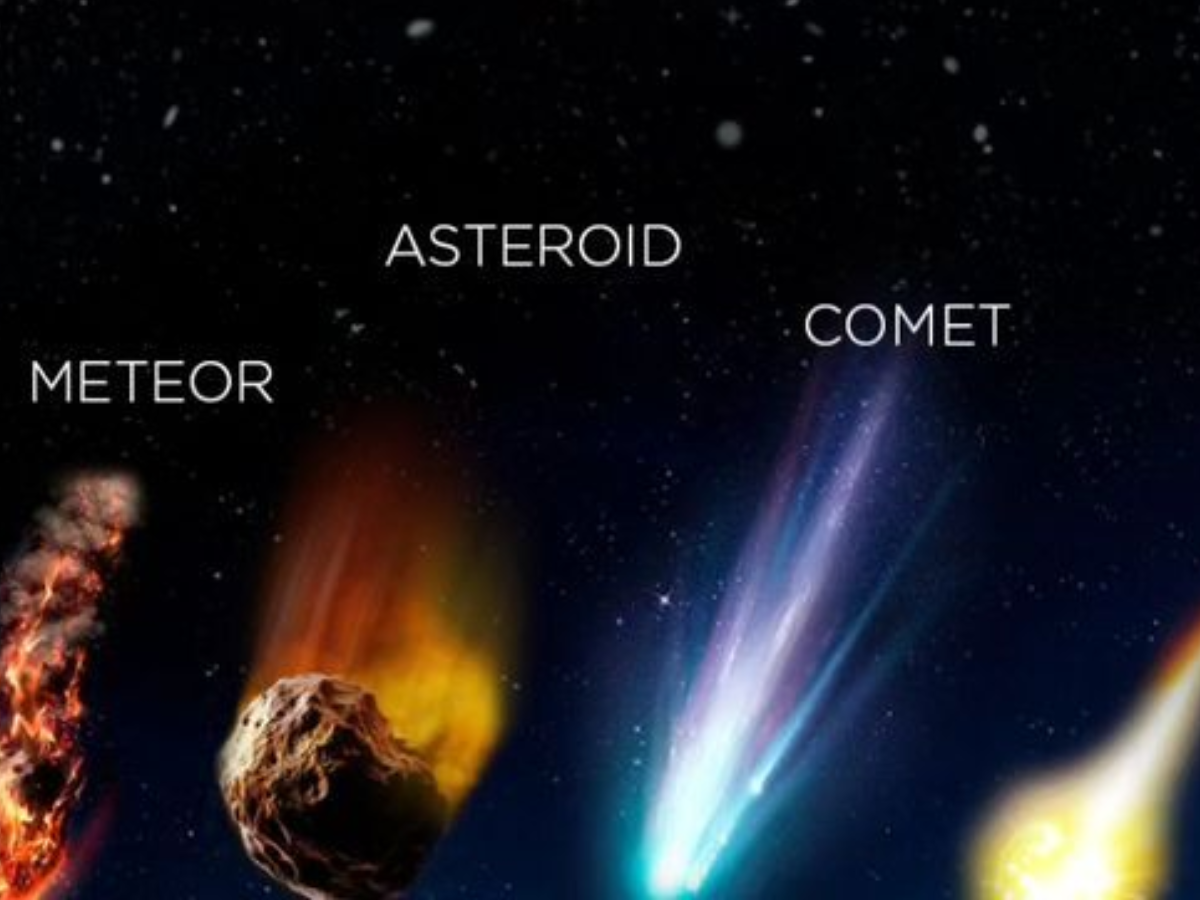
Universe contains some celestial bodies that stir our consciousness. Asteroids, comets and meteors make news even more but what are they, how do they differ and how do they form.
What Are Asteroids?
Asteroids are rocky fragments that remained since the solar system was formed approximately 4.6 billion years ago. They did not coalesce into planets due to gravitational disruptions and the most significant of which was Jupiter. Most asteroids orbit the Sun in a zone called the asteroid belt between Mars and Jupiter.
These bodies vary in size from very tiny pieces of rock to objects of hundreds of kilometers in size. Some asteroids even have moons of their own. Most asteroids remain a considerable distance from our Earth, from time to time, some near Earth asteroids cross our planet’s path and triggering continuous monitoring for any possible threat.
ALSO READ: When the Sky Dances: Science Behind the Northern Lights
What Are Comets?
Comets are much larger bodies and have greater potential for affecting planet life and history. They are referred to as dirty snowballs, composed of frozen gases, dust and some rocky material. The heat from the Sun causes sublimation of the icy comet nucleus and the expulsion of gas and dust, forming a glowing coma with a beautiful tail.
Comets not only come from warmer regions like the asteroid belt, but from far southern regions of the solar system the Kuiper belt and the Oort cloud. The periodic returns of some comets, such as Halley’s comet every 76 years have enthralled humans for centuries and are frequently accompanied by meteor showers created by debris left along the comet’s orbit.
What Are Meteors?
Meteors are the dazzling streaks of light produced when tiny space debris known as meteoroids plunges into the Earth’s atmosphere at high velocity. Friction with air causes meteoroids to burn away, producing bright streaks called shooting stars.
Most meteors disintegrate before they reach the surface of the Earth, but some withstand the heat and land as meteorites. These rocky samples from space give scientists valuable clues to the nature and history of the early solar system.
ALSO READ: What Really Happened in the Bermuda Triangle | Flight 19 to Cyclops Mystery
Differences In Between Asteroids, Comets & Meteors
These three groups differ in terms of composition and operation. Asteroids are rocky or metallic while comets are icy and dusty in composition. Meteors are ephemeral luminosities meant to diverge by very small fragments burning up in the atmosphere.
Asteroids orbit between Mars and Jupiter, comets come from the outer solar system areas and meteorites are seen only during atmospheric entry.
How Are Asteroids, Comets & Meteors Formed?
Asteroids are formed from leftover planetary building blocks which never assembled into planets. Comets originated in the cold outskirts of the solar system where the volatile compounds could freeze. Meteoroids are fragments from collisions between asteroids or debris shed by comets. These fragments intersect Earth’s orbit, upon atmospheric entry and they will ignite as meteors.
ALSO READ: Great Pyramid’s Latitude & Light Speed | Cosmic Coincidence or Myth