
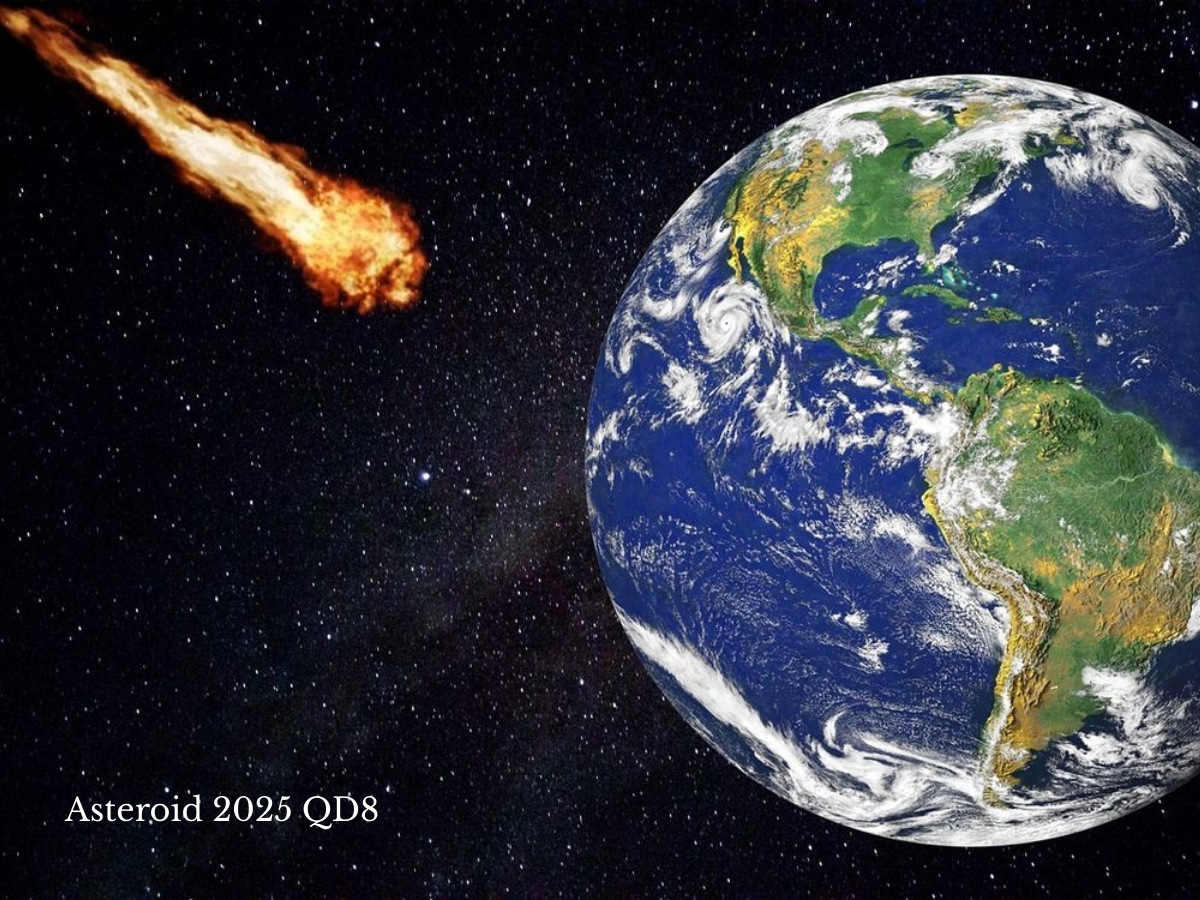
NASA has now confirmed that the asteroid 2025 QD8 will fly extremely close to our planet on September 3, 2025 at exactly 10:57 a.m. ET. Its actual size is 71 feet estimated, and it passes within a distance of 218,000 kilometers from our planet or almost 57 percent of what the distance is to the Moon.
At this point, the astrological view sounds disturbing, but scientists at NASA’s Jet Propulsion Laboratory (JPL) have been stressing that there is no danger from the asteroid for Earth. Instead of such a rare opportunity for an astral body can be used to understand close viewing of a part of the Earth’s sky.
Asteroid 2025 QD8: Capture the Flyby in Real Time
Asteroid 2025 QD8 at a pace of 45,000 kilometers per hour, the asteroid hurtles past, creating a spectacular flyby towards astronomers and the public. To ensure that it will reach a maximum audience, a live streaming of the encounter should be made through the Virtual Telescope Project 2.0, wherein remote-controlled telescopes will follow the asteroid in real-time.
ALSO READ: Primordial Black Hole: James Webb Telescope Unveils a 13 Billion Year Old Mystery
In advance of the flyby, astronomer Gianluca Masi was able to get a picture of QD8 using the Elena telescope in Italy. His 120 second exposure showed the asteroid as a faint needle like mark against a dark field of bright stars; to remind us how small and elusive these cosmic visitors can seem despite their scale.
Asteroid 2025 QD8: Future Visits with Continuous Monitoring
Asteroid 2025 QD8 will not visit September alone-it is expected that according to the European Space Agency’s Near Earth Objects Coordination Center, the asteroid will make several more trips in this century. Wednesday’s approach will be the closest ever recorded of the mentioned asteroid, but it will reappear in 2038 and 2121 at exactly the same passing distance.
With more than 40,000 near Earth asteroids tracked since 1980 and QD8 is just one in many that astronomers are continuously monitoring for the purposes of safeguarding the world against potential threats.
ALSO READ: Blood Moon vs Corn Moon: What Makes September’s Lunar Show Special
Preparing for a Future of Planetary Defense
This asteroid is safe from posing any danger at the moment. But NASA and the rest of the international space agencies would it takes a chance when it comes to planetary safety. Missions like those of the Double Asteroid Redirection Test (DART) which successfully altered the original trajectory of the small asteroid moonlet Dimorphos in 2022 are showing how much humanity’s capacity to protect the Earth from such cosmic threats is increasing.
The importance of this test is that impact deflection works; surprising outcomes were revealed, such as a huge debris release and changes to Dimorphos’s shape. Events like QD8’s flyby provide reminder purposes on why there was a need for these defensive technologies and albeit at very little risk.
Asteroid 2025 QD8: Observation
It will pass, but observation and preparedness should remain the basis. Today, humanity is safe; certainly, scientists are conducting research to learn more about asteroids their nature, paths and how they might someday be redirected if necessary. For space enthusiasts, this close flyby in September should create excitement rather than alarm, offering a front-row seat to one of the numerous cosmic happenings that remind us of our place in the solar system.
ALSO READ: Canada’s First Lunar Rover to Join NASA’s Artemis Moon Mission in 2029