
A Dazzling Discovery in Ethiopia’s Afar Desert
In the arid badlands of northern Ethiopia, scientists have made a uncommon find from deep within the history of mankind fossilized teeth that indicate a previously unknown creature in the human evolutionary tree.
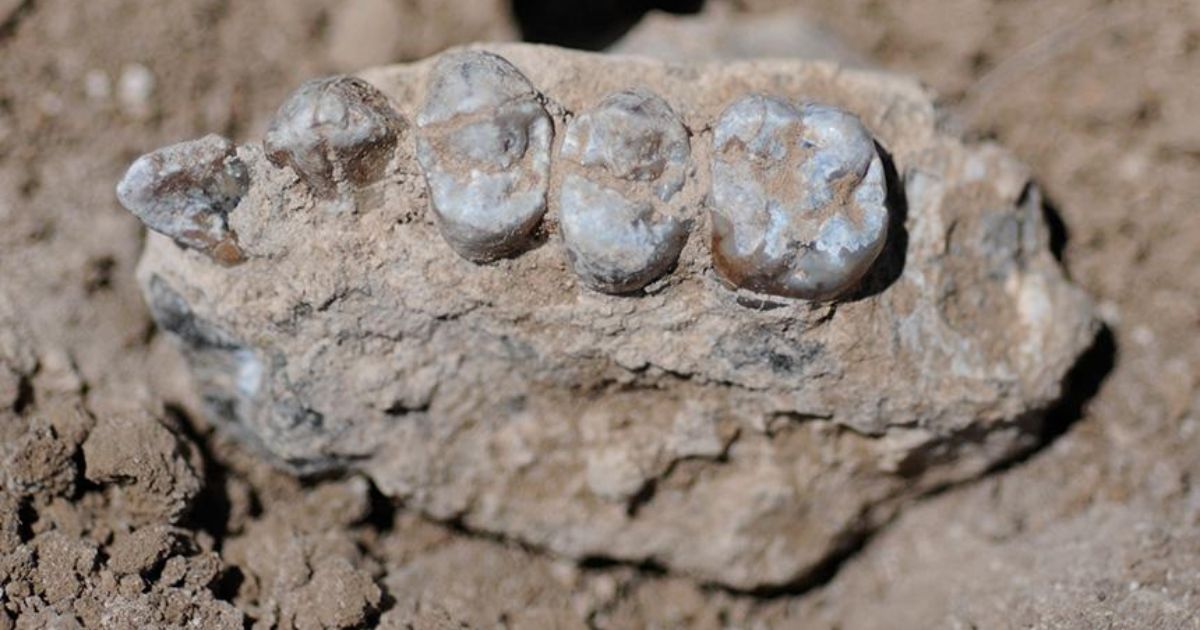
The 10 teeth, estimated to be around 2.65 million years old, were unearthed in the Afar Region’s Ledi-Geraru research zone. The two teeth were from individuals of a previously unknown species of Australopithecus, a group of early human relatives characterized by their combination of ape and human-like characteristics. Scientists have known six Australopithecus species based on fossils from around Africa up until today. The new discovery brings a seventh species to the tally.
The fossil collection consists of six molars, two incisors, a premolar, and a canine. Although fragmentary, the teeth show special characteristics that differentiate them from the previously known species, including Australopithecus afarensis the species to which the renowned fossil “Lucy” belonged.
Coexisting Cousins in Early Human History
What is most interesting about the find, however, is the company it kept. In addition to these Australopithecus teeth, researchers also discovered three other teeth from 2.59 million years ago that belonged to the earliest known species of Homo our genus. The remains of the Homo species had previously been hinted at by a nearby jawbone discovered in 2013.
The fact that the fossils are so precisely dated indicates that two distinct human ancestors one on the Australopithecus lineage and one on the Homo lineage inhabited the same general area simultaneously. That would make it possible that they fought over food.
“We’re currently analyzing the teeth to see if they ate similar foods,” said paleoecologist Kaye Reed of Arizona State University, co-director of the project. “If they did, competition may have been part of the story.”
When the Afar Region was at its height, the landscape was much different from today’s harsh desert. Rivers flowed through dense foliage, nourishing shallow lakes. The landscape was full of life giraffes, elephants, hippos, antelopes, and top predators such as saber-toothed cats and hyenas. It was, in short, a difficult but resource-dense environment for early human forebears.
A Crowded Evolutionary Stage
The discovery adds a new dimension to an already intricate time in human evolution. The evidence indicates that East Africa, 2.5 to 2.6 million years ago, had at least four hominin species on its grounds the newly found Australopithecus, the initial Homo species, another Australopithecus species known, and Paranthropus, a powerful hominin for heavy mastication. Southern Africa, on the other hand, had yet another Australopithecus species, making the continental total five.
That supports the notion that human evolution was never a gradual, one-way progression,” added Brian Villmoare, lead author of the study and a paleoanthropologist at the University of Nevada, Las Vegas. “Rather, several species existed simultaneously, splitting and going extinct, as with other types of life in the fossil record.
The research, found in Nature, highlights that our human family tree is more like a bush with many tangled branches than a straightforward, linear road. Most of these never directly ended up at us but still contributed to the environments and challenges our forebears encountered.
Not a Missing Link, but a Missing Chapter
Although the find would lead some to classify it as a “missing link,” the scientists are cautious not to use the term. Villmoare stresses that there is no indication the new species of Australopithecus was directly related to Homo. Rather, it could be a side branch that had since died out.
“This new species is not necessarily ancestral to any known species,” said Villmoare. “Species evolved and many died out. Each discovery is another twig on the bushy tree of human evolution.”
The fossils were dated through argon-based radiometric dating of volcanic ash with feldspar crystals from the excavation site. The process provided this highly accurate dating, verifying both their great age and their time overlap.
Stone implements discovered nearby, dating to the same period, were probably crafted by the Homo species and not by the recently discovered Australopithecus. This technological distinction may have provided an advantage for early Homo in survival and perhaps played a part in the death of their Australopithecus neighbors.
In the end, this discovery doesn’t just add a new name to the list of human ancestors. It paints a richer, more competitive, and more crowded picture of our origins a time when multiple species walked the same land, drank from the same rivers, and perhaps eyed the same resources in a fight for survival.
ALSO READ:
Ohio Couple Welcomes Baby from 30-Year-Old Frozen Embryo in IVF Breakthrough