
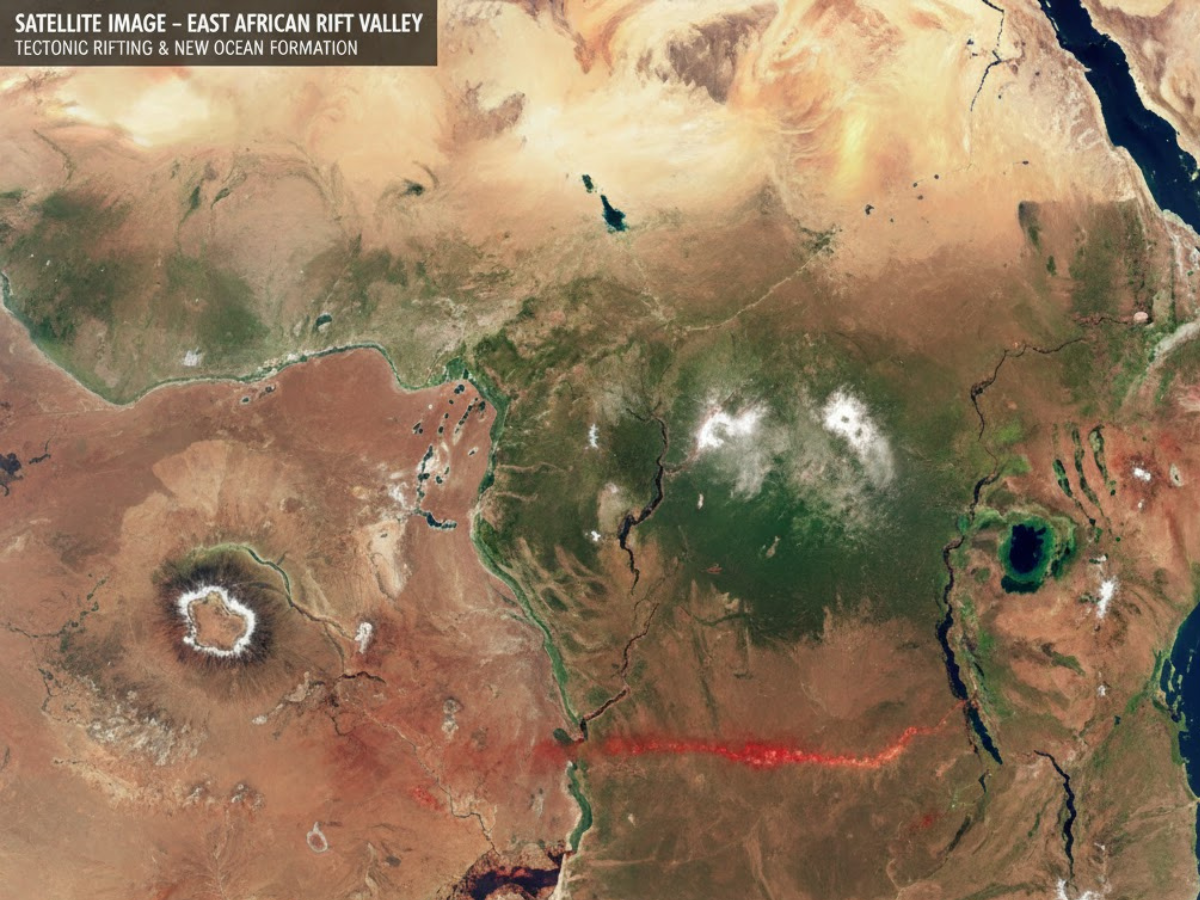
Underneath East Africa’s crust is an extraordinary development which is taking place overthrow global geography in the coming several million years. An ocean is slowly forming in the eastern section of the African continent. Although human time is almost imperceptible to this slow geologic movement and this slow process may one day cause an entirely different set of landscapes on Earth.
Cracks Beneath the Continent: Where It All Begins
The Geologic activity occurs in association with the East African Rift, a tectonic boundary where the African plate is being pulled apart. This massive rift system stretches from the Afar region in Ethiopia, down through Kenya, Tanzania and Mozambique delineating the separation between the Nubian Plate to the west and the Somali Plate to the east.
ALSO READ: What If 31/ATLAS Is an Alien Mothership? How Earth Could Respond
As the plates drift apart slowly over time great fissures begin to form within the Earth’s crust-message truly more befitting an ocean to fill.
Red Sea & Gulf of Aden Could Merge with the New Ocean
Geologists think the new ocean would connect with the Red Sea and the Gulf of Aden, forming a very rare three way intersection between seas. It is a situation that resembles the creation of the Atlantic Ocean whereby tectonic processes pushed South America away from Africa millions of years ago.
ALSO READ: Why the Moon is Rusting & Turning Red: Earth’s Role Explained by Science
What is the Science Behind Ocean Formation
The whole process begins far beneath the surface. Magma from the mantle of the Earth rises through faults in the crust initiated by seismic activity. Continuing in the Afar area, frequent earthquakes and volcanic eruptions cause the molten rock to intrude into existing formations, spreading them apart and generating long fissures as given time, these rifts develop deeper as thinning of the crust continues, seawater from nearby oceans would eventually get in and turn the land into a marine basin.
How Long Until the Ocean Fully Forms?
This tectonic move with quite dramatic in the scale of things is happening at geologically slow rates, a few millimeters a year. Scientists suggest that it could take between 5 and 10 million years for a complete split of the continent and the formation of a new ocean but now, the Earth is quietly reshaping itself under East Africa is one fracture at a time.
ALSO READ: Why Earth’s Days Are Getting Shorter: The Science Behind Time’s Speed-Up
Disclaimer: This article is for informational and educational use only. Geological timelines and processes are based on current scientific understanding and may evolve.