
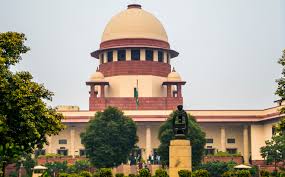
New Delhi: The Supreme Court on Friday granted interim bail to two accused in the 2020 Delhi riots larger conspiracy case, while referring to a larger bench the question of law whether prolonged incarceration and delay in trial can outweigh the statutory restrictions governing the grant of bail.
A division bench of Justices Aravind Kumar and PB Varale granted interim bail to Tasleem Ahmed and Khalid Saifi for a six-month period on various conditions.
Justice Kumar’s bench has referred to a larger bench the questions raised by a bench of Justices BV Nagarathna and Ujjal Bhuyan regarding the correctness of a judgment that denied bail to Umar Khalid and Sharjeel Imam in the Delhi riots case.
Justice Nagarathna has recently expressed reservations about the January ruling refusing bail to Khalid and Imam, observing that the principle of “bail is the rule and jail the exception” should continue to apply even in cases under the Unlawful Activities (Prevention) Act (UAPA).
The bench had also observed that the order denying bail to them appeared to run contrary to the principles laid down in the three-judge bench KA Najeeb judgment, where the court had held that prolonged delay in completion of trial could justify grant of bail in UAPA cases despite the stringent conditions prescribed under the law.
Ahmed and Saifi were earlier denied bail by the Delhi High Court. Thereafter, they approached the apex court, which granted them interim bail.
The top court, by its January verdict, granted bail to five other accused, while denying bail to Khalid and Imam on the ground that they stand on a separate footing when compared to other accused persons.
Today, Additional Solicitor General SV Raju, appearing for the Delhi police, sought reference of the issue to a larger bench, contending that the stringent bail conditions under the UAPA do not infringe the right to personal liberty guaranteed under Article 21 of the Constitution.
He argued that the principle of “bail, not jail” cannot be applied uniformly to all accused booked under the UAPA. ASG said bail petitions in UAPA cases should be decided on a case-by-case assessment, after accounting for the gravity of the offences alleged in each case.
The bench took note of Raju’s submission that it was not as if the January 2026 judgement denying bail to Khalid and Imam completely ignored the ruling in KA Najeeb.
It noted that Justice Nagarathna bench (in the case in which observations were made regarding Khalid and Imam) has, nevertheless, expressed doubts about the correctness of the January judgment. The apex court added that a bench cannot unsettle a law given by another bench of equal strength.
“Judgments of this court are not to be answered by counter-observations from another bench of equal strength… A coordinate bench cannot, by strong observations, effectively unsettle the ratio of another coordinate bench while continuing to sit on equal strength,” said a bench headed by Justice Kumar.
The bench then directed that the matter be placed before the Chief Justice of India for the constitution of an appropriate bench to examine the issues and render an authoritative ruling