Tamil Nadu’s political history has long been defined by powerful personalities and transformative movements. Since the decline of the Congress system in the 1960s, the state’s political landscape has largely been dominated by the Dravidian parties—the DMK and the AIADMK—whose ideological roots, organisational strength, and charismatic leadership shaped generations of political discourse. The emergence of any new political force in such an environment has traditionally been viewed as an uphill battle.
It is against this backdrop that the rise of K. Annamalai must be understood.
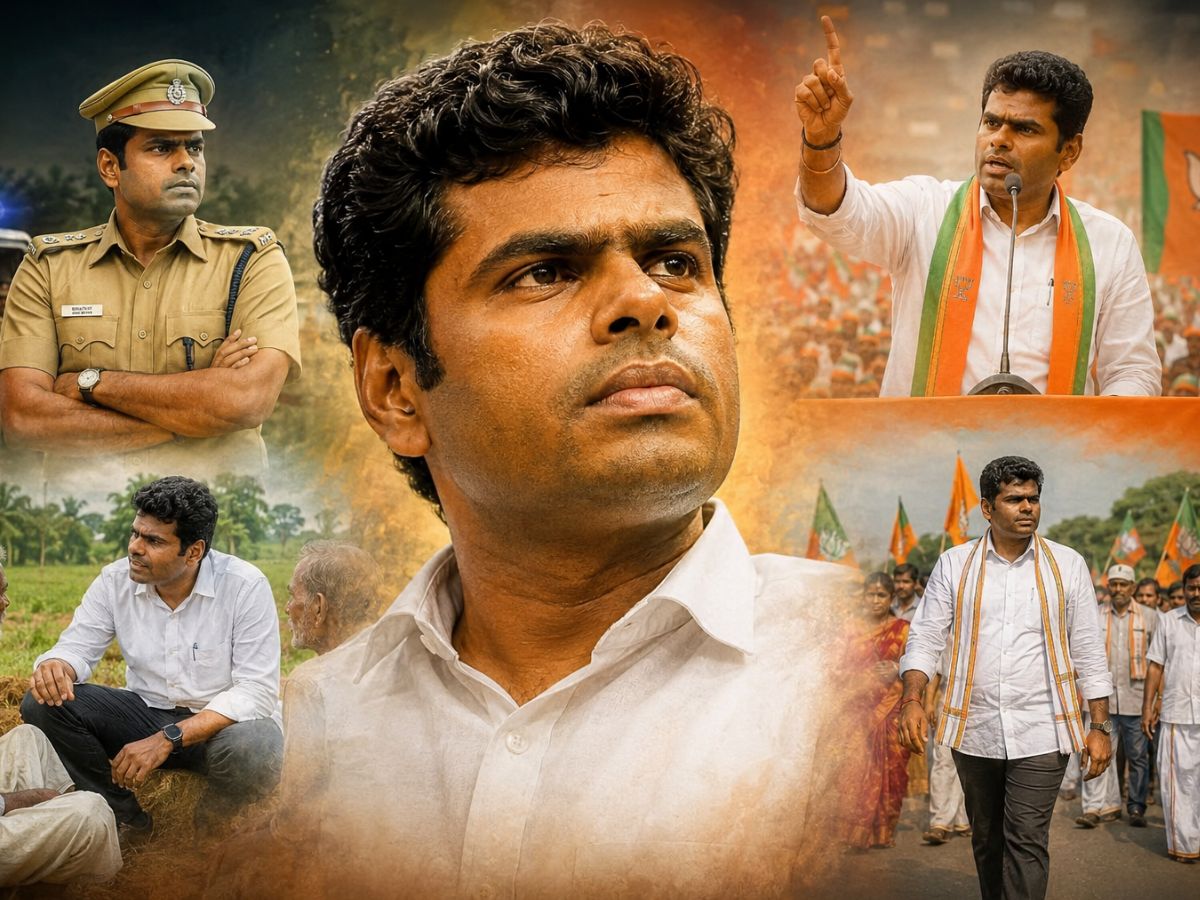
A former Indian Police Service officer, Annamalai’s political journey represents one of the most intriguing developments in contemporary Tamil Nadu politics. Within a few years of entering public life, he transformed himself from a respected police officer into one of the state’s most recognisable political faces. Now, amid reports that he may part ways with the Bharatiya Janata Party and launch a new political movement, his career appears to be entering a decisive new phase.
Whether this chapter ultimately leads to the creation of a new political party or a broader socio-political platform remains uncertain. What is clear, however, is that Annamalai has already carved out a unique place in Tamil Nadu’s evolving political history.
Tamil Nadu’s Distinct Political Tradition
Unlike many Indian states where national parties have retained significant influence, Tamil Nadu has remained largely resistant to national political currents for much of the post-Independence era.
The rise of the Dravidian movement in the mid-twentieth century fundamentally altered the state’s political trajectory. Leaders such as C.N. Annadurai, M. Karunanidhi and M.G. Ramachandran built mass movements rooted in Tamil identity, social justice, regional pride and welfare politics. Their success transformed electoral politics and relegated national parties to secondary roles.
The BJP, despite becoming India’s dominant national political force, struggled for decades to establish an independent presence in Tamil Nadu. Electoral gains often depended on alliances with regional parties, particularly the AIADMK.
For the BJP, therefore, finding a leader capable of expanding its appeal beyond traditional supporters became an organisational necessity.
That search eventually led to Annamalai.
From Karur to the Civil Services
Born on June 4, 1984, in Karur district, Annamalai grew up in a farming family. His rural upbringing would later become an important component of his political identity, helping him project himself as a leader connected to ordinary citizens rather than political elites.
After completing his schooling, he pursued Mechanical Engineering at PSG College of Technology in Coimbatore before earning an MBA from the Indian Institute of Management, Lucknow.
Like many talented graduates from elite institutions, he had opportunities in the corporate world. Instead, he chose public service and cleared the Civil Services Examination in 2011, joining the Indian Police Service.
His decision reflected a desire to work directly with people and engage with issues affecting society at the grassroots level.
The Making of ‘Singham’
Annamalai’s police career unfolded in Karnataka, where he served in several districts including Karkala, Udupi, Chikkamagaluru and Bengaluru.
Over time, he acquired a reputation for discipline, efficiency and accessibility. His campaigns against drug abuse, illegal liquor sales and organised criminal activities earned him considerable public goodwill.
He became known for conducting surprise inspections, interacting directly with citizens and taking a hands-on approach to administration.
His policing style eventually earned him the nickname “Singham”, inspired by the fearless fictional police officers popularised in Indian cinema.
The title stuck.
More importantly, it gave Annamalai a public image that would later prove politically valuable. In a political culture that often rewards strong personalities, his reputation as an uncompromising officer created a ready-made narrative of courage, honesty and decisiveness.
By the late 2010s, he had become one of the most recognisable IPS officers in the Karnataka cadre.
The Political Leap
In 2019, Annamalai resigned from the Indian Police Service, bringing an end to an eight-year career in law enforcement.
The decision surprised many observers. He was young, respected and appeared destined for a successful administrative career.
Yet the resignation reflected a broader desire to engage in public life beyond the constraints of bureaucracy.
After a brief period devoted to social initiatives and public engagement, Annamalai formally entered politics.
In 2020, former IPS officer K. Annamalai entered politics by joining the Bharatiya Janata Party, quickly emerging as the party’s most prominent face in Tamil Nadu. Elevated to state president within a year, Annamalai became known for his aggressive attacks on the ruling DMK, high-profile protests, and extensive grassroots outreach. His statewide yatra further boosted his visibility, transforming him into a major political figure. However, despite generating significant public attention, the BJP struggled to convert momentum into major electoral gains, eventually leading to a leadership change that saw Annamalai replaced as state chief.
This period marked the beginning of what many supporters described as the “Annamalai phenomenon.”
Reimagining the BJP in Tamil Nadu
Historically, the BJP’s challenge in Tamil Nadu has not merely been electoral; it has been cultural and political.
The party has often struggled to establish an identity distinct from its alliance partners. Annamalai sought to change that equation by building a more visible and assertive organisational presence.
His political style differed from many traditional Tamil Nadu leaders.
He embraced social media, held frequent press interactions and launched campaigns aimed at exposing alleged corruption within the ruling establishment. His speeches often focused on governance, accountability and transparency.
At the same time, he positioned himself as a champion of Prime Minister Narendra Modi’s development agenda.
Supporters viewed him as a fresh voice capable of breaking entrenched political patterns. Critics accused him of relying excessively on confrontation and publicity.
Regardless of perspective, he succeeded in drawing attention to a party that had long struggled to command the political spotlight.
Electoral Challenges
Despite growing visibility, electoral success remained elusive.
Annamalai contested the 2021 Assembly election from Aravakurichi but lost. In 2024, he contested the Lok Sabha election from Coimbatore, one of the BJP’s most closely watched constituencies in southern India.
Once again, victory proved unattainable.
These defeats highlighted the structural challenges facing the BJP in Tamil Nadu. Public visibility and media attention did not automatically translate into electoral support.
Yet many within the BJP argued that Annamalai’s contribution should be measured through organisational growth rather than immediate electoral outcomes.
Indeed, under his leadership, the party expanded its grassroots presence and significantly increased its visibility across the state.
The En Mann En Makkal Yatra
One of the defining episodes of Annamalai’s political career was the “En Mann En Makkal” yatra.
Covering all 234 Assembly constituencies, the journey represented a massive exercise in political mobilisation.
Historically, yatras have served as powerful tools in Indian politics. They allow leaders to connect directly with voters while creating a narrative of commitment and accessibility.
For Annamalai, the yatra accomplished several objectives.
It reinforced his image as a grassroots leader.
It expanded his statewide recognition.
And it allowed him to project himself not merely as a BJP functionary but as a political figure with broader ambitions.
The campaign attracted significant crowds and media coverage, further strengthening his personal brand.
The Alliance Question
As the BJP prepared for future elections, strategic disagreements reportedly emerged regarding the party’s direction in Tamil Nadu.
Annamalai was widely perceived as favouring a more independent political path for the BJP. He often spoke about expanding the party’s vote share and eventually transforming it into a major force capable of challenging the Dravidian parties directly.
The national leadership, however, remained mindful of electoral realities.
The revival of the BJP-AIADMK alliance reflected a pragmatic assessment that coalition politics remained necessary to challenge the ruling DMK.
This decision exposed a broader tension between long-term organisational expansion and short-term electoral strategy.
For many observers, it also marked a turning point in Annamalai’s relationship with the party leadership.
Leadership Change and New Speculation
The appointment of Nainar Nagendran as Tamil Nadu BJP president signalled the end of Annamalai’s tenure as state chief.
Although leadership transitions are routine in political organisations, the development immediately sparked speculation regarding his future.
Supporters expected him to receive a significant national assignment.
Instead, his role remained unclear.
As rumours intensified about dissatisfaction with the party’s strategic direction, reports began emerging that Annamalai was considering a new political initiative.
Recent indications suggest that he is preparing to launch a movement aimed at mobilising volunteers, professionals, youth and civic-minded citizens.
The proposed platform is expected to focus on public participation, governance reforms and grassroots engagement.
Whether it ultimately evolves into a political party remains to be seen.
A Familiar Pattern in Tamil Nadu Politics
Historically, Tamil Nadu has repeatedly witnessed the emergence of leaders who broke away from established political structures to create new movements.
The DMK itself emerged as a challenge to the political order of its time. The AIADMK was born from a dramatic split within the DMK. More recently, several leaders have attempted to build alternatives outside the traditional Dravidian framework.
Most have struggled.
A few have succeeded.
The challenge lies not merely in attracting attention but in building durable organisations capable of surviving electoral setbacks and sustaining public engagement.
Annamalai now appears poised to test whether his personal popularity can be converted into such an institution.
The Next Chapter
At forty-two, Annamalai remains one of the youngest prominent political figures in Tamil Nadu.
His journey from farmer’s son to IPS officer, from administrator to politician, and potentially from party leader to movement-builder reflects a broader trend in Indian politics, where leadership increasingly emerges from outside traditional political families.
Whether his next venture succeeds or fails will depend on factors far beyond personal charisma. Organisation, ideology, resources and sustained public support will all play decisive roles.
Yet few would dispute that Annamalai has already become an important figure in contemporary Tamil Nadu politics.
If his proposed movement gains momentum, it could reshape political calculations in a state long dominated by familiar players. If it falters, it will join the long list of ambitious experiments that failed to challenge the established order.
Either way, the story of K. Annamalai is no longer merely the story of a former IPS officer or a former BJP state president. It has become part of a larger debate about political change, leadership and the future direction of Tamil Nadu politics.