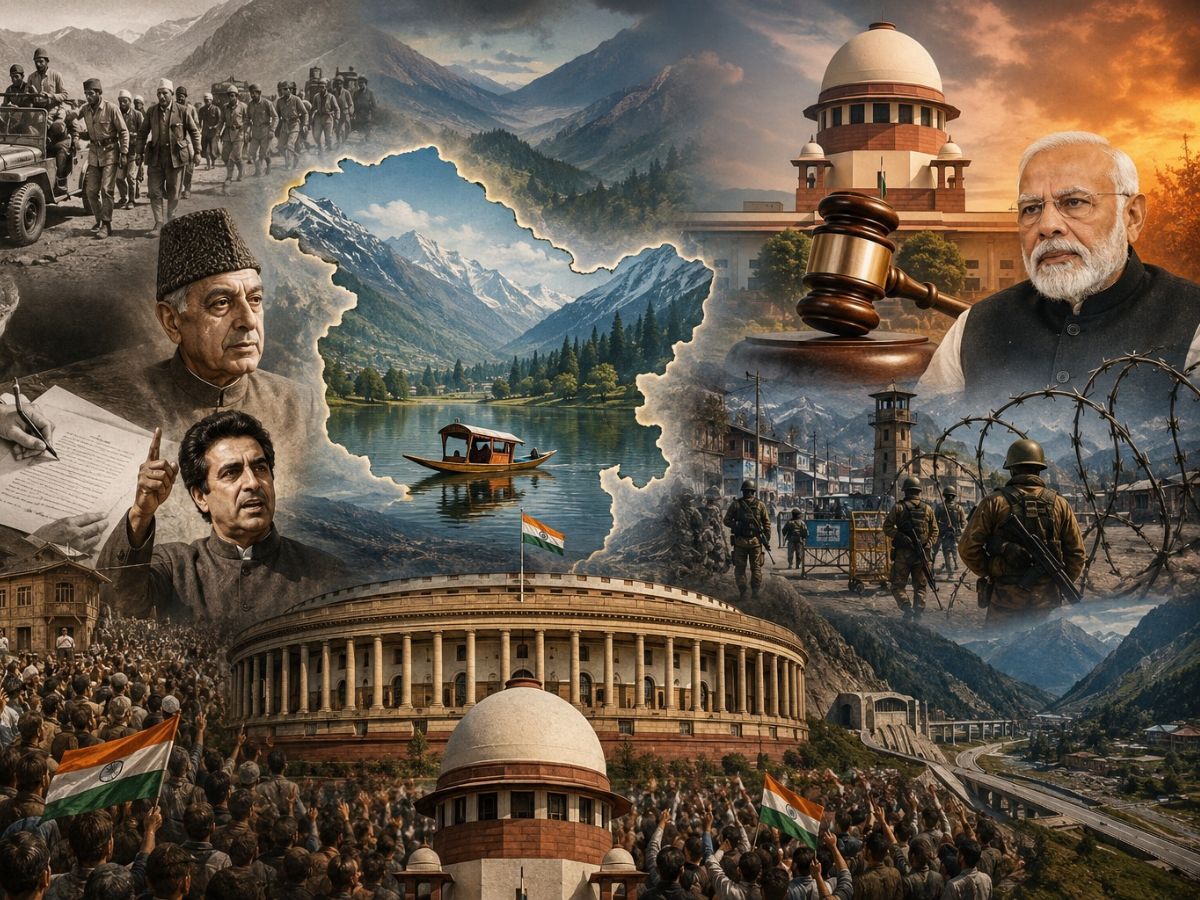
The Long Journey of Kashmir’s Special Status
On August 5, 2019, the Government of India revoked Article 370 of the Constitution, ending Jammu and Kashmir’s special constitutional status that had existed for nearly seven decades. The move was hailed by supporters as the completion of India’s national integration and criticised by opponents as a departure from constitutional and political commitments made at the time of accession.
The story of Article 370, however, did not begin in 2019. Its roots lie in the tumultuous events surrounding Partition, the first India-Pakistan war, and the complex political negotiations that shaped the relationship between Jammu and Kashmir and the Indian Union. Understanding Article 370 requires revisiting the historical circumstances that led to its creation and tracing its evolution through the decades.
A Princely State at the Time of Partition
When British rule ended in August 1947, the Indian subcontinent was divided into India and Pakistan. Alongside the two new dominions existed more than 560 princely states whose rulers were given the choice of joining either nation.
Among them was Jammu and Kashmir, a vast princely state ruled by Maharaja Hari Singh. Geographically strategic and culturally diverse, the state included the Kashmir Valley, Jammu, Ladakh, Gilgit and Baltistan. Its population was majority Muslim, while its ruler was Hindu.
Unlike many other princely rulers, Hari Singh initially sought independence. He signed a Standstill Agreement with Pakistan to maintain existing arrangements but delayed a decision on accession to either country.
The Tribal Invasion and Accession to India
The situation changed dramatically in October 1947 when tribal militias from Pakistan’s North-West Frontier region entered Kashmir. The invasion threatened Srinagar and placed the Maharaja’s administration under severe pressure.
Facing military collapse, Hari Singh requested assistance from India. New Delhi agreed on the condition that Jammu and Kashmir accede to India. On October 26, 1947, the Maharaja signed the Instrument of Accession, legally joining India.
The Instrument was similar to those signed by other princely states but carried unique political implications. India accepted accession in matters of defence, foreign affairs and communications while indicating that the wishes of the people would eventually be considered once normalcy returned.
Indian troops were airlifted to Srinagar, beginning the first India-Pakistan war over Kashmir.
Kashmir Goes to the United Nations
As fighting intensified, India approached the United Nations in January 1948, accusing Pakistan of aiding the invasion. The issue soon became internationalised.
The UN Security Council called for a ceasefire and proposed a plebiscite to determine the future of the region after the withdrawal of forces and restoration of peace. While a ceasefire came into effect on January 1, 1949, disagreements over demilitarisation prevented the proposed plebiscite from taking place.
The conflict left Kashmir divided between territories administered by India and Pakistan, creating a dispute that continues to shape South Asian geopolitics.
The Birth of Article 370
The unsettled conditions in Kashmir posed a constitutional challenge for India. Unlike other princely states, Jammu and Kashmir had joined India under extraordinary circumstances amid war and international scrutiny.
To accommodate these realities, the framers of the Constitution devised a special provision. Drafted primarily by Gopalaswami Ayyangar, Article 370 was incorporated into the Constitution under Part XXI, dealing with “Temporary, Transitional and Special Provisions.”
When India’s Constitution came into force on January 26, 1950, Article 370 granted Jammu and Kashmir a distinctive constitutional position.
Under the arrangement:
● Jammu and Kashmir would have its own Constitution.
● The Indian Parliament could legislate only on matters specified in the Instrument of Accession unless the state government consented.
● The state would have its own flag.
● Constitutional provisions applicable elsewhere in India would require presidential orders and state concurrence to extend to Jammu and Kashmir.
The article was explicitly described as temporary, reflecting the expectation that the state’s constitutional relationship with India would evolve over time.
Sheikh Abdullah and the Delhi Agreement
During the early years after accession, Sheikh Mohammad Abdullah emerged as the dominant political figure in Kashmir. A close associate of Jawaharlal Nehru, Abdullah headed the National Conference and enjoyed significant popularity in the Valley.
In 1952, negotiations between New Delhi and Sheikh Abdullah’s government produced the Delhi Agreement. The accord sought to clarify constitutional relations between India and Jammu and Kashmir.
It confirmed Indian citizenship for Kashmiris while preserving the state’s autonomy in certain areas. It also recognised the state’s right to define permanent residents and grant them special privileges.
The agreement became a foundation for subsequent constitutional arrangements.
The Constitution of Jammu and Kashmir
A Constituent Assembly for Jammu and Kashmir was elected in 1951 to frame the state’s own constitution.
After several years of deliberation, the Constitution of Jammu and Kashmir was adopted in 1956 and came into force in 1957.
The Constitution declared Jammu and Kashmir an integral part of India while preserving substantial autonomy. The state retained authority over many internal matters, distinguishing it from other Indian states.
At the same time, constitutional links with India continued to deepen through presidential orders issued under Article 370.
Article 35A and Special Rights
One of the most significant developments came in 1954 when a Presidential Order introduced Article 35A into the Indian constitutional framework.
Article 35A empowered the Jammu and Kashmir legislature to define “permanent residents” and grant them special rights. These included:
● Ownership of land and immovable property.
● Government employment.
● Educational scholarships.
● Other welfare benefits.
Supporters argued that these protections preserved the region’s demographic and cultural character. Critics maintained that they created unequal citizenship rights within India.
The provision remained one of the most debated aspects of Kashmir’s special status for decades.
Erosion of Autonomy
Although Article 370 remained formally intact, successive governments gradually extended numerous provisions of the Indian Constitution to Jammu and Kashmir.
Through a series of presidential orders, central laws covering elections, taxation, judiciary, emergency powers and administrative structures were applied to the state.
Many scholars described this process as the gradual erosion of autonomy. By the late twentieth century, far more provisions of the Indian Constitution applied to Jammu and Kashmir than originally envisaged.
Despite this integration, symbolic elements of special status continued to exist.
Political Upheavals and Insurgency
The dismissal and arrest of Sheikh Abdullah in 1953 marked a turning point in Kashmir’s politics. His removal generated resentment among sections of the population and contributed to long-term political instability.
Though Abdullah returned to power following the 1975 Indira-Sheikh Accord, tensions persisted.
The late 1980s witnessed another major transformation. Allegations of electoral manipulation, rising political discontent and external influences fuelled an armed insurgency in the Valley.
Militancy, counterinsurgency operations and cross-border terrorism transformed Kashmir into one of the world’s most heavily militarised regions.
Thousands of civilians, militants and security personnel lost their lives over the following decades.
The conflict also triggered the exodus of large numbers of Kashmiri Pandits from the Valley, creating one of modern India’s most painful episodes of internal displacement.
The Rise of the BJP’s Opposition to Article 370
Opposition to Article 370 had existed since the early years of independent India.
Dr. Syama Prasad Mookerjee, founder of the Bharatiya Jana Sangh—the ideological predecessor of the Bharatiya Janata Party (BJP)—famously argued against special arrangements for Jammu and Kashmir.
His slogan, “Ek desh mein do vidhan, do pradhan aur do nishan nahi chalenge” (One nation cannot have two constitutions, two heads and two flags), became central to the nationalist critique of Article 370.
For decades, the BJP maintained that the provision hindered full integration of Jammu and Kashmir with India.
The abrogation of Article 370 remained a core political objective in successive BJP manifestos.
The Road to August 2019
The BJP’s victory in the 2014 and 2019 general elections significantly altered the political landscape.
In Jammu and Kashmir, the BJP initially participated in a coalition government with the People’s Democratic Party (PDP). However, the alliance collapsed in 2018.
Governor’s Rule and subsequently President’s Rule were imposed in the state. The elected Legislative Assembly ceased to function.
In the months leading up to August 2019, unusual developments raised speculation. Additional security forces were deployed, educational institutions were closed, political leaders were placed under restrictions, and communication networks were curtailed.
Few anticipated the scale of the announcement that followed.
The Abrogation of Article 370
On August 5, 2019, Home Minister Amit Shah informed Parliament that the government had decided to revoke the operative provisions of Article 370.
Using a Presidential Order and parliamentary resolutions, the government effectively ended Jammu and Kashmir’s special status.
Article 35A was simultaneously nullified.
Parliament also passed the Jammu and Kashmir Reorganisation Act, 2019, dividing the state into two Union Territories:
● Jammu and Kashmir.
● Ladakh.
For the first time since accession, the region ceased to exist as a full-fledged state within the Indian Union.
Arguments in Favour
Supporters described the move as a historic correction.
They argued that:
● Article 370 had fostered separatism.
● It impeded economic development.
● It discouraged investment.
● It created constitutional barriers between Kashmir and the rest of India.
The government maintained that full integration would bring better governance, expanded opportunities and stronger national unity.
Many nationalist organisations celebrated the decision as the fulfilment of a long-standing political commitment.
Arguments Against
Critics viewed the move differently.
They argued that the special status formed part of the constitutional understanding underpinning accession.
Questions were raised about whether the required consent mechanisms had been properly followed, especially since the state’s elected institutions were suspended at the time.
Human rights groups also criticised the extensive security restrictions, communication shutdowns and detention of political leaders that accompanied the decision.
Several petitions challenging the abrogation were subsequently filed before the Supreme Court.
The Supreme Court Verdict
In December 2023, the Supreme Court upheld the government’s decision to revoke Article 370.
The Court ruled that Jammu and Kashmir did not retain internal sovereignty after accession and affirmed Parliament’s authority in the circumstances under which the changes were made.
The verdict closed one of the most significant constitutional disputes in modern Indian history, although political debates continue.
Legacy of Article 370
Article 370 was never merely a constitutional clause. It represented competing visions of federalism, autonomy, identity and nationhood.
For some, it symbolised India’s commitment to accommodating diversity within a federal framework.
For others, it embodied an incomplete integration that required correction.
Its journey—from the uncertain days of Partition, through decades of conflict and negotiation, to its dramatic abrogation in 2019—mirrors the broader story of Kashmir itself.
More than seven decades after accession, Kashmir remains central to debates about democracy, nationalism, constitutionalism and regional identity in South Asia. While Article 370 has passed into history, the questions it raised about autonomy, representation and belonging continue to shape discussions about the future of Jammu and Kashmir.
The story of Article 370 is therefore not only the history of a constitutional provision but also the history of one of the most contested and consequential political relationships in independent India.