
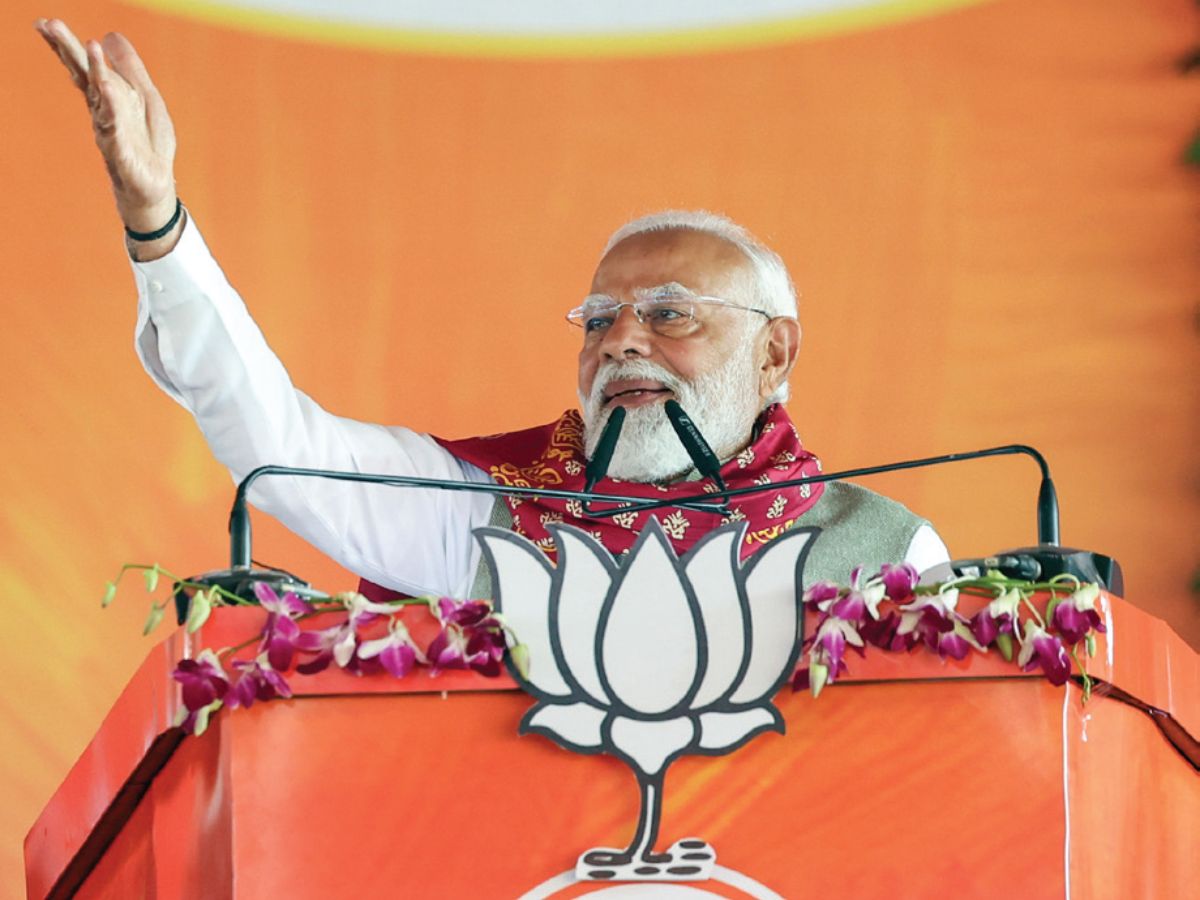
Prime Minister Narendra Modi on Sunday launched a sharp attack on West Bengal Chief Minister Mamata Banerjee and the Trinamool Congress (TMC), asserting that the state was ready for “paltano dorkar” (needed change) and to bid farewell to what he described as the TMC’s “mega jungle raj”, while inaugurating development projects worth over Rs 830 crore at Singur in Hooghly district ahead of the upcoming West Bengal Assembly elections.
Addressing a massive rally in the politically significant town of Singur, Modi urged voters to support the Bharatiya Janata Party (BJP) in the forthcoming polls, claiming the state had witnessed 15 years of lawlessness under the Mamata Banerjee-led TMC government. “It is very necessary for TMC’s reign of jungle raj to end in Bengal and for BJP’s good governance to come,” Modi told the gathering, invoking 19th-century social reformer Ishwar Chandra Vidyasagar. He called upon the women and youth of Bengal to raise their voices for change, saying these groups would once again act as catalysts for transformation, as they had during Vidyasagar’s time.
The Prime Minister’s attack on the TMC centred on allegations of deteriorating law and order, particularly with regard to women’s safety. He claimed that under the current administration, daughters were not safe and that the education system had fallen into the grip of mafias and corrupt elements. Referring to the Sandeshkhali controversy, where villagers accused TMC functionaries of land grabbing and sexual assault, Modi said a BJP government would ensure such incidents were not repeated.
“Your one vote for BJP will ensure that incidents of rape and violence in colleges here are curbed, that incidents like Sandeshkhali do not happen again in Bengal, and that thousands of teachers in Bengal do not lose their jobs again,” Modi said, also alluding to the state’s teacher recruitment controversy.
Drawing parallels with Bihar, where the BJP-led National Democratic Alliance recently secured a victory, Modi expressed confidence that West Bengal voters were ready for similar change. The enthusiasm of the crowd in Singur reflected a widespread desire for transformation after what he described as 15 years of misgovernance, he said.
The Prime Minister accused the TMC government of obstructing the implementation of central welfare schemes in the state. He cited Ayushman Bharat for healthcare, the Har Ghar Jal scheme for piped water supply, and the Pradhan Mantri Matsya Sampada Yojana for fishermen, alleging that the state government had prevented these initiatives from reaching beneficiaries.
On infiltration, a key plank of the BJP’s campaign in border districts, Modi alleged that the TMC had compromised national security by supporting illegal immigration and failing to cooperate with the Centre on requests for land to fence the international border. He claimed the party facilitated the creation of documents for infiltrators and promised strict action if the BJP formed the government.
Modi also highlighted cultural milestones under the BJP-led central government, noting that Bengali was accorded Classical Language status and Durga Puja received UNESCO recognition as an Intangible Cultural Heritage during his tenure.
Before the political rally, the Prime Minister inaugurated and laid the foundation stones for infrastructure projects collectively valued at more than Rs 830 crore. The key project was the Extended Port Gate System at Balagarh, which includes an Inland Water Transport terminal and a Road Over Bridge. Spread across around 900 acres, the Balagarh facility is designed to handle 2.7 million tonnes of cargo annually and is aimed at easing congestion in Kolkata’s urban corridors. He also flagged off a new rail line connecting Jayrambati, Barogopinathpur and Mayapur, addressing a long-standing demand for improved connectivity. The service is expected to benefit daily commuters, students and pilgrims. In addition, Modi inaugurated a state-of-the-art electric catamaran in Kolkata, one of six vessels built by Cochin Shipyard and equipped with lithiumtitanate battery technology for zero-emission inland water transport.
Three new Amrit Bharat Express trains were also flagged off from Singur, linking Kolkata with Anand Vihar Terminal in Delhi, Banaras and Tambaram near Chennai, further strengthening West Bengal’s rail connectivity with other parts of the country.
Referring to the infrastructure push, Modi said the past 24 hours had been unprecedented for rail connectivity in West Bengal. He cited the previous day’s programme in Malda, where he flagged off India’s first Vande Bharat Sleeper Train between Howrah and Guwahati and inaugurated projects worth over Rs 3,250 crore.
“Perhaps in the last 100 years, so much work has not been done in 24 hours for rail connectivity in West Bengal,” the Prime Minister said, underlining his government’s focus on developing eastern India as a growth engine for the country.
The choice of Singur for the event carried symbolic significance. Nearly two decades ago, the area was the epicentre of a violent anti-land acquisition movement led by Mamata Banerjee against the Left Front government’s plan to set up the Tata Nano car plant. The agitation, which eventually forced Tata Motors to relocate the project, proved a turning point in Bengal politics and paved the way for Banerjee’s rise to power in 2011. By returning to Singur with promises of industrialisation and development under a “double-engine” BJP government, Modi sought to challenge the TMC on its own political turf ahead of the Assembly elections expected in the coming months.