
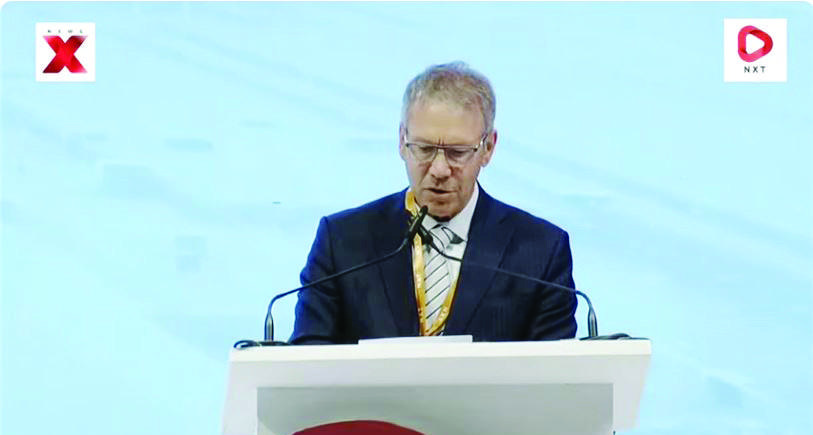
NEW DELHI: New Zealand Member of Parliament Stuart Smith on Thursday emphasised the growing strategic importance of India in shaping the future of the Indo-Pacific, describing the bilateral relationship as a “strategic necessity” for New Zealand’s economy, security and global engagement.
Delivering a special address on the future of Indo-Pacific trade at the NXT Summit 2026 on Day 1 at Bharat Mandapam in New Delhi, Smith said India’s rising global influence and economic momentum make it an indispensable partner for New Zealand in an increasingly complex and interconnected world.
Highlighting shifting global supply chains and evolving strategic alignments, Smith said trusted partnerships and economic resilience are becoming more crucial than ever. “India is not simply an emerging power anymore. Its global influence is established and growing,” he noted.
He pointed to India’s rapid economic expansion, describing the country as the world’s fifth-largest economy with projections to become the third-largest by 2030. Smith also highlighted India’s strategic role in the Indo-Pacific, its democratic governance, technological innovation, and leadership across international platforms including the G20 and the Quad.
Citing India’s expanding infrastructure and a rapidly growing middle class of over 445 million people, Smith said the country represents one of the largest and fastest-growing consumer markets globally.
Underscoring the strengthening bilateral engagement, Smith noted that New Zealand Prime Minister Christopher Luxon led one of the country’s largest trade missions to India in March last year, signalling Wellington’s long-term commitment to deepening ties with New Delhi.
He also highlighted the strong people-to-people connections between the two nations, noting that nearly 300,000 New Zealanders of Indian origin now live in the country, accounting for about six per cent of its population.
On the economic front, Smith said India is currently New Zealand’s 12th largest trading partner, with total bilateral trade reaching NZ$3.8 billion in the year ending September 2025, marking a 25 per cent increase from the previous year.
Negotiations for a comprehensive India-New Zealand Free Trade Agreement (FTA) began in March 2025 and concluded later that year, which Smith described as a significant step towards strengthening long-term economic cooperation.
He acknowledged that while opportunities are substantial, building market presence requires patience and sustained engagement. Using New Zealand’s wine exports to India as an example, Smith noted that despite strong consumer interest, exports remain modest due to high tariffs and the need for long-term market development.
Smith also highlighted opportunities for collaboration in emerging sectors such as space technology, noting that New Zealand has become one of the world’s top three countries for space launches in recent years through its commercially driven space sector.
Beyond trade, he pointed to growing security cooperation in the Indo-Pacific, referencing the defence cooperation arrangement signed between the two countries in March 2025 and subsequent exchanges aimed at strengthening regional stability.
Concluding his address, Smith reaffirmed New Zealand’s commitment to building a deeper partnership with India across trade, innovation, security, culture and people-to-people ties.